
A Match Made in Heaven: Choosing Your Perfect 3 Stone Pear Diamond Ring
The Ring That Tells Your Love Story: Why 3 Stone Pear Diamond Rings Captivate
What is a 3 stone pear diamond ring? Here's a quick overview:
- Shape: Features a teardrop-shaped (pear-cut) center diamond flanked by two matching side stones
- Symbolism: Each stone represents a chapter — past, present, and future
- Setting styles: Common side stones include marquise, tapered baguette, or round brilliant cuts
- Metal options: Available in platinum, white gold, yellow gold, and rose gold
- Price range: Settings typically start around $1,700 and rise well above $5,000 depending on metal and diamond quality
- Diamond types: Both natural and lab-grown diamonds are widely available in this style
A 3 stone pear diamond ring is one of the most emotionally resonant choices in fine jewelry. The pear cut — sometimes called a teardrop — brings together the brilliance of a round diamond and the pointed elegance of a marquise. Placed at the center of a trilogy setting, it becomes something genuinely special.
The three-stone design has deep meaning. Each diamond represents a stage of a relationship: where you've been, where you are, and where you're going. That's a lot of feeling packed into one ring.
And the pear cut adds another layer. It's often associated with tears of joy — an emotion that feels right at an engagement, a milestone anniversary, or any moment worth marking forever.
Right now, the style is having a real moment. Buyers are drawn to its combination of vintage romance and modern elegance, and the variety of ways it can be customized makes it feel personal rather than off-the-shelf.
Whether you're just beginning to explore this style or you're ready to design your own, this guide will walk you through everything — from diamond quality and metal choices to what separates a good ring from a truly unforgettable one.
What is a 3 Stone Pear Diamond Ring?
At its heart, a 3 stone pear diamond ring is a trilogy ring that features a pear-cut diamond as its central focus. The "trilogy" or "three-stone" setting is a classic layout in the jewelry world, but introducing a pear-shaped diamond elevates the design from traditional to uniquely artistic.
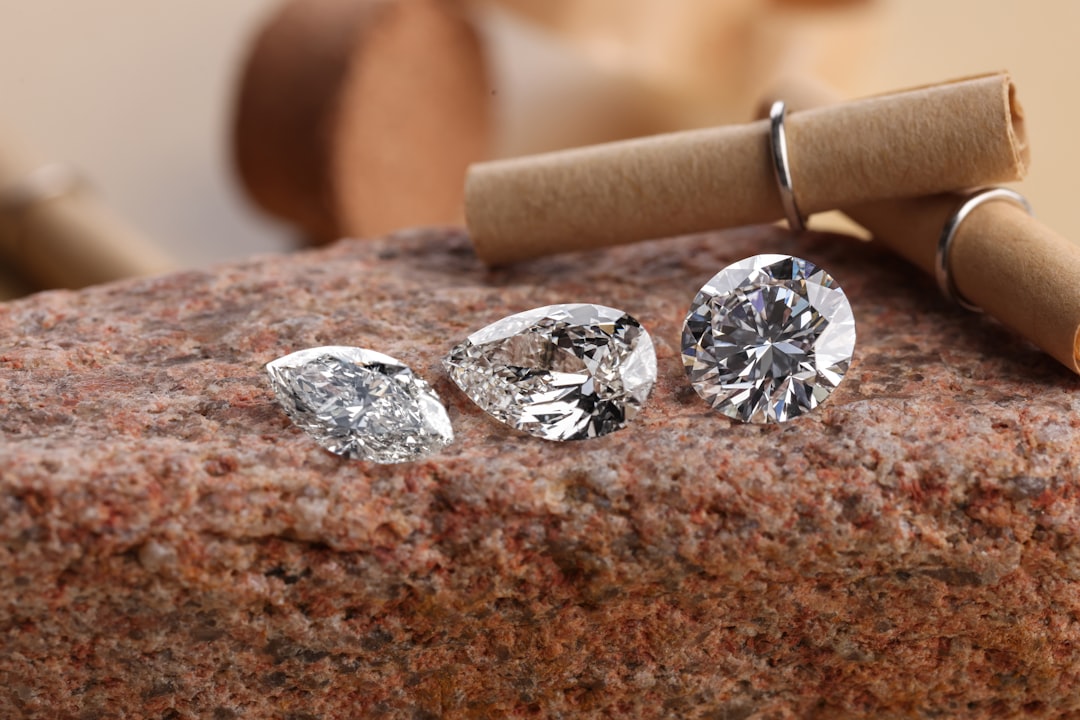
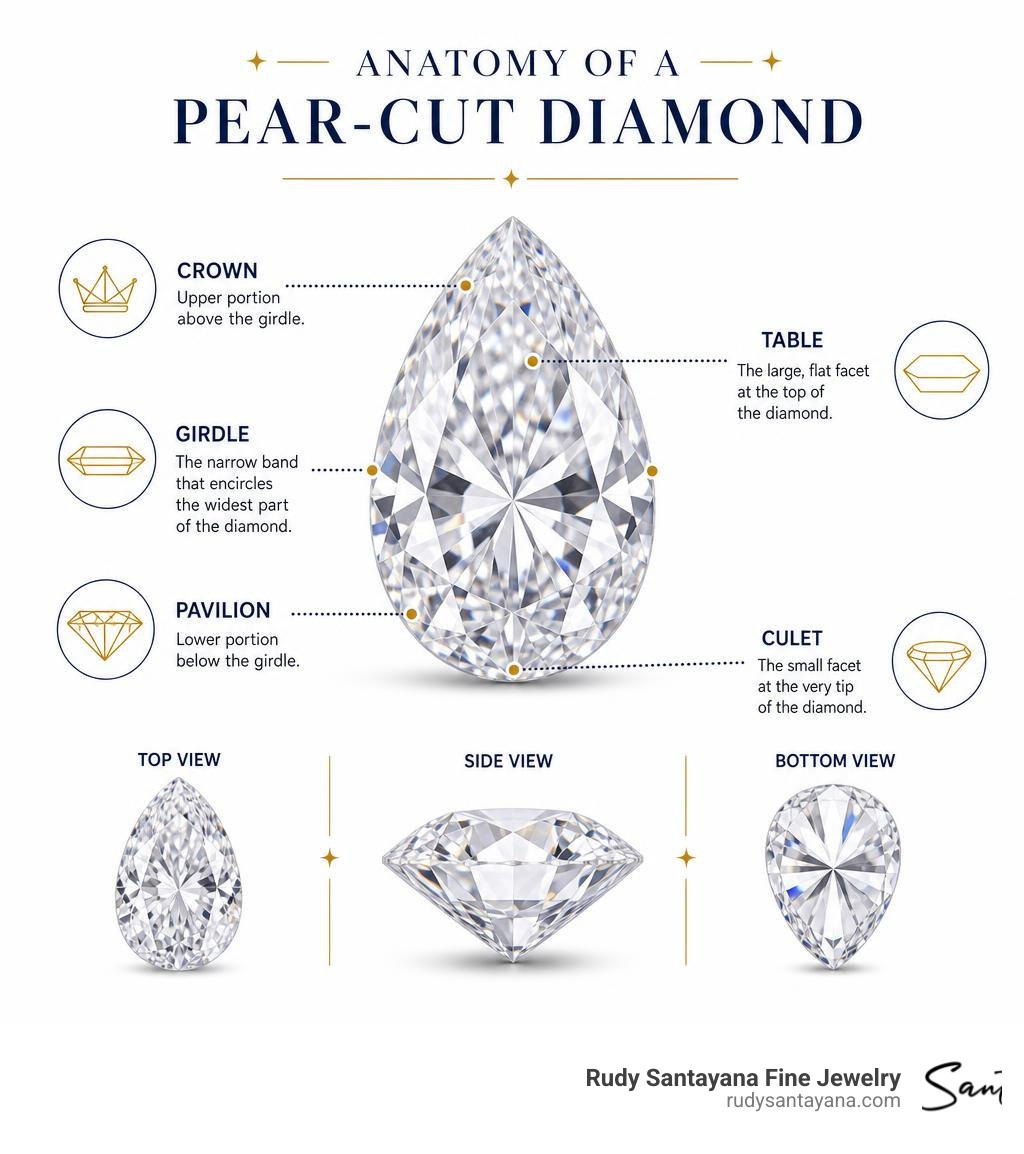
The pear cut itself dates back to the 15th century when Flemish polisher Lodewyk van Bercken introduced the scaif (a polishing wheel that revolutionized diamond cutting). This invention allowed for the placement of symmetrical facets on asymmetrical shapes, paving the way for the teardrop design we admire today. By combining the fiery brilliance of a round brilliant cut with the elongated, finger-flattering shape of a marquise, the pear diamond offers a striking silhouette.
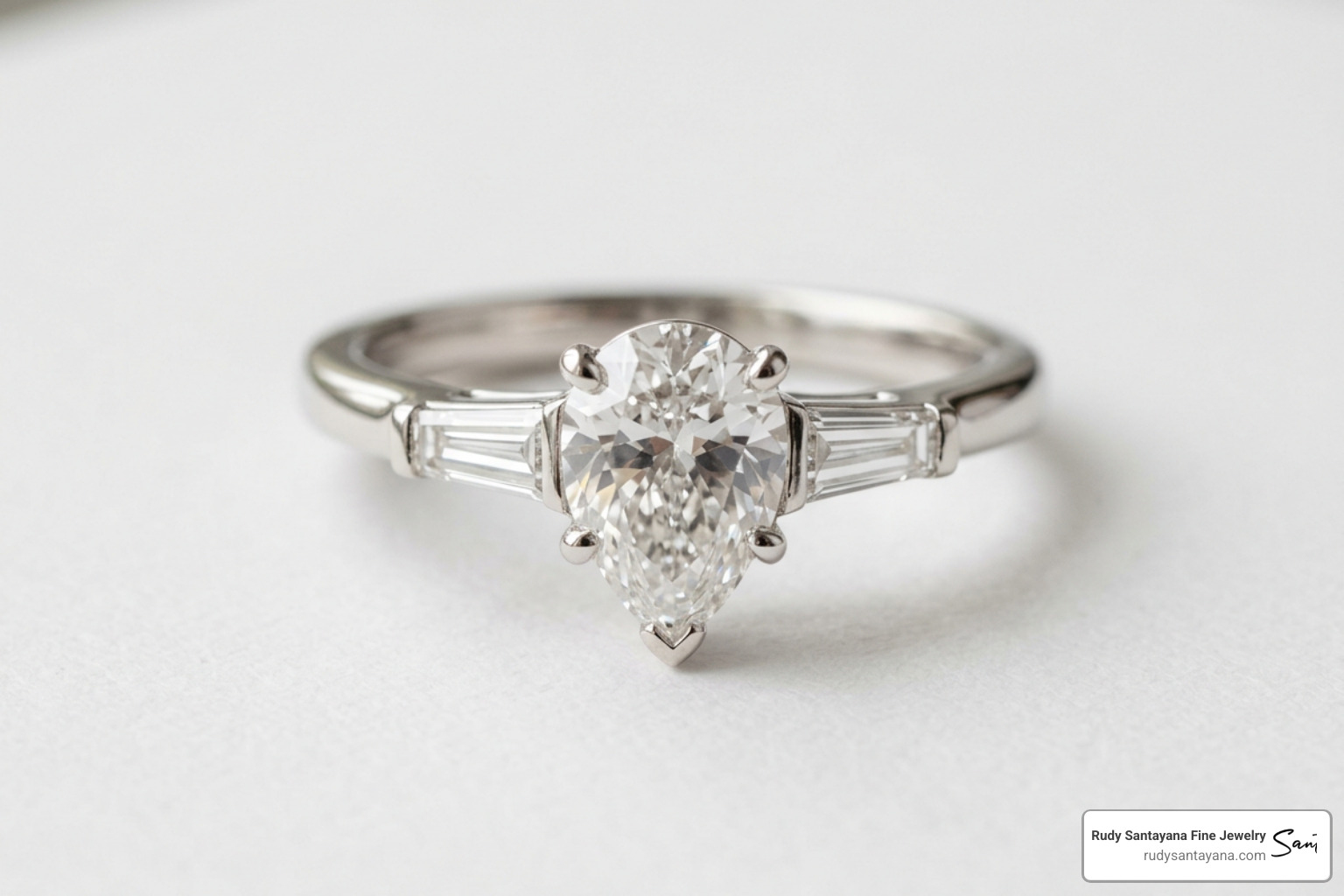
When we design these rings, we look at how the three stones interact. The side stones are not merely secondary pieces; they are visual anchors that frame the center diamond, drawing the eye inward and accentuating the teardrop's unique curves. Because the pear cut is asymmetrical—having one rounded end and one pointed end—the way the side stones are positioned is highly customizable.
Some designs place the pear center stone pointing "north" (toward the fingernail) to elongate the finger, while others experiment with "east-west" orientations for a modern, avant-garde twist. No matter the orientation, the three-stone layout brings an incredible depth of light and reflection to the hand.
For couples looking to celebrate their journey, exploring three-stone engagement rings - Coral Gables is a wonderful place to start. This style is not just beautiful; it carries an emotional weight that few other designs can match. It speaks of shared memories, current joy, and the promises of tomorrow.
Designing Your Dream Ring: Metal, Carat, and Setting Options
When designing a custom 3 stone pear diamond ring, the magic is in the details. Because we handcraft our pieces right here in Coral Gables, we know that small adjustments in band width, prong style, and setting height can completely transform how a ring looks and feels on your finger.
Let's break down the core components you will need to consider:
- Carat Weight: The center stone typically takes up the majority of the carat weight (often ranging from 1.00 to 3.00 carats or more), while the side stones are carefully scaled to match. For example, a 2.00-carat center pear looks beautiful when flanked by two 0.25-carat side stones, creating a balanced 2.50-carat total weight (ctw).
- Setting Height: Pear diamonds can be set low to the hand in a protective "sling" or "basket" setting, or raised high on a cathedral foundation. High-set rings allow more light to enter the diamond from below, maximizing sparkle, but they can catch on clothing. Low-set rings offer a sleeker profile and excellent durability for everyday wear.
- Prong Styles: The pointed tip of a pear diamond is its most vulnerable feature. We always recommend protecting this tip with a sturdy V-prong (a claw shaped like a "V" that wraps around the point). The rounded end is typically secured by two or four standard round or claw prongs.
- Band Width: Modern trends lean toward delicate, slim bands (around 1.7mm to 2.0mm). While a thin band makes the center stones look larger, it must be crafted with enough depth to ensure structural integrity over a lifetime of wear.
The choice of precious metal is the foundation of your ring's aesthetic and durability. Here is how the most popular options compare:
| Metal Type | Color Profile | Durability & Maintenance | Best For |
|---|---|---|---|
| Platinum | Naturally bright white, does not fade | Highly durable, develops a vintage "patina" over time, hypoallergenic | Showcasing colorless (D-F) diamonds securely |
| 18K White Gold | Crisp white (requires rhodium plating over time) | Harder than platinum, scratch-resistant, requires occasional replating | A bright, modern look with maximum structural rigidity |
| 18K Yellow Gold | Warm, rich classic gold | Highly durable, requires minimal maintenance | Complementing slightly warmer diamond color grades |
| 14K Rose Gold | Soft, romantic pinkish hue | Extremely durable due to copper alloy, low maintenance | Vintage-inspired designs and unique skin tones |
If you are looking for design inspiration that perfectly balances classic elegance with a tapered silhouette, exploring a Tapered 3 Stone Oval and Pear Diamond Engagement Ring can help you visualize how different stone shapes and metal choices come together in harmony.
Selecting the Perfect Center Stone for Your 3 stone pear diamond ring
Choosing a pear-cut diamond requires a slightly different approach than selecting a standard round brilliant. Because of the pear's unique geometry, you must look beyond the "4 Cs" on a certificate and evaluate the stone with your own eyes.
First, consider the length-to-width ratio. The classic, most sought-after ratio for a pear diamond is between 1.45 and 1.55. A ratio closer to 1.40 will look shorter and more "plump," while a ratio above 1.65 will look long and narrow. Neither is wrong—it is entirely a matter of personal taste and what looks best on your hand.
Second, watch out for the bow-tie effect. Because of how light reflects through the facets of fancy-cut diamonds (like pears, ovals, and marquises), a dark, bow-tie-shaped shadow can sometimes appear across the center of the stone. While almost all pear diamonds have a subtle bow-tie, a well-cut diamond will minimize this shadow, ensuring that light bounces beautifully across the entire surface of the gem.
Finally, check for symmetry. If you draw an imaginary line down the center of the pear from the tip to the rounded base, the two halves should be exact mirror images. The curves (or "wings") should be smooth and even, without any flat spots or bulges.
Choosing Side Stones to Complement a 3 stone pear diamond ring
The side stones you choose will define the overall personality of your 3 stone pear diamond ring. Rather than competing with the center pear, the side stones should act as a supporting cast, guiding the eye toward the main gem.
Here are the most popular side stone pairings and the visual effects they create:
- Tapered Baguettes: These step-cut, rectangular stones offer a clean, architectural look. Their straight lines and mirror-like reflections contrast beautifully with the soft, brilliant curves of the center pear, creating a sophisticated, Art Deco-inspired aesthetic.
- Marquise Side Stones: Flanking a pear diamond with two marquise-cut stones creates an organic, leaf-like design. This look is perfect for nature lovers and those who appreciate delicate, vintage-inspired details.
- Round Brilliant Accents: Small round diamonds set in baskets or along a micropavé band add classic, continuous sparkle. They soften the transition between the center stone and the metal band, offering a romantic, cohesive shimmer.
Whichever side stones you select, visual harmony is key. The side stones should match the color grade of your center pear within one to two color grades to ensure they look uniform and bright when viewed together on your hand.
Diamond Quality Factors to Consider
When buying a diamond for a 3 stone pear diamond ring, understanding how the quality factors interact is essential to getting the best value for your budget.
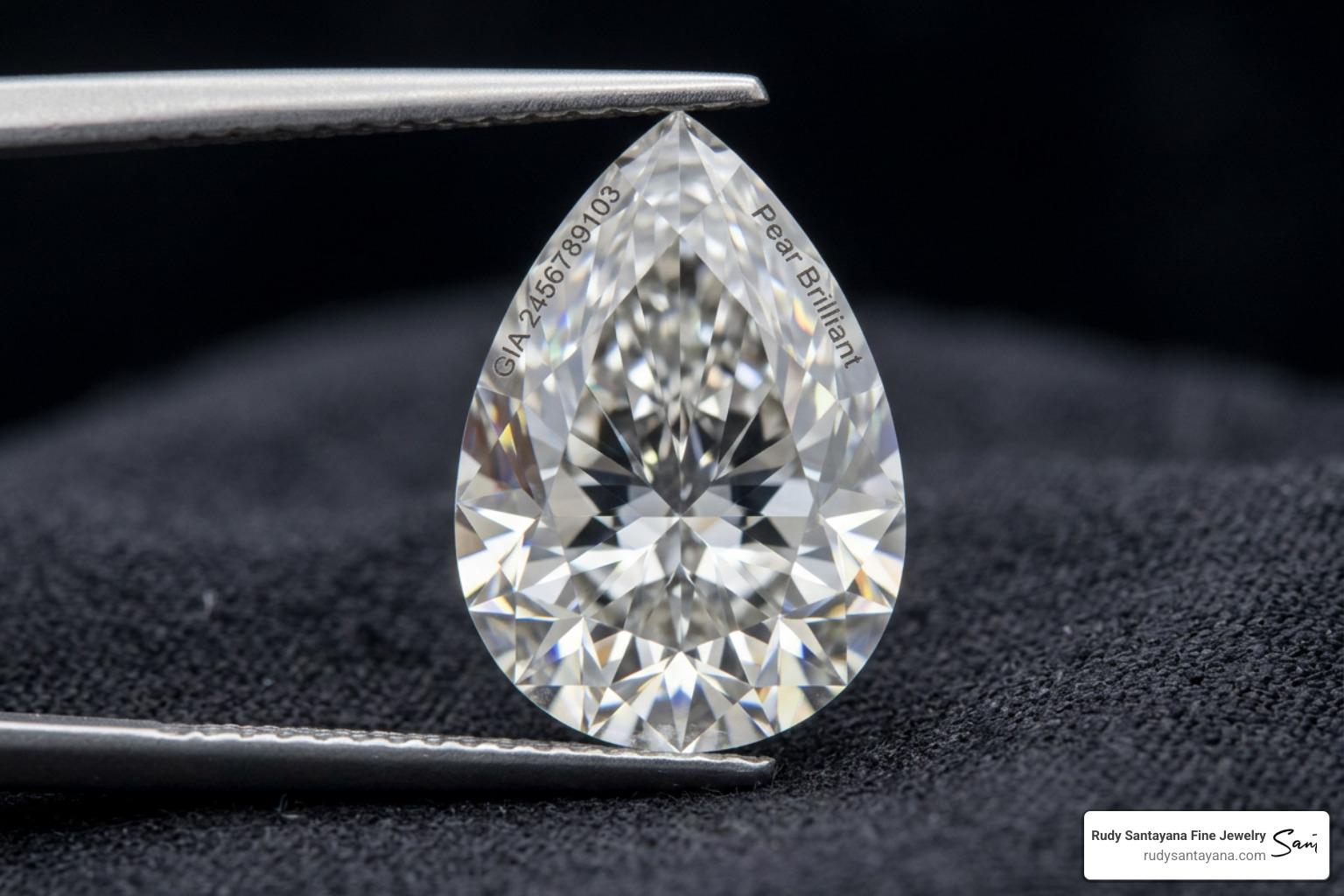
- Certification: Always insist on an independent laboratory grading report. The Gemological Institute of America (GIA) is the gold standard for natural diamonds, while the International Gemological Institute (IGI) is highly respected, particularly in the grading of lab-grown diamonds. A certificate ensures that the color, clarity, and carat weight you are paying for are verified by unbiased gemologists.
- Color Matching: In a three-stone ring, matching the color of all three diamonds is critical. If your center stone is an 'F' (colorless) and your side stones are 'I' (near-colorless), the side stones may look slightly yellow or warm by comparison. We recommend keeping all three stones within one color grade of each other.
- Clarity Grades: Pear-cut diamonds are excellent at hiding small natural inclusions, especially near the faceted brilliant base. You do not need to pay a premium for a "Flawless" (FL) or "Very Very Slightly Included" (VVS1) diamond to have a beautiful ring. An "Eye-Clean" VS1 or VS2 diamond will look completely pristine to the naked eye, allowing you to allocate more of your budget toward a larger carat weight or a superior cut.
- Ethical Sourcing: We believe that beautiful jewelry should carry a beautiful history. Ensure your jeweler sources conflict-free diamonds that comply with the Kimberley Process, or opt for sustainably grown lab diamonds.
Natural vs. Lab-Grown Diamonds
One of the biggest decisions modern buyers face is choosing between a natural (mined) diamond and a lab-grown diamond. Both are excellent choices, but they appeal to different priorities and budgets.
First, let's clear up a common misconception: lab-grown diamonds are real diamonds. Physically, chemically, and optically, they are identical to natural diamonds. They possess the exact same hardness (10 on the Mohs scale), the same refractive index, and the same breathtaking sparkle. The only difference is their origin—one grew deep within the Earth over billions of years, while the other was grown in a highly controlled laboratory setting using advanced technology that mimics the Earth's natural heat and pressure.
Here is a quick look at the key differences to help you decide:
- Rarity & Value: Natural diamonds are geological miracles. Because their supply is finite, they hold their long-term resale value remarkably well. Lab-grown diamonds, while beautiful, can be produced on demand, meaning they do not carry the same historical rarity or long-term investment value.
- Price Comparison: Because the supply chain for lab-grown diamonds is more direct, they are significantly more affordable. Choosing a lab-grown diamond for your 3 stone pear diamond ring can save you up to 50% to 70% compared to a natural diamond of the same size and quality, allowing you to opt for a much larger center stone or a more intricate setting.
- Sustainability: Lab-grown diamonds generally have a smaller environmental footprint, especially when grown using renewable energy. However, responsibly mined natural diamonds support vital economies and communities in developing nations.
At our Coral Gables showroom, we love helping couples weigh these options side-by-side. Whether you value the ancient, romantic history of a natural stone or the modern, accessible luxury of a lab-grown diamond, we can source the perfect gems for your design.
Frequently Asked Questions about Pear Trilogy Rings
What does a three-stone pear ring symbolize?
The three-stone ring is deeply symbolic. Traditionally, the three gems represent the past, present, and future of your relationship—a beautiful reminder of your shared journey and the adventures still to come.
When you use pear-shaped stones, there is an added layer of romance. The teardrop shape of the pear cut is historically associated with "tears of joy" and emotional depth. When arranged in a trilogy, some couples like to think of the stones representing tears of gratitude for the past, joy in the present, and hope for the future.
How do I care for and maintain my pear-shaped diamond?
Because pear diamonds have a delicate, pointed tip, they require a little extra love and care to keep them safe and sparkling:
- Avoid Impact: Try to take your ring off during heavy hands-on activities like gardening, working out, or cleaning.
- Regular Inspections: We recommend bringing your ring to our Coral Gables or Miami locations twice a year for a complimentary professional inspection. We will check that the prongs (especially the protective V-prong on the tip) are tight and secure.
- Gentle Cleaning: At home, you can keep your ring looking brilliant by soaking it in warm water with a few drops of mild dish soap. Use a soft-bristled baby toothbrush to gently clean behind the stones where oils and lotion can build up, then rinse and pat dry with a lint-free cloth.
Can a three-stone pear ring be resized easily?
Most three-stone pear rings can be resized, but it depends on the design of the band. If your ring has a plain metal band, resizing is straightforward.
However, if your ring features a micropavé diamond band or a highly detailed design like the signature raised crescents found in some cathedral settings, resizing can be more complex. In these cases, the ring can usually only be safely resized up or down by about three-quarters of a size without compromising the security of the small accent diamonds. We always recommend using our professional ring sizing tools in-store before handcrafting your final piece.
Conclusion
Choosing a 3 stone pear diamond ring is a beautiful way to celebrate a love story that is entirely your own. With its rich symbolism, flattering elongated shape, and endless opportunities for personalization, it is a design that will look just as elegant decades from now as it does the day you first slip it on your finger.
At Rudy Santayana Fine Jewelry, we specialize in bringing these dream designs to life. From our workshop in Coral Gables, we handcraft custom, innovative pieces designed to stand the test of time, backed by the warm, personalized service our community has trusted for years. Whether you want to select a breathtaking natural diamond, explore the brilliant possibilities of lab-grown stones, or design a completely bespoke setting from scratch, we are here to guide you every step of the way.
Ready to take the next step or curious about how to style your new treasure? Read our guide on How to wear a pear-shaped diamond ring to find the perfect wedding band pairing, or visit us in Coral Gables today to start designing your own masterpiece.
%20center%20dia...)