Five Times the Brilliance: Everything You Need to Know About 5 Stone Pear Rings
The 5 Stone Pear Diamond Ring: A 2026 Guide to the Most Flattering Multi-Stone Trend
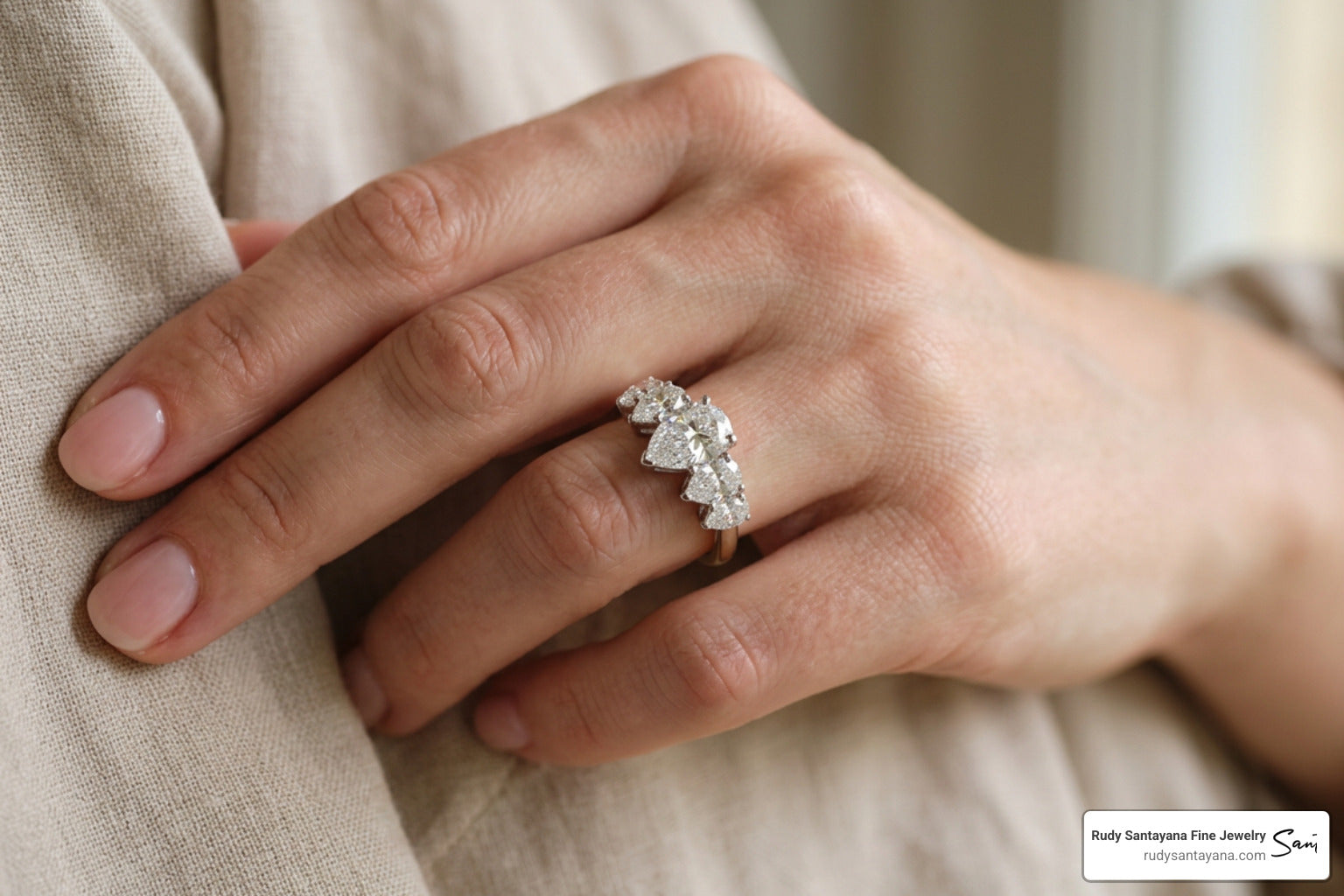
A 5 stone pear diamond ring is one of the most elegant and eye-catching engagement ring styles you can choose in 2026. It features five diamonds — typically with a larger pear-shaped center stone flanked by four accent diamonds — set in a single band that draws the eye across the finger.
Here's a quick overview of what makes this style stand out:
- Shape: Pear (teardrop) diamonds, prized for their ability to elongate and flatter the finger
- Setting: Five stones in a row, graduated in size from center outward
- Price range: From around $335 for affordable lab-grown versions to well over $100,000 for high-end natural diamonds
- Metal options: Platinum, white gold, yellow gold, and rose gold
- Best for: Anyone who wants more brilliance and finger coverage than a solitaire, with a distinctly modern look
Pear-shaped diamonds have been growing in popularity, now accounting for roughly 5-7% of all diamond engagement ring sales globally. And five-stone settings have seen a 23% rise in popularity over the past three years, as more couples move away from traditional solitaires toward designs that feel personal and unique.
Whether you're drawn to the romantic teardrop silhouette, the finger-lengthening effect, or simply the extra sparkle of five diamonds working together, this guide covers everything you need to choose the right ring with confidence.
What is a 5 Stone Pear Diamond Ring?
When you first hear the term "five-stone ring," you might picture a simple, uniform wedding band with five identical round diamonds lined up like neat little soldiers. While that classic look has its place, a 5 stone pear diamond ring is a completely different breed of fine jewelry. It is a bold, architectural, and deeply romantic design that reimagines the traditional multi-stone layout.
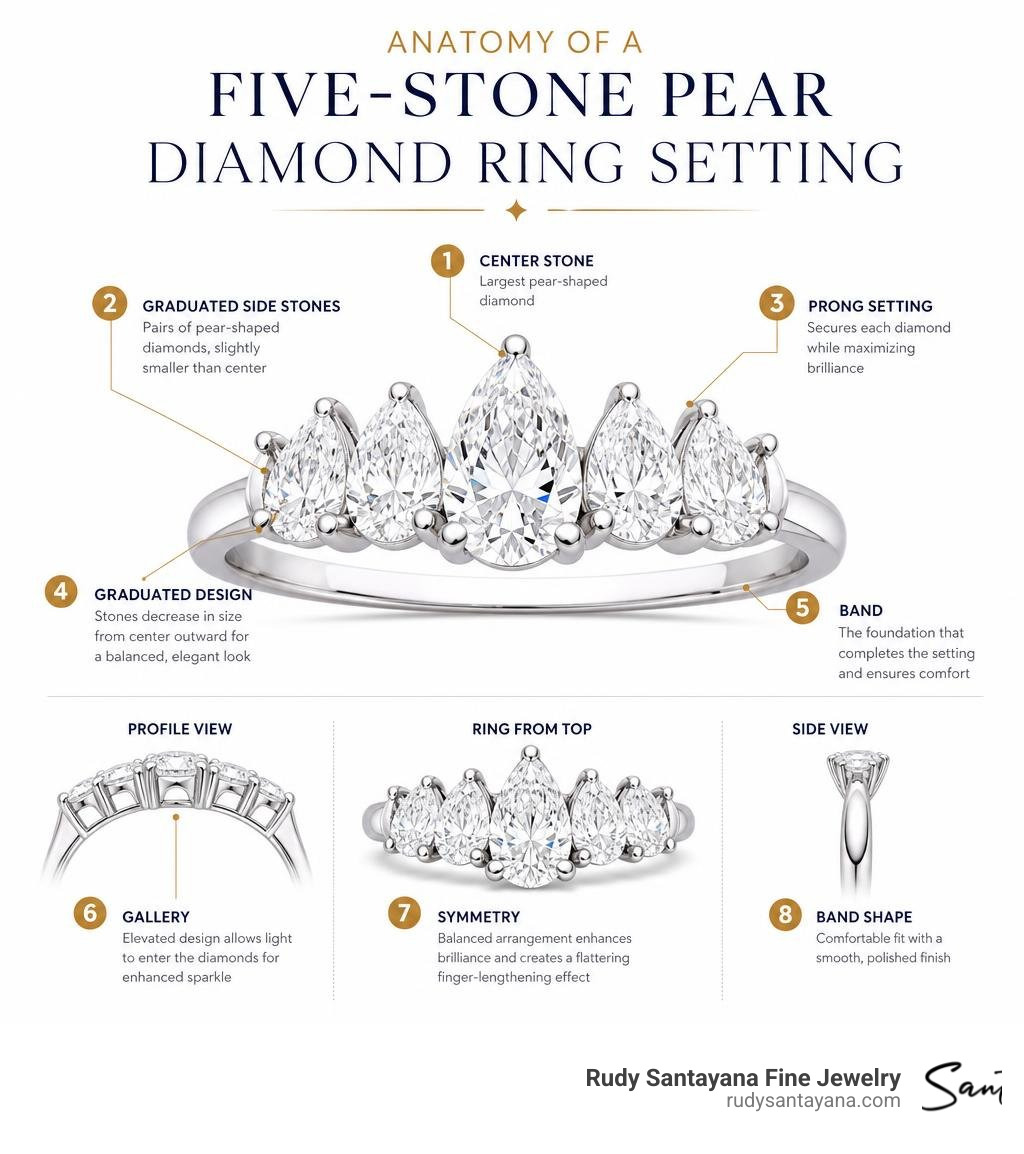
Unlike standard engagement rings that rely on a single center stone (solitaire) or a cluster of tiny diamonds (halo), the five-stone pear design utilizes five distinct, beautifully cut diamonds. The most common configuration features a prominent center pear-shaped diamond flanked by two pairs of graduated side stones. These side stones can also be pear-shaped, or they can transition into other brilliant cuts like round brilliants, marquise, or tapered baguettes.
The visual impact of this layout is nothing short of breathtaking. By placing five substantial diamonds in a row, the ring covers a larger percentage of the finger's width, creating a continuous wall of fire and brilliance. The side stones do not merely sit there looking pretty; they act as a visual runway, directing the eye inward toward the center diamond while amplifying its overall sparkle. Because pear diamonds feature a unique hybrid cut—combining the rounded bottom of a round brilliant with the tapered point of a marquise—they catch and refract light at multiple angles. When paired with four strategically placed side stones, the result is a harmonious symphony of light performance that outshines traditional single-stone rings.
Anatomy of a Five-Stone Setting
To truly appreciate the craftsmanship of a 5 stone pear diamond ring, we must look closely at its structural anatomy. At Rudy Santayana Fine Jewelry, we believe that a ring's structural integrity is just as important as its aesthetic beauty.
Design Elements: Proportions, Metals, and Diamond Quality

Creating a stunning 5 stone pear diamond ring requires a delicate balance of proportions, diamond quality, and metal choices. Unlike simpler rings, a five-stone ring has many moving parts that must coordinate perfectly to look unified.
When selecting diamonds for your five-stone ring, pay close attention to the following quality factors:
- Color Match: It is vital that all five diamonds match in color. If you choose a G-color center stone, your side stones should also be within the F-G range. A mismatched color grade will stick out immediately, making some stones look yellow and others bright white.
- Clarity Grades: While the center stone should ideally be eye-clean (usually VS2 or higher), the smaller side stones can sometimes be slightly lower in clarity (such as SI1) as long as the inclusions are not visible to the naked eye.
- GIA Certification: Always look for GIA-certified center diamonds to ensure you are getting exactly what you pay for in terms of quality, cut, and origin.
The Importance of Length-to-Width Ratio in a 5 Stone Pear Diamond Ring
The length-to-width (L/W) ratio is the secret formula that dictates a pear diamond's personality. Calculated by dividing the diamond's length by its width, this ratio determines whether your pear looks short and chubby or long and skinny.
For a classic, balanced teardrop look, the ideal length-to-width ratio for a pear diamond is 1.45 to 1.55.
- Under 1.40: The diamond will appear wider and more oval-like. While this can look beautiful in some settings, it loses some of the dramatic finger-elongating effect.
- Over 1.60: The diamond will look highly elongated and slender. This can be striking, but it increases the risk of the dreaded "bow-tie effect."
The bow-tie effect is a dark, shadow-like pattern resembling a bow-tie that runs across the center of fancy-cut diamonds (like pears, ovals, and marquises) when light leaks through the stone. A skilled diamond cutter minimizes this effect, ensuring excellent light performance across the entire surface of the stone. When designing a five-stone ring, selecting well-proportioned diamonds is crucial to ensure the side stones do not overshadow the center or create distracting dark spots.
Choosing the Right Metal: Platinum vs. Gold
The metal you choose for your band acts as the frame for your diamond masterpiece. Each metal has its own aesthetic and structural benefits:
| Metal | Composition | Key Benefits | Best For |
|---|---|---|---|
| Platinum | 95% Pure Platinum | Hypoallergenic, extremely durable, naturally white, holds stones incredibly securely | High-carat heavy center stones, active lifestyles |
| White Gold | Gold alloyed with white metals, finished with rhodium plating | Bright white finish, highly reflective, more affordable than platinum | Classic, high-brilliance modern designs |
| Yellow Gold | Gold alloyed with copper and zinc | Warm, traditional, vintage appeal; contrasts beautifully with white diamonds | Classic and vintage-inspired designs |
| Rose Gold | Gold alloyed with copper | Romantic, warm pink hue, highly durable | Unique, modern, and romantic bridal styles |
Platinum is the gold standard for security, especially in multi-stone rings. Because it is a dense, malleable metal, it bends rather than breaks under pressure, meaning your prongs are less likely to snap. White gold is a popular, budget-friendly alternative, though it requires occasional replating with rhodium to maintain its bright, silvery-white luster.
For those looking to explore different styles, you can browse various collections to see how various metals complement different pear-cut dimensions.
Comparing Multi-Stone Settings: Solitaire, Halo, and 5-Stone
Choosing an engagement ring style is a deeply personal decision. To help you visualize how a five-stone pear setting stack up against other popular choices, we have put together a comparison table:
| Feature | Solitaire Setting | Halo Setting | 5-Stone Pear Setting |
|---|---|---|---|
| Visual Impact | Classic, minimalist, focuses entirely on one stone | Maximizes perceived size of the center stone | Bold, dramatic, continuous sparkle across the finger |
| Finger Coverage | Low to moderate | Moderate to high | Exceptionally high |
| Style Profile | Traditional and timeless | Romantic and vintage-inspired | Modern, luxurious, and unique |
| Stacking Ease | Very easy; fits flush with most bands | Can be difficult; often requires curved bands | Requires strategic planning or high-profile settings |
| Uniqueness | Common | Very common | Highly unique and personalized |
Why Choose a 5 Stone Pear Diamond Ring Over a Solitaire?
While the classic solitaire will always have a place in our hearts, the 5 stone pear diamond ring offers several distinct advantages for the modern bride.
First, let's talk about finger coverage. A solitaire ring, no matter how beautiful, only covers a small portion of your finger widthwise. A five-stone ring spreads the love, creating a horizontal band of light that sparkles from every angle, even when your hand is turned.
Second, it offers incredible value. Buying a single 3-carat diamond is significantly more expensive than buying a combination of diamonds that add up to 3 carats total weight. By using graduated side stones, you can achieve a massive, luxurious look on the hand at a fraction of the cost of a giant single stone.
Finally, it provides a modern twist on bridal jewelry. If you want a ring that stands out in a crowd and serves as an instant conversation starter, a multi-stone pear design is the perfect way to express your individual style. To understand how these custom elements come together, explore our insights into The Art of Custom Made Jewelry.
Customization, Stacking, and Pricing

One of the most exciting parts of choosing a five-stone ring is the ability to customize it to your exact specifications. From choosing your diamond origin to selecting the perfect band width, the options are virtually endless.
When it comes to pricing, the market offers a wide spectrum of options. For those seeking budget-friendly luxury, complete five-stone rings featuring graduated lab-grown diamonds can start around $335 to $2,959 depending on the metal and diamond quality. On the other end of the spectrum, high-end natural diamonds can easily range into the tens or hundreds of thousands. For instance, the average price for a high-quality 5-carat natural pear-shaped diamond ranges from $23,128 to $425,486, with a mean price of $157,247, reflecting how dramatically color, clarity, and origin impact overall cost.
Stacking with Wedding Bands
A common question we hear from clients in our Coral Gables showroom is: "Can I stack a five-stone ring with a wedding band?"
The answer is a resounding yes, but it does require some strategic design planning. Because five-stone rings have a wider footprint on the finger, a traditional straight wedding band may not sit flush against the engagement ring.
To solve this, many brides opt for:
- Nesting or Curved Bands: These bands feature a gentle wave or V-shape that curves gracefully around the rounded bottom or pointed tip of the pear diamond.
- Chevron Bands: A sharp V-shaped band that echoes the pointed end of the pear, creating a beautiful geometric frame.
- High-Profile Settings: Designing your five-stone ring with a slightly elevated basket allows a straight wedding band to slide right underneath, sitting perfectly flush.
Lab-Grown vs. Natural Diamonds
The debate between lab-grown and natural diamonds is a major consideration for couples in 2026. Both options are physically, chemically, and optically identical, but they differ significantly in price and origin.
Lab-grown diamonds are created in controlled laboratory environments using either the Chemical Vapor Deposition (CVD) or High Pressure High Temperature (HPHT) method. Because they do not require mining, they offer a highly ethical and sustainable sourcing story.
The price difference is also substantial. Lab-grown pear-shaped diamonds in five-stone settings are typically priced 40-60% lower than their natural counterparts. For example, a stunning 5.58-carat lab-grown pear hidden halo ring might retail for around $5,520, whereas a natural diamond ring of the exact same specifications could easily cost $9,200 or more.
If you are trying to decide which option is right for you, check out our educational resources on Lab Diamonds and explore other options in our guide to the Best Diamond Alternatives. You can also look at specific designs to see how these modern stones perform in a multi-stone setting.
Frequently Asked Questions about Five-Stone Pear Rings
What is the best length-to-width ratio for pear diamonds in a five-stone ring?
The most visually balanced and popular length-to-width ratio for a pear diamond in a five-stone ring is between 1.45 and 1.55. This range ensures the diamond maintains its classic teardrop silhouette without looking too wide or too narrow, which helps it integrate seamlessly with the side stones.
Can you stack a five-stone pear ring with a traditional wedding band?
Yes, but you may need a curved, open, or chevron-style wedding band to accommodate the low-profile setting of the side stones. Alternatively, you can design the ring with a high-profile setting so a traditional straight band can sit flush underneath the diamonds.
How do lab-grown pear diamonds compare in price to natural ones?
Lab-grown pear diamonds generally offer a 40% to 60% savings compared to natural diamonds of the same size and quality. This makes them an incredibly popular choice for couples who want to maximize their budget and get a larger center stone.
Conclusion
A 5 stone pear diamond ring is more than just a piece of jewelry; it is a stunning work of art that celebrates your unique love story with five times the brilliance. By combining the timeless elegance of the pear shape with the dramatic flair of a multi-stone setting, this ring style offers unparalleled finger coverage, exceptional light performance, and a highly personalized aesthetic.
At Rudy Santayana Fine Jewelry in Coral Gables, FL, we specialize in bringing these custom dreams to life. Our passion is handcrafting innovative, superior-quality pieces that you will cherish for a lifetime. Whether you are looking for local guidance in the Miami area or want to explore your options online, we invite you to read our guide on How Do You Wear a Pear Shaped Diamond Ring to start planning your perfect design.
To explore further options and connect with jewelry professionals in our area, you can also check out resources like The Best Local Jewelers in Coral Gables, FL - StoneAlgo to see how our local community shines. Ready to take the next step? Visit our Coral Gables showroom today, and let’s design something extraordinary together!