Which Custom Photo Engraved Necklace Material Holds Up Best Over Time?
Introduction
When choosing a custom photo engraved necklace, the materials that hold up best over time are solid 14k gold for lifetime heirloom wear and 316L stainless steel for active daily durability. Solid 14k gold resists tarnishing and scratching, while 316L stainless steel offers superior toughness against moisture and abrasion. A personalized keepsake carries an emotional weight unlike any standard accessory. Whether capturing a newborn's first smile, a couple's wedding day, or a tribute to a beloved pet, transforming a memory into wearable art creates an immediate, heartfelt connection. As of September 2026, personalized jewelry trends continue to climb, with daily searches for unique photo jewelry surging as more people seek meaningful alternatives to mass-produced items.
However, because these pieces hold immense sentimental value, longevity is paramount. Nobody wants a cherished memory to fade, scratch, or turn their skin green after a few months of wear. The durability of a custom piece depends heavily on two critical factors: the raw materials chosen for the pendant and chain, and the engraving technique used to translate your picture into physical form. Understanding how different metals and optical mediums react to moisture, friction, and daily environmental exposure is the first step in ensuring your keepsake lasts for decades rather than days.
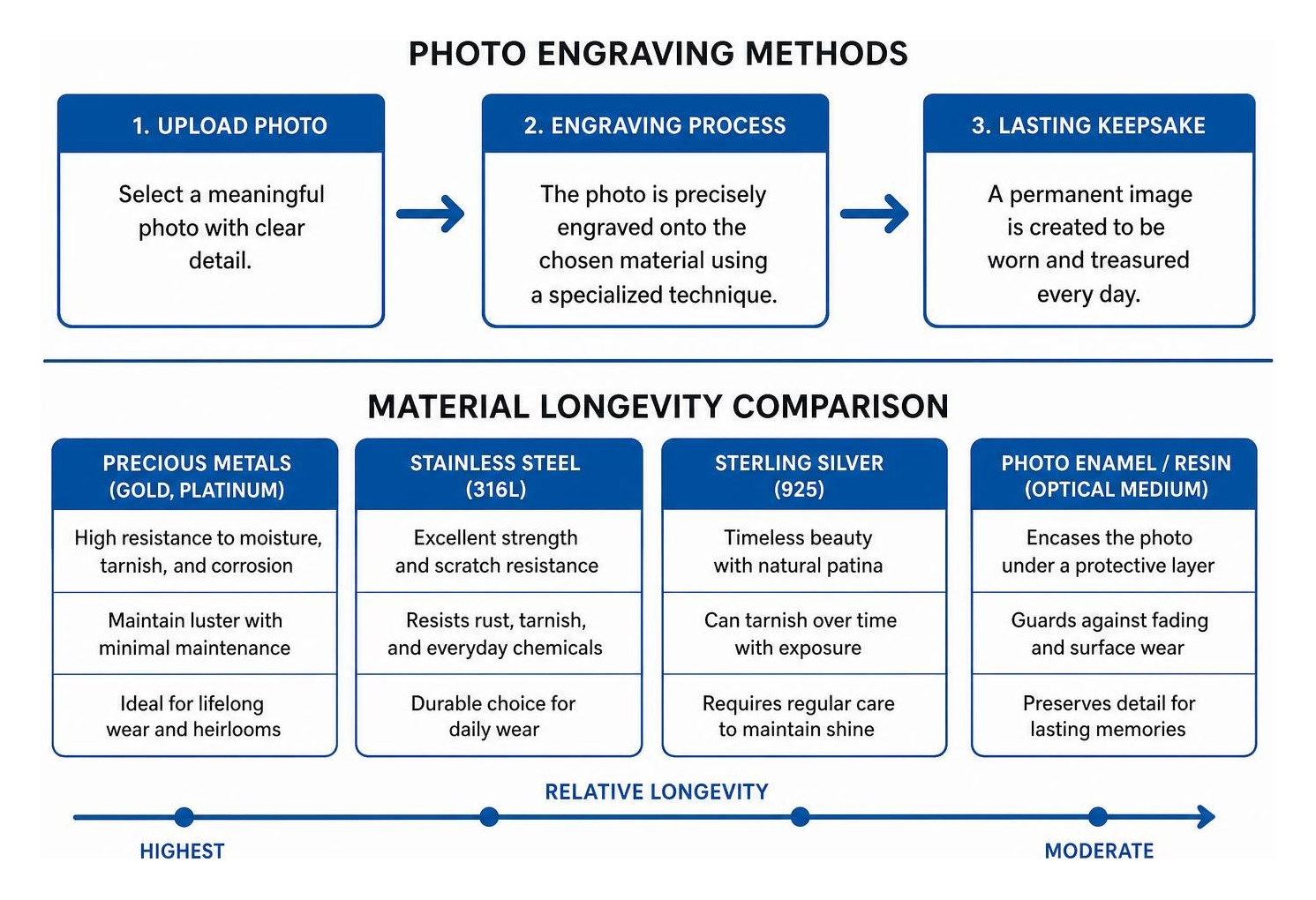
Comparing Materials for a Custom Photo Engraved Necklace
When evaluating materials for your personalized pendant, you must weigh visual warmth, hypoallergenic properties, tensile strength, and resistance to everyday chemical exposure. While some metals form a natural patina over time, others maintain an unwavering mirror finish with virtually zero maintenance. For a broader look at how these choices affect long-term wear, see this overview of jewellery durability.
| Material | Scratch Resistance | Water & Tarnish Resistance | Hypoallergenic Level | Best Long-Term Use Case |
|---|---|---|---|---|
| Solid 14k / 18k Gold | High (14k) to Moderate (18k) | Excellent (Never tarnishes or rusts) | 100% Hypoallergenic | Multi-generational heirloom wear and daily luxury |
| 925 Sterling Silver | Moderate (Prone to surface micro-scratches) | Moderate (Oxidizes when exposed to sulfur/air) | Very High (Nickel-free alloys) | Occasional to regular wear with routine polishing |
| 316L Stainless Steel | Very High (Resists deep gouges) | Superior (Immune to oxidation and rust) | High (Medical-grade composition) | Active, low-maintenance daily lifestyles |
| Optical K9 Crystal | High hardness (Brittle against heavy drops) | Impervious (Image sealed internally) | Inert / Complete | Desk-to-dinner keepsakes and novelty display |
Solid Gold Custom Photo Engraved Necklace Durability
Solid gold remains the unrivaled benchmark for luxury keepsakes. Unlike gold-plated alternatives that wear down over time to reveal base metals underneath, solid 14k and 18k alloys offer permanent stability. In our fine jewelry atelier, we craft heirloom-grade custom gold pendants designed to withstand generations of handling without structural breakdown or color distortion.
From a metallurgical perspective, 14k gold contains 58.3% pure gold alloyed with durable metals like copper, silver, and zinc. This composition provides exceptional scratch resistance while preserving gold’s innate immunity to oxidation. Solid 18k gold features a richer, warmer tone with 75% purity, offering a softer canvas that catches the light beautifully when vaporized by precision lasers.
Because gold does not react with oxygen, sweat, or moisture, the micro-grooves created by laser engraving stay sharp, distinct, and clean indefinitely. For a truly elevated presentation, combining this enduring metal with gemstone accents—as explored in our custom-made diamond pendants guide 2026—creates a piece that commands attention while protecting your core memory.
Sterling Silver and Stainless Steel Options
For clients seeking bright, cool-toned metals, 925 sterling silver and medical-grade 316L stainless steel are two primary contenders, though they perform very differently under daily stress.
Sterling silver consists of 92.5% pure silver alloyed with 7.5% copper to give it workable strength. Silver provides exceptional brightness and micro-contrast when laser etched, making intricate facial details pop against the reflective background. However, silver reacts naturally with atmospheric hydrogen sulfide, causing surface tarnish over time. It requires regular polishing to maintain its original luster and must be shielded from harsh household cleaners. If you appreciate the organic, evolving character of precious metals, silver remains a classic choice for custom engraved pendants.
By contrast, 316L surgical stainless steel is engineered for resilience. It is an exceptionally hard alloy that resists gouging, bending, and abrasive scuffs. High-quality stainless steel pendants finished with advanced physical vapor deposition (PVD) can simulate the look of yellow gold while offering complete resistance to rust, sweat, and tarnishing. While it lacks the precious metal value and weight of solid gold, stainless steel is a practical, budget-conscious choice for everyday wear.
3D Subsurface Crystal and Projection Keepsakes
Moving beyond traditional metal plates, 3D optical crystal necklaces use internal laser vitrification. Instead of etching the surface of the pendant, high-frequency green lasers focus micro-points of light inside a solid block of K9 optical crystal. This process fractures microscopic internal points to build a three-dimensional floating image suspended within the clear medium.
Because the picture is inside the crystal, it is physically impossible to scratch, peel, or rub away through contact with clothing or skin. The surface remains completely smooth, impervious to tarnishing or atmospheric yellowing. The heart shape is the most popular silhouette for these keepsakes, frequently chosen for mothers, grandmothers, and romantic partners.
However, optical crystal comes with a trade-off: structural brittleness. While it easily resists abrasive scuffs from fabrics, dropping a crystal pendant onto a tile floor or granite countertop can cause edge chipping or internal fracturing. Furthermore, while the crystal itself is safe in water, the metal bails, jump rings, and clasps that hold it can weaken over time if continuously submerged.
How Photo Engraving Technology Affects Long-Term Detail

The longevity of your image depends as much on the engraving technology as the metal beneath it. Traditional mechanical diamond-drag engraving works by physically scratching lines into the metal plate, which creates high shine but lacks tonal depth. Modern keepsakes rely on precision fiber laser vaporization.
Fiber lasers operate at microscopic wavelengths, firing rapid pulses that vaporize minute layers of metal to create deep, controlled contrast. By varying the laser’s focal intensity and pulse frequency, master jewelers achieve subtle grayscale shading—reproducing delicate features like skin textures, individual hair strands, and expressive eye reflections. This deep micro-etching ensures the portrait remains crisp and legible instead of rubbing away as a faint surface print.

Photo Selection and Clarity Guidelines
Even the most advanced laser engraving system cannot compensate for a poorly lit or blurry source file. The final piece reflects the data provided in the initial image file. To create exceptional personalized jewelry, follow these core image selection guidelines:
- Prioritize Close-Up Portraits: Small pendants measuring between 15mm and 25mm have limited surface area. Choose close-up images where the subject's face fills at least 50% to 75% of the frame.
- Ensure High-Contrast Lighting: Strong separation between the subject and the background is essential. Evenly lit faces with defined shadows translate into rich grayscale depth, whereas flat, flash-washed photos appear washed out when engraved.
- Avoid Large Group Shots: Attempting to fit four or five full-body figures onto an 18mm pendant results in facial features smaller than a millimeter, turning individual expressions into indistinct blurs.
- Check File Resolution: Upload clean, uncompressed digital files rather than low-resolution screenshots taken from social media feeds.
Ordering Workflow: Uploads, Proofs, and Revisions
Creating a custom piece should be transparent, collaborative, and precise. A standard production workflow moves through several distinct quality checkpoints:
- Initial Asset Review: Once you submit your photograph, our design team evaluates the contrast, subject framing, and background noise. Distracting backgrounds are digitally isolated and softened to keep the visual focus entirely on the subject.
- Digital Art Rendering: A digital proof is generated to show exactly how the laser will translate tonal ranges onto the metal or crystal canvas, accounting for the pendant's specific geometry (such as an oval, disc, or heart).
- Design Approval & Revisions: You review the mock-up to confirm facial alignment, cropping, and any optional reverse-side inscriptions (such as commemorative dates, names, or coordinates).
- Precision Fabrication: Once approved, the piece enters fabrication. Production takes approximately 2 to 3 business days, followed by hand-finishing, bail inspection, and ultrasonic cleaning.
Care and Longevity: Daily Wear vs. Specialty Pieces
Every piece of fine jewelry requires thoughtful care to preserve its structural integrity and surface luster over years of wear. While metal pendants resist daily friction, environmental contaminants like lotions, sunscreens, and body chemistry can dull the crisp contrast of your engraving over time.
Maintaining Your Custom Photo Engraved Necklace Over Time
Establishing a simple, consistent maintenance routine prevents residue buildup inside the microscopic grooves of your engraving. To keep your necklaces in showroom condition, apply these essential practices:
- Clean with Gentle Detergents: Wash your pendant monthly in a bowl of warm water mixed with a few drops of mild, phosphate-free dish soap. Use an ultra-soft cosmetic brush or microfiber cloth to gently dislodge skin oils from the engraved recesses.
- Avoid Abrasive Polishing Pastes: Never apply heavy industrial polishing compounds or stiff wire brushes to the engraved surface. Aggressive mechanical buffing can flatten the microscopic laser ridges over time, reducing image contrast.
- Remove Before Swimming: Always take off your jewelry before entering swimming pools, hot tubs, or ocean water. Chlorine and bromine chemically attack silver alloys and can pit or discolour gold solder joints and delicate chains.
- Apply the "Last On, First Off" Rule: Put your necklace on after applying perfumes, hairsprays, and body lotions. Chemical propellants and cosmetic oils create a thin surface film that attracts airborne dust and obscures fine detail.
Warranties, Guarantees, and Replacement Coverage
A fine jewelry purchase should always come with long-term peace of mind. Reputable custom jewelers stand behind their fabrication standards with comprehensive warranties covering color retention, structural integrity, and engraving permanence.
Lifetime coverage typically protects against manufacturing flaws, premature clasp failures, and weld point separations under normal wearing conditions. While warranties do not cover accidental loss, heavy blunt-force impact, or exposure to harsh industrial acids, trusted ateliers provide ongoing support—including professional ultrasonic cleaning, bail retipping, and chain repair—to ensure your personalized keepsake remains a source of pride for years to come.
Frequently Asked Questions About Photo Engraved Necklaces
Does a photo engraved necklace fade or wear off with daily wear?
True laser-engraved pendants do not "fade" in the way ink prints or surface dyes do. The laser vaporizes and displaces microscopic amounts of metal to permanently alter the surface topography and light refraction of the piece. While daily friction against coarse fabrics can soften ultra-fine surface lines over many years, deep fiber-laser engravings on solid gold, stainless steel, and sterling silver remain permanently legible throughout the wearer's lifetime.
Can I wear my photo engraved necklace in the shower or swimming pool?
While solid gold and 316L stainless steel are completely water-resistant and will not rust in clean water, showering with your necklace is generally discouraged. Bath soaps, body washes, and hard mineral water leave a dull, milky film across the micro-crevices of the engraving, which softens visual contrast until cleaned. Swimming pools and hot tubs should always be avoided due to harsh chlorine, which actively attacks precious metal alloys and damages delicate spring rings and clasps.
What type of photograph produces the best laser engraving results?
The best photographs for laser engraving feature sharp focus, balanced natural lighting, and high contrast between the subject and the background. Close-up portraits—such as headshots of a single person or pet—produce the clearest and most expressive engravings. Avoid using underexposed images, heavily filtered snapshots, or distant group photos where faces occupy only a tiny fraction of the overall frame.
Conclusion
A custom photo engraved necklace is far more than a simple accessory; it is a wearable archive of personal history, love, and connection. Choosing the right material ensures that the story you carry close to your heart remains clear and beautiful for years to come. For unmatched longevity and multi-generational permanence, solid 14k and 18k gold provide the ultimate canvas. For resilient, active daily wear, surgical-grade stainless steel offers dependable toughness, while sterling silver brings a timeless fine-jewelry aesthetic when paired with routine care.
At Rudy Santayana Fine Jewelry, we combine traditional craftsmanship with modern laser precision at our design bar in Coral Gables, FL. Whether you wish to translate a family portrait into a custom gold pendant, set a memory alongside ethical diamonds, or explore the art of custom made jewelry, our team is dedicated to creating meaningful, handcrafted pieces that endure.
Contact our Miami-area studio today to collaborate on a one-of-a-kind personalized keepsake that preserves your most meaningful moments forever.