
The Complete Guide to Can Diamond Melt
Can Diamond Melt? The Science Behind the World's Hardest Gemstone
Can diamond melt? Yes — but only under conditions so extreme they barely exist on Earth. Here's the quick answer:
| Condition | What Happens to Diamond |
|---|---|
| Normal air, any temperature | Burns to CO₂ gas at ~900 °C |
| High heat, no oxygen, low pressure | Converts to graphite |
| Heat + pressure above 10 GPa (100,000 bar) | Melts into liquid carbon at ~4500 °C |
| Lava (~1200 °C) | Nothing — lava is far too cool |
| Acid (even piranha solution) | Nothing — diamond resists all acids |
So while diamonds can melt, it takes pressures found deep inside planets — not anything you'd encounter in everyday life.
The old saying "diamonds are forever" is mostly true on a human scale. Diamond is the hardest natural material on Earth. But push it to the right extremes of heat and pressure, and even it gives way.
I'm Rudy Santayana, a fine jewelry designer in Miami, Florida, and understanding the physical limits of diamonds — including the question of can diamond melt — is fundamental to how I work with these remarkable stones every day. In this guide, I'll walk you through the complete science, from what happens in a lab to what it means for your jewelry.
Under What Conditions Can Diamond Melt?
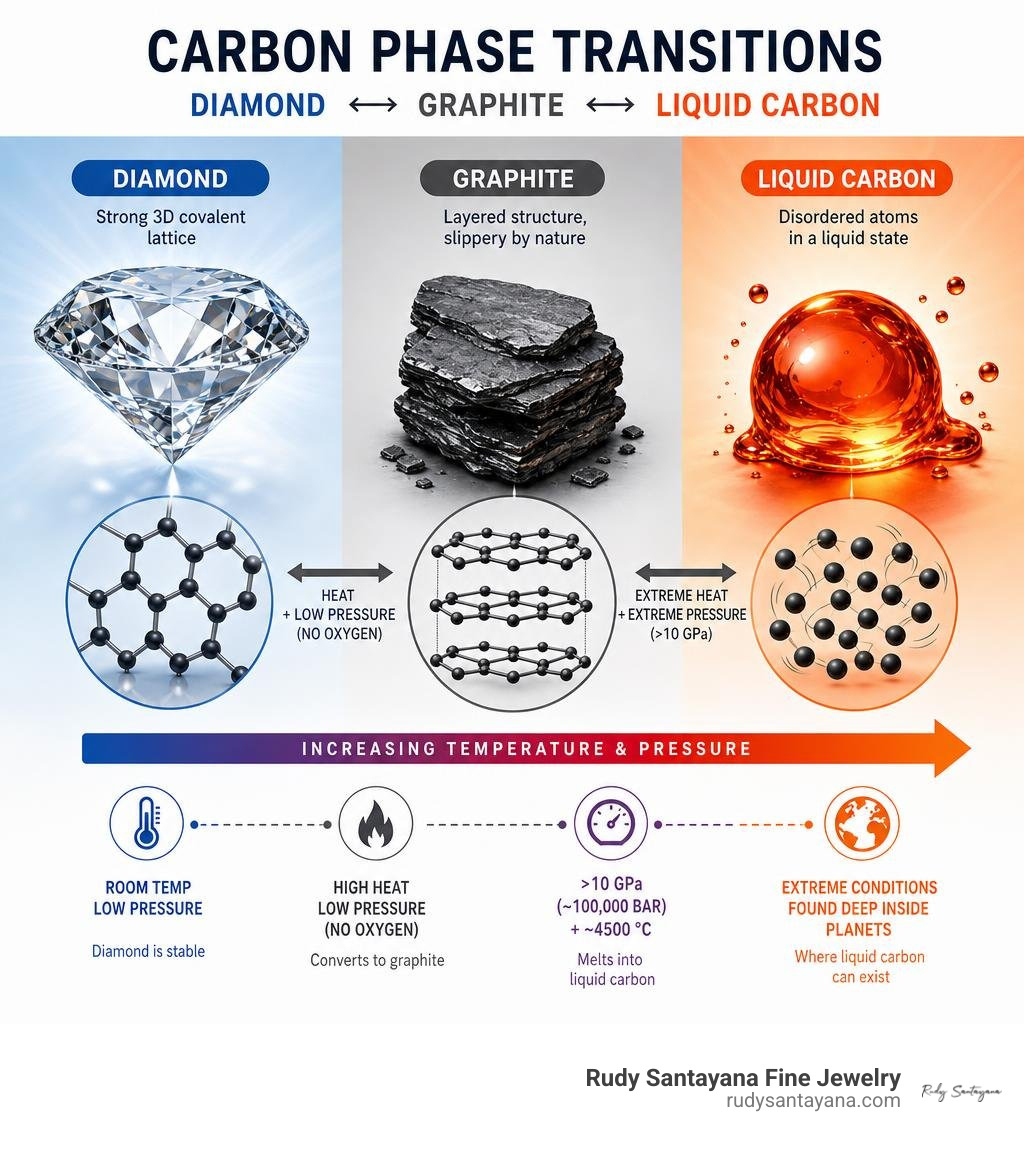
To understand how we can melt a diamond, we have to look at what a diamond actually is. At its core, a diamond is a crystalline lattice of carbon atoms. Each carbon atom is bound to four neighbors in a tetrahedrally coordinated structure. This three-dimensional network of covalent bonds is what gives diamond its legendary hardness. However, even the strongest bonds can be disrupted if you throw enough energy at them.
To turn solid diamond into liquid carbon, you must provide enough thermal energy to break those tight covalent bonds, while simultaneously applying massive amounts of pressure to prevent the carbon atoms from simply drifting apart into gas or rearranging into a less dense solid structure.
The minimum baseline conditions required to melt a diamond are a temperature of approximately 4500 °C (which is just over 4700 Kelvin) combined with a pressure of at least 100,000 bar. To put that in perspective, 100,000 bar is equivalent to 10 gigapascals (GPa) or roughly 100,000 times the atmospheric pressure at sea level. Without this crushing pressure, the carbon atoms will not form a liquid. Instead, they will bypass the liquid phase entirely.
Historically, mapping these extreme boundaries has been one of the greatest challenges in high-pressure physics. For decades, scientists debated the exact parameters of the carbon phase diagram. You can read more about these early high-pressure thermodynamic theories in this classic study on the Melting of Diamond at High Pressure | Science .
Why Can't Diamond Melt at Normal Atmospheric Pressure?
If you were to take a gorgeous diamond and heat it up on a standard kitchen stove or with a jeweler's torch in the open air, you would not end up with a puddle of liquid diamond. Instead, you would watch your precious gemstone literally vanish into thin air.
At normal atmospheric pressure (1 bar), diamond is thermodynamically unstable. When heated in the presence of oxygen, diamond begins to oxidize—or burn—at around 900 °C. The carbon atoms in the diamond react with the oxygen in the air to produce carbon monoxide and carbon dioxide gas. The diamond doesn't melt; it combusts.
But what if you heat it in a perfect vacuum or an inert gas chamber where there is absolutely no oxygen? Even then, you still won't get a liquid. At normal atmospheric pressure, the carbon atoms do not have enough external pressure holding them in their tight diamond lattice. As the temperature rises, the thermal vibrations become so intense that the atoms rearrange themselves into a lower-energy, more stable form at ambient pressure: graphite. This process is known as graphitization.
Essentially, instead of melting, your diamond turns into the same material found in a common pencil. For a deeper look at this phenomenon and how it affects both science and jewelry care, check out our article on Can You Melt Diamonds.
How Can Diamond Melt in Laboratory Settings?
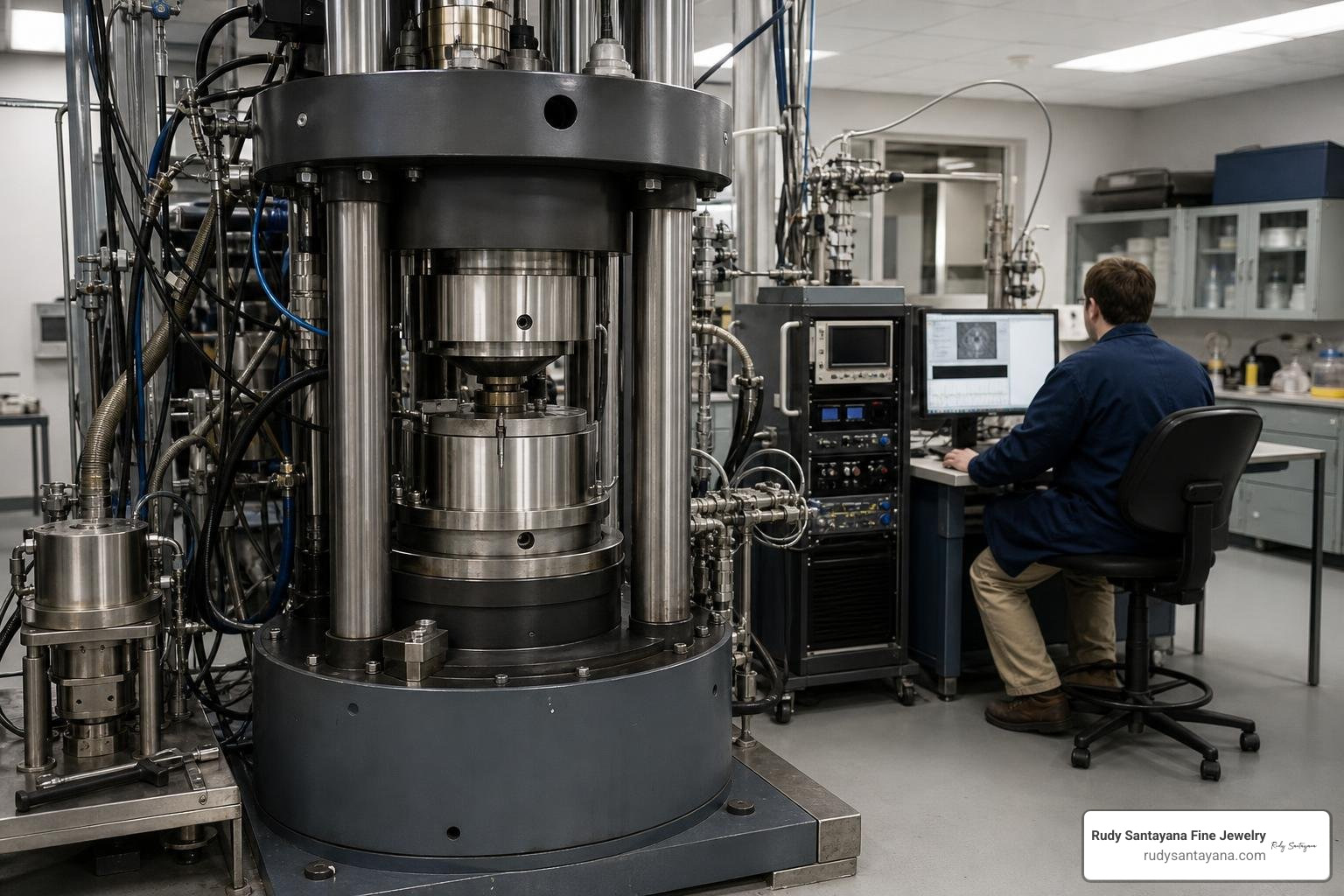
Since we cannot achieve the necessary crushing pressures on a standard laboratory bench, physicists have had to design incredibly sophisticated experiments to study liquid carbon. Over the years, scientists have used a variety of high-tech methods to briefly cross the threshold into the liquid phase.
One of the most famous breakthroughs occurred in 2006 at Sandia National Laboratories. Using the famous "Z machine"—the world's largest high-frequency electromagnetic wave generator—researchers shot tiny metal plates at diamonds using massive magnetic fields. This created dynamic shockwaves that subjected the diamonds to pressures equivalent to more than 10 million times Earth's atmospheric pressure, successfully melting them.
In 2009, shock-compression experiments pushed the boundaries even further. Researchers used high-power lasers, such as the OMEGA laser system, to blast diamond targets with intense pulses of light. These experiments revealed the melting temperature of diamond at ultrahigh pressures ranging from 0.6 to 1.1 terapascals (TPa), which is 6 to 11 million atmospheres. In this ultrahigh-pressure regime, diamond was observed to melt at a staggering 9,000 Kelvin. You can review the detailed experimental data in the published paper on the Melting temperature of diamond at ultrahigh pressure .
More recently, in 2019, a study utilized a two-stage multiple-anvil apparatus combined with a rapid flash-heating method. By applying a static pressure of 15 GPa and using a high-voltage electrical pulse to flash-heat the sample, scientists successfully measured the melting temperature of diamond under static conditions as 5968 ± 457 K, providing a highly accurate benchmark for static thermodynamic models.
The Carbon Phase Diagram and Thermodynamic Stability
To truly grasp why carbon behaves the way it does, we have to look at the carbon phase diagram. A phase diagram is a map that shows which state of matter (solid graphite, solid diamond, or liquid carbon) is stable at any given combination of temperature and pressure.
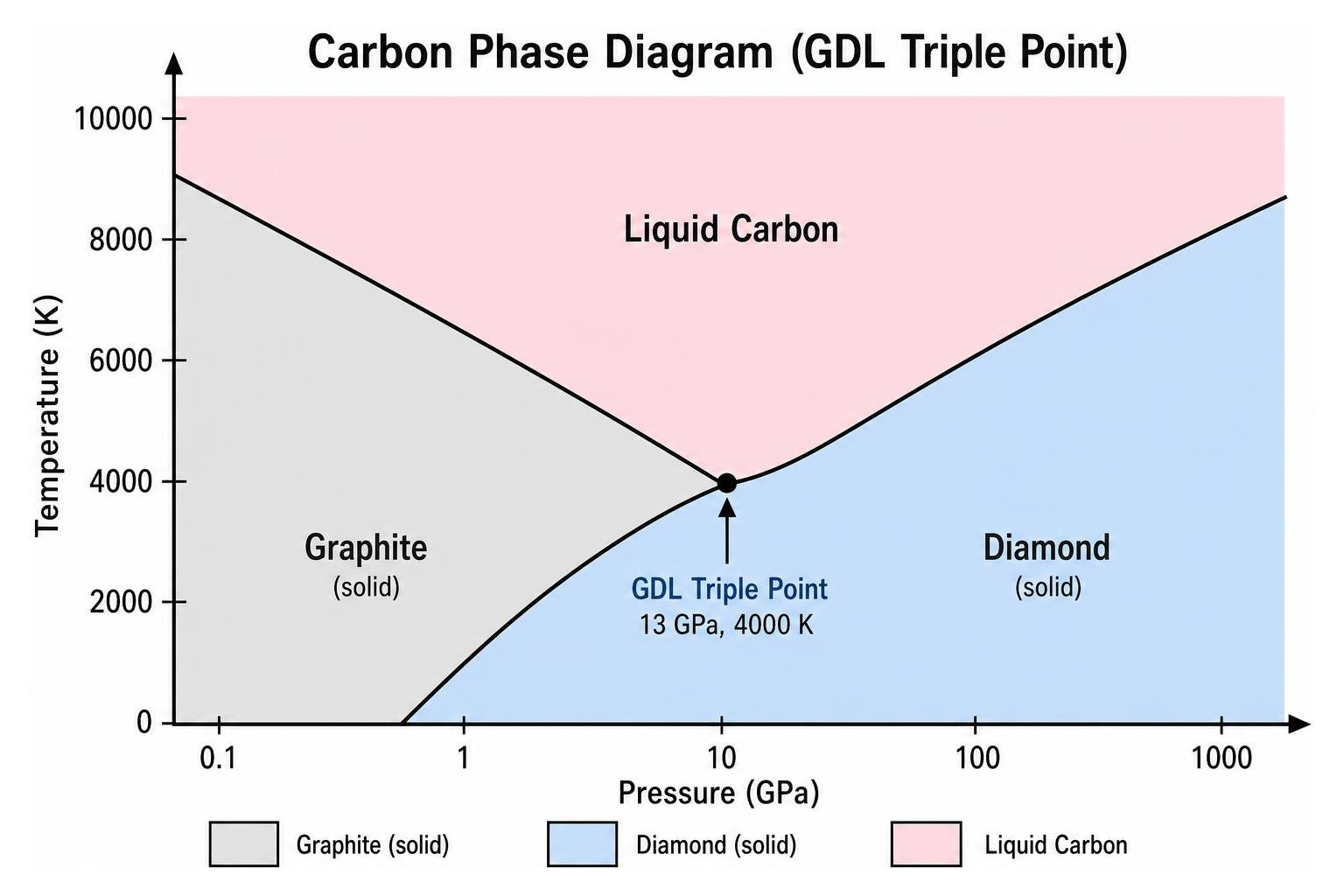
At room temperature and standard atmospheric pressure, graphite is actually the thermodynamically stable phase of carbon. Diamond is what scientists call "metastable." This means that while it is technically unstable and "wants" to turn into graphite, the kinetic energy barrier to do so is so incredibly high at room temperature that the transition would take billions of years. So yes, your diamond jewelry is safe on a human timescale!
However, as you move up the pressure scale, the stability region shifts. At high pressures, the denser structure of diamond (3.51 g/cm³) becomes more stable than the less dense structure of graphite (2.26 g/cm³).
The point where solid graphite, solid diamond, and liquid carbon all meet in thermodynamic equilibrium is known as the Graphite-Diamond-Liquid (GDL) triple point. This triple point occurs at approximately 13 GPa of pressure and a temperature of 4000 Kelvin. For decades, the exact behavior of carbon around this triple point has been a subject of intense research. Modern laser-flash heating experiments in diamond anvil cells have continued to refine our understanding of this boundary, as detailed in this paper on Melting diamond in the diamond cell by laser-flash heating (Journal Article) | OSTI.GOV .
The Clapeyron Slope and Volume Changes
In thermodynamics, the Clapeyron equation describes the slope of the boundary line between two phases on a phase diagram. The slope of the melting curve is determined by the change in entropy and the change in volume that occurs when a substance melts.
For most substances, solid is denser than liquid, meaning the substance expands when it melts, resulting in a positive Clapeyron slope. However, carbon behaves quite uniquely at ultrahigh pressures.
Shock-compression experiments have revealed that the melting curve of diamond exhibits a negative Clapeyron slope of -2.6 ± 0.6 K GPa⁻¹ in the pressure range between 0.6 and 1.05 TPa. A negative Clapeyron slope means that as the pressure increases, the melting temperature actually decreases.
Physically, this negative slope implies that liquid carbon is denser than solid diamond under these extreme conditions. When diamond melts in this pressure regime, the carbon atoms pack together even more tightly in the liquid state than they do in the rigid solid crystal. You can read more about the implications of this negative slope in the research paper on the Melting temperature of diamond at ultrahigh pressure .
Can Diamond Melt in Lava or Acid?
Now let's bring things back to Earth and address some common myths. You might have seen movies where a diamond is dropped into a volcano or dissolved in a beaker of bubbling acid. Is any of this actually possible?
First, let's look at lava. The hottest volcanic lava on Earth reaches temperatures of about 1200 °C. As we established earlier, the melting point of diamond is roughly 4500 °C (under massive pressure), and it will only begin to burn in the presence of oxygen at around 900 °C. Because lava is only 1200 °C, it does not possess anywhere near the heat required to melt a diamond. If a diamond were submerged deep inside a lava flow where oxygen is excluded, it would simply remain a solid. If it were exposed to air on the surface of the lava, it might slowly burn away into carbon dioxide, but it would never melt into a liquid puddle.
What about acid? Diamonds are famous for their chemical inertness. The carbon atoms are so tightly bound together that even the most corrosive acids on Earth cannot break them apart. Scientists have tested diamonds by submerging them in "piranha solution"—a highly corrosive mixture of sulfuric acid and hydrogen peroxide used to clean organic residues off laboratory equipment. The result? Absolutely nothing. The diamond emerges completely unscathed. No acid can dissolve or melt a diamond.
What Happens to Liquid Carbon When Diamond Melts?
When a standard material like ice melts, it transitions from a transparent solid to a transparent liquid (water). But what happens when you melt a diamond? Does it look like a sparkling, liquid gemstone?
Not at all. When diamond melts under ultrahigh pressures, it undergoes a profound structural transition. It ceases to be an insulator and transitions into a metallic fluid. This liquid carbon is highly reflective and possesses high electrical conductivity.
In this metallic liquid state, the carbon atoms lose their localized covalent bonds and share their electrons freely, much like the atoms in liquid iron or copper. This transition has been verified by measuring the optical reflectivity of shocked diamond, which jumps up to 30% when the material melts.
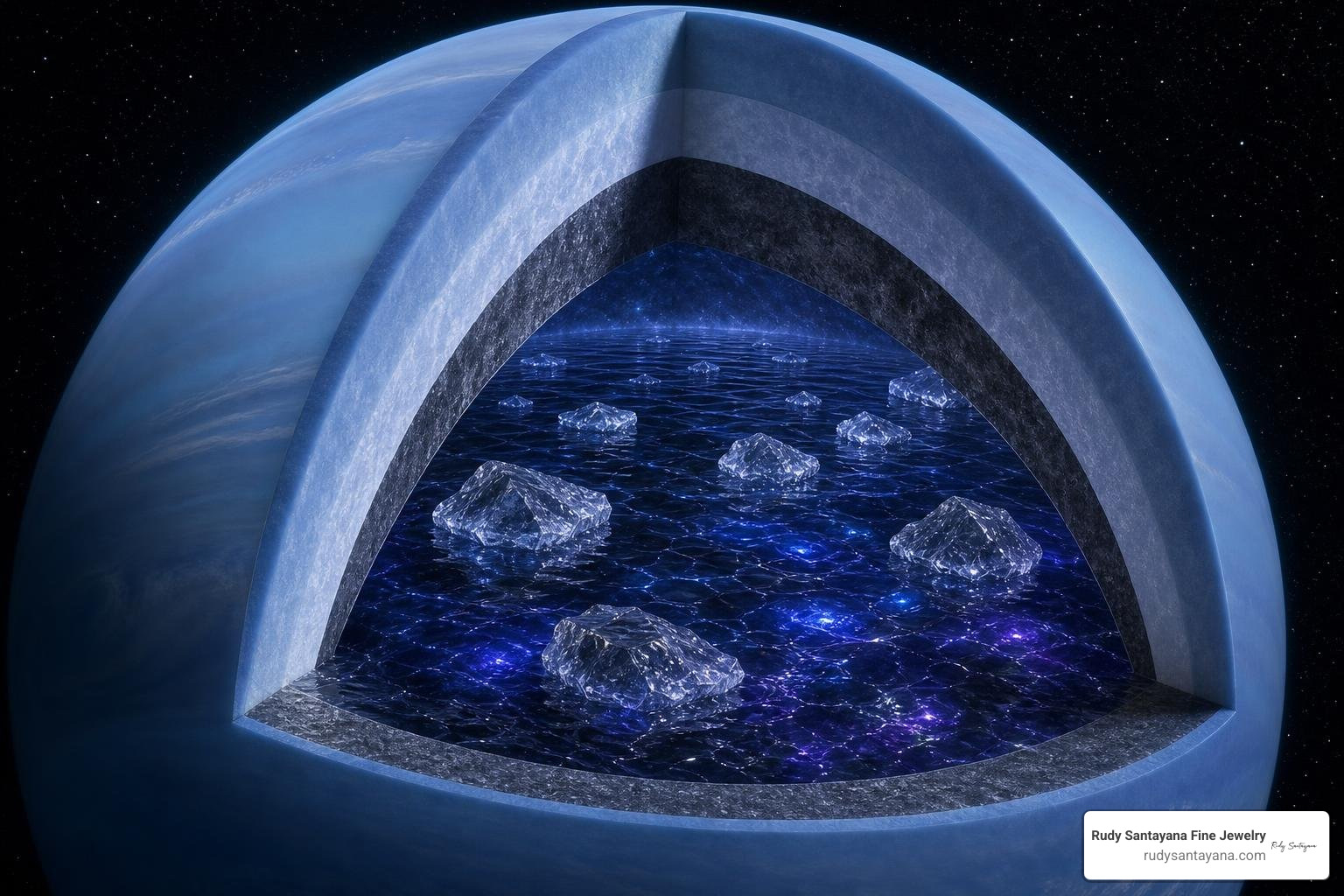
This metallic liquid phase of carbon is of immense interest to planetary scientists. It is highly suspected that the ice giant planets in our solar system, such as Uranus and Neptune, contain massive amounts of pure carbon (estimated at 11% to 17% of their total mass). Deep within these planets, the extreme temperatures and pressures are perfect for creating liquid carbon. Some planetary models even suggest that these planets have vast, swirling oceans of liquid metallic carbon, complete with solid "diamond icebergs" floating on top!
Additionally, studying how diamond behaves when it melts is crucial for the development of clean energy. In inertial confinement fusion experiments, high-density carbon (diamond) is used as an ablator material to encase the hydrogen fuel. Understanding the precise melting point and phase transitions of the diamond shell helps scientists design more efficient fusion targets, as discussed in the study on the Melting temperature of diamond and cubic boron nitride at 15 gigapascals .
Frequently Asked Questions About Diamond Melting
Is diamond the substance with the highest melting point in nature?
While diamond has an incredibly high melting point, it is often compared to other superhard synthetic materials. In 2019, researchers compared the melting point of diamond to cubic boron nitride (cBN) at a static pressure of 15 GPa.
Under these conditions, cubic boron nitride was measured to melt at 5689 ± 411 Kelvin, while diamond melted at 5968 ± 457 Kelvin. This confirms that diamond holds the crown for the highest melting point of any natural substance. To explore the comparative physics of these superhard materials, you can read the classic paper on the Melting of Diamond | Science .
Can you melt small diamonds together to make a larger one?
It is a common question: if you have a handful of cheap, tiny industrial diamonds, can you just melt them down and cast them into a single, massive, sparkling gem-quality diamond?
Unfortunately, no. Because carbon requires such extreme pressures to remain in a solid diamond state or transition to a liquid, you cannot simply "melt and pour" diamonds like gold or silver. If you heated them up to melt them, they would turn into graphite or burn.
While the High-Pressure High-Temperature (HPHT) process is used to grow synthetic diamonds in a lab, this process involves dissolving carbon in a molten metal catalyst (like iron or nickel) at high pressures and allowing it to precipitate onto a seed crystal. It is not a matter of melting diamonds together, and doing so would not be economically profitable or physically feasible for creating large gems.
What does a burning diamond look like compared to a melting one?
A burning diamond does not melt. In the presence of oxygen, a diamond heated past 900 °C will begin to glow red, then bright white. Instead of liquefying, it will slowly shrink in size as the surface carbon atoms react with oxygen and float away as invisible carbon dioxide gas. A melting diamond, which can only exist under millions of atmospheres of pressure in a laboratory shockwave, turns into a highly reflective, metallic liquid fluid before rapidly vaporizing or solidifying back into graphite or nanocrystalline diamond as the pressure drops.
Conclusion
At the end of the day, the answer to can diamond melt is a resounding yes—but it requires the kind of extreme physics found in planetary cores or advanced laser fusion laboratories. On the surface of the Earth, your diamond is safe from melting in any fire, lava flow, or acid bath you could ever throw at it.
At Rudy Santayana Fine Jewelry in Coral Gables and Miami, Florida, we celebrate this incredible, cosmic resilience. We specialize in crafting custom, handcrafted jewelry designs that showcase the natural beauty and unmatched durability of these extraordinary gemstones. While you won't be melting diamonds in your backyard, we can certainly help you shape them into breathtaking, custom-designed heirlooms that will truly last forever.
If you are ready to begin your custom jewelry journey or want to learn more about the fascinating properties of these precious stones, explore our guide on Can You Melt Diamonds or contact us today to schedule a consultation at our Coral Gables showroom.