The Ultimate Guide to Diamond Melting Points and Cutting Durability
Why Diamond Melting Point Cutting Durability Is Worth Understanding
Diamond melting point cutting performance is one of the most misunderstood topics in material science — and it matters whether you're a manufacturer choosing industrial tools or a jewelry lover curious about what makes diamonds so extraordinary.
Here's a quick answer to what most people want to know:
| Property | Diamond Value |
|---|---|
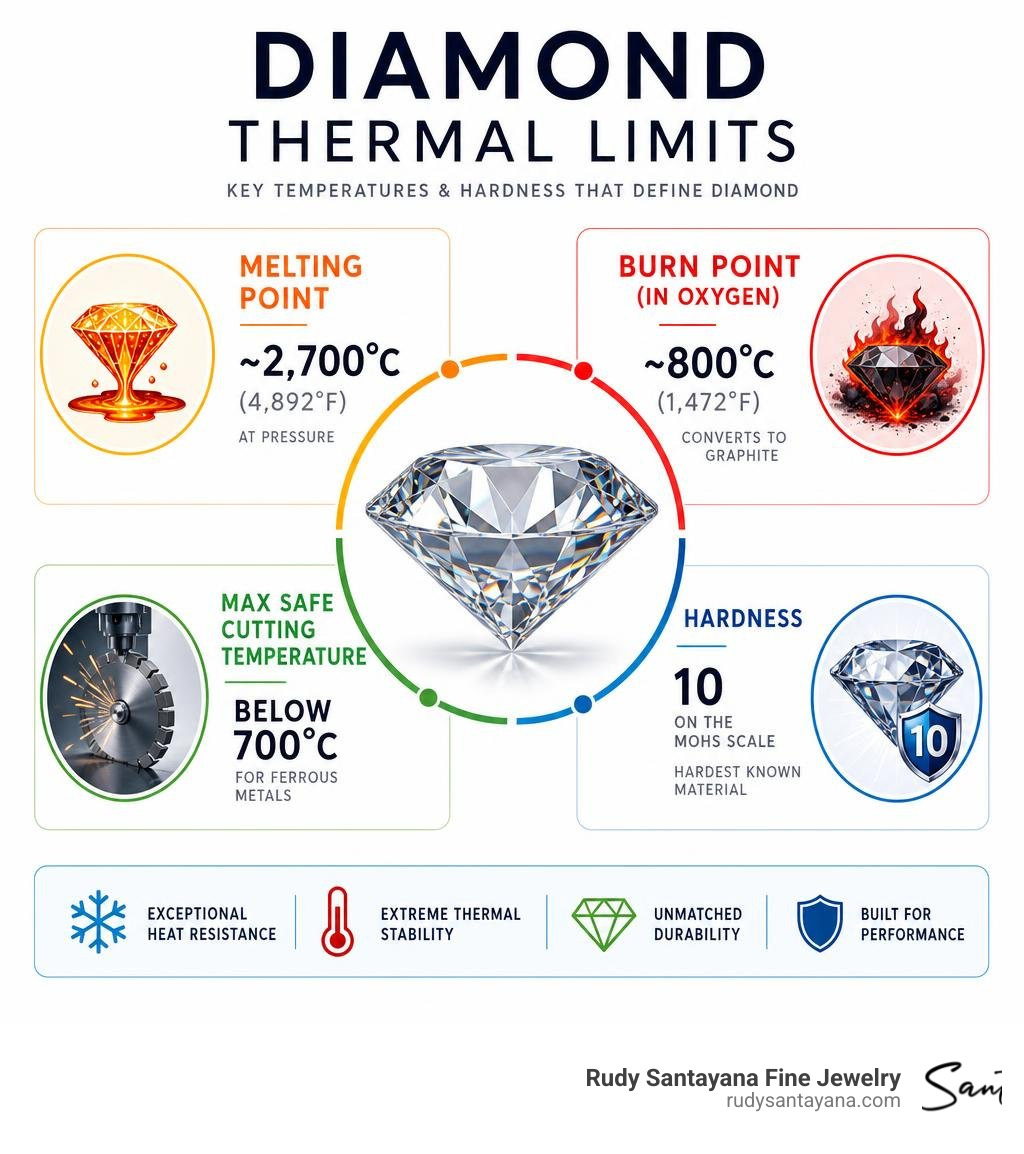
| Melting point (at pressure) | ~2,700°C (4,892°F) |
| Burns/graphitizes in oxygen | ~800°C (1,472°F) |
| Mohs hardness | 10 (hardest known material) |
| Thermal conductivity | 5× better than copper |
| Max safe cutting temp (ferrous metals) | Below 700°C |
| Melting point at 15 GPa pressure | ~5,968 K (~5,695°C) |
The short version: diamond does not melt under normal conditions. Heat it in open air and it converts to graphite — or simply burns — long before it ever becomes liquid. Reaching true liquid diamond requires pressures hundreds of thousands of times greater than atmospheric pressure.
That extreme resistance to heat is exactly what makes diamond such a powerful cutting material. But it also comes with real limits, especially when cutting ferrous metals like steel.
I'm Rudy Santayana, a fine jewelry designer based in Miami with deep expertise in how diamond melting point cutting properties shape both industrial applications and the art of custom gemstone work. Understanding these thermal boundaries has been central to my craft — and it will help you make smarter decisions about diamonds, whether in a machine shop or a jewelry setting.
The Science of Diamond Melting Points and Phase Transitions
To understand why a diamond acts the way it does under intense heat, we have to look at the carbon phase diagram. Carbon is a master of disguise. It can exist as soft, slippery graphite (like the lead in your pencil) or as the hardest natural substance on Earth (diamond).
At standard room temperature and atmospheric pressure, diamond is actually thermodynamically unstable. It is slowly—imperceptibly—trying to turn back into graphite. Fortunately for our engagement rings, this process takes billions of years under normal conditions. However, when you add extreme heat to the mix, this transition accelerates dramatically.
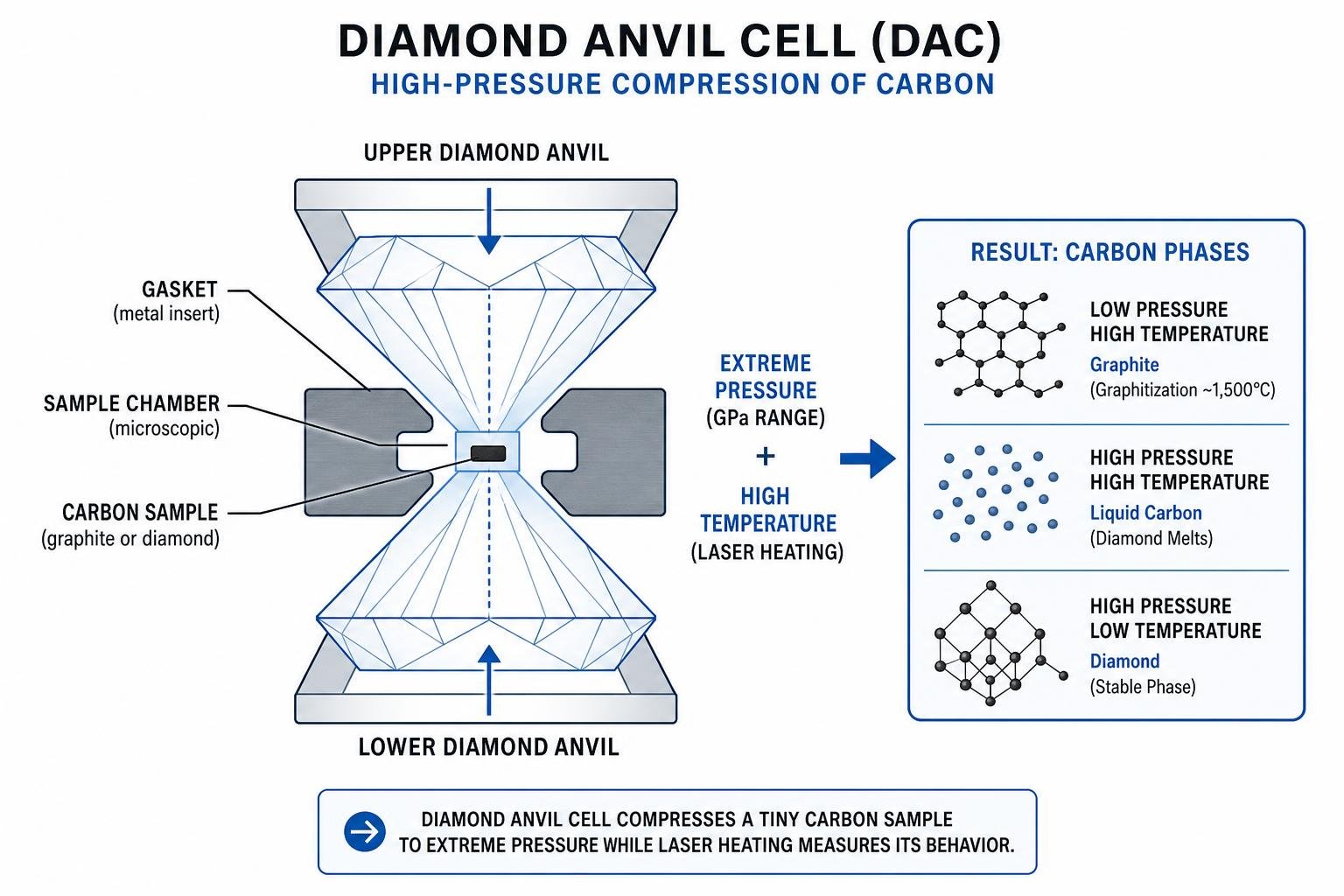
If you heat a diamond in the presence of oxygen at standard atmospheric pressure, it will not melt. Instead, it will start to combine with oxygen and burn, turning into carbon dioxide gas at around 800°C (1,472°F). If you heat it in an oxygen-free vacuum, it bypasses the liquid state entirely and undergoes graphitization—turning directly into graphite—at around 1,500°C.
To actually melt a diamond into a liquid carbon state, you must subject it to astronomical amounts of pressure alongside intense heat. This behavior is detailed in classic research such as the Melting of Diamond | Science paper, which outlines how carbon transitions between solid and liquid phases under extreme geological and laboratory environments.
Measuring the Melting Point of Diamond Under Extreme Pressure
Because diamonds require such extreme environments to melt, measuring their true melting point is a massive challenge for modern physics. How do you heat a substance hotter than the surface of the sun while squeezing it with the force of a tectonic plate collision?
Scientists overcome this obstacle using a combination of a multi-anvil press or a diamond anvil cell (DAC) and high-powered lasers. However, there is a catch: diamond is optically transparent. If you shine a standard laser through a diamond, the light passes right through it without heating it up.
To solve this, researchers use clever workarounds. In a landmark study published in Phys. Rev. Research 1, 033090 (2019), scientists utilized a specialized flash-heating method within a multi-anvil press. They placed the diamond in contact with a highly conductive graphite heater. By passing a massive electrical current through the graphite, they generated a rapid burst of heat that transferred to the diamond, successfully melting it at a static pressure of 15 gigapascals (GPa).
The experimental melting temperature of diamond at 15 GPa was measured to be an incredible 5,968 ± 457 Kelvin (approximately 5,695°C). This was nearly 1,000 K higher than previous theoretical computer models had predicted! The primary evidence that the diamond had actually melted was the discovery of nanocrystallized diamond structures upon cooling, proving the carbon had transitioned from solid to liquid and back to solid.
How Pressure Shifts the Diamond Melting Point Cutting Threshold
As pressure increases, the behavior of diamond changes in ways that surprise even experienced material scientists. For most materials, squeezing them makes them harder to melt (a positive melting curve slope). However, carbon behaves quite uniquely.
At the graphite-diamond-liquid (GDL) triple point—which occurs at roughly 13 GPa of pressure and 4,000 Kelvin—solid graphite, solid diamond, and liquid carbon can coexist in perfect equilibrium. Beyond this point, up to about 50 GPa, researchers have discovered that the melting curve of diamond actually has a negative slope (a negative Clapeyron slope). This means that within this specific high-pressure window, diamond actually melts at lower temperatures as the pressure increases.
This fascinating phenomenon is detailed in the study Melting diamond in the diamond cell by laser-flash heating, which corrected decades of thermodynamic assumptions by proving that liquid carbon is actually denser than solid diamond in this pressure regime.
However, when you push the pressure even higher—into the realm of shock compression experiments simulating the cores of giant gas planets like Uranus and Neptune—the trend reverses. According to the research paper Melting temperature of diamond at ultrahigh pressure, shock compression experiments at pressures of 0.6 to 1.1 terapascals (TPa)—which is 6 to 11 million times Earth's atmospheric pressure—reveal that diamond melts at approximately 9,000 Kelvin.
Furthermore, another core study on the Melting of Diamond at High Pressure | Science highlights how the structural and bonding properties of liquid carbon vary dramatically with pressure, matching the complexity of solid carbon's transitions.
Why Diamond Melting Point Cutting Durability Matters in Industrial Applications
While planetary physics is fascinating, the extreme thermal properties of diamond have highly practical, everyday applications right here on Earth. In the manufacturing and heavy industries, diamond is the undisputed king of cutting, drilling, and grinding.
Diamonds are rated as a perfect 10 on the Mohs hardness scale. This extreme hardness allows diamond-tipped tools to easily scratch and cut through tungsten, which is the toughest known metal with a Mohs rating of 9.5.
However, hardness is only half the battle. When a industrial saw blade cuts through concrete, or a drill bit bores miles into the Earth's crust, the friction generates immense localized heat. If the cutting material has a low melting point or poor thermal stability, the cutting edge will soften, deform, and fail almost instantly. This is where diamond's high thermal thresholds and structural durability become critical.
| Material | Mohs Hardness | Melting Point / Thermal Limit | Key Strength | Primary Weakness |
|---|---|---|---|---|
| Diamond | 10 | ~2,700°C (At pressure) / 700°C (In air) | Ultimate hardness, highest thermal conductivity | Reacts with iron (ferrous metals) |
| Cubic Boron Nitride (CBN) | 9.5 | ~2,973°C (Decomposes) / 1,400°C (In air) | Chemically inert with iron, high thermal stability | Lower hardness than diamond |
| Tungsten Carbide | 9.0 | ~2,870°C | High toughness, shock absorption | Lower wear resistance at extreme speeds |
Thermal Conductivity and Overheating Prevention
One of the most remarkable unsung properties of diamond is its thermal conductivity. Diamond is one of the best thermal conductors on Earth—performing roughly five times better than copper.
When a diamond cutting tool makes contact with a workpiece, the friction generates intense heat at the microscopic interface. Because diamond conducts heat so rapidly, it acts as a highly efficient thermal shield. Instead of allowing the heat to build up at the delicate cutting edge (which would cause the tool to degrade), the diamond quickly pulls the heat away from the point of contact and dissipates it into the tool body and surrounding coolant. This rapid heat diffusion prevents the cutting edge from overheating, preserving its sharpness and structural integrity over long production runs.
Comparing Diamond to CBN and Tungsten Carbide
To appreciate diamond's dominance, we must compare it to its closest rivals: Cubic Boron Nitride (CBN) and Tungsten Carbide.
Tungsten Carbide is the workhorse of the machining industry. It is incredibly tough and acts as an excellent shock absorber, making it ideal for the main body of cutting tools. However, it lacks the extreme hardness and wear resistance of diamond, meaning it wears down much faster when cutting highly abrasive materials.
Cubic Boron Nitride (CBN) is the second-hardest material known to science, ranking just below diamond. While CBN is slightly softer than diamond, it possesses a massive advantage: superior thermal stability in oxygen. CBN can withstand temperatures up to 1,400°C in open air before oxidizing, and it does not react with iron. This makes CBN the preferred choice for high-speed machining of hard steels, whereas diamond remains the ultimate choice for non-ferrous materials.
Cutting Non-Ferrous Metals and Composites
Because of its extreme hardness and rapid heat dissipation, diamond is highly effective at cutting non-ferrous metals (such as aluminum, brass, and copper), geological stone, and modern advanced composites.
In industries like aerospace and automotive manufacturing, materials like Carbon Fiber Reinforced Polymers (CFRP) are highly favored for their strength-to-weight ratio. However, carbon fiber is incredibly abrasive and will dull standard steel or carbide tools in a matter of minutes.
Using diamond-tipped tools allows manufacturers to cut through abrasive composites and high-silicon aluminum alloys with extreme precision. The diamond edge maintains its razor-sharp profile without developing flat wear spots, ensuring perfect dimensional accuracy and a flawless surface finish.
Thermal Degradation and Practical Limits of Diamond Tools
Despite its near-mythical reputation, diamond is not invincible. In industrial machining, engineers must work within strict thermal and chemical boundaries to prevent diamond tools from failing prematurely.
The Ferrous Metal Problem: Why Diamond Cannot Cut Steel
If diamond is the hardest material on Earth, why can't we use it to cut steel? This is one of the most famous paradoxes in manufacturing.
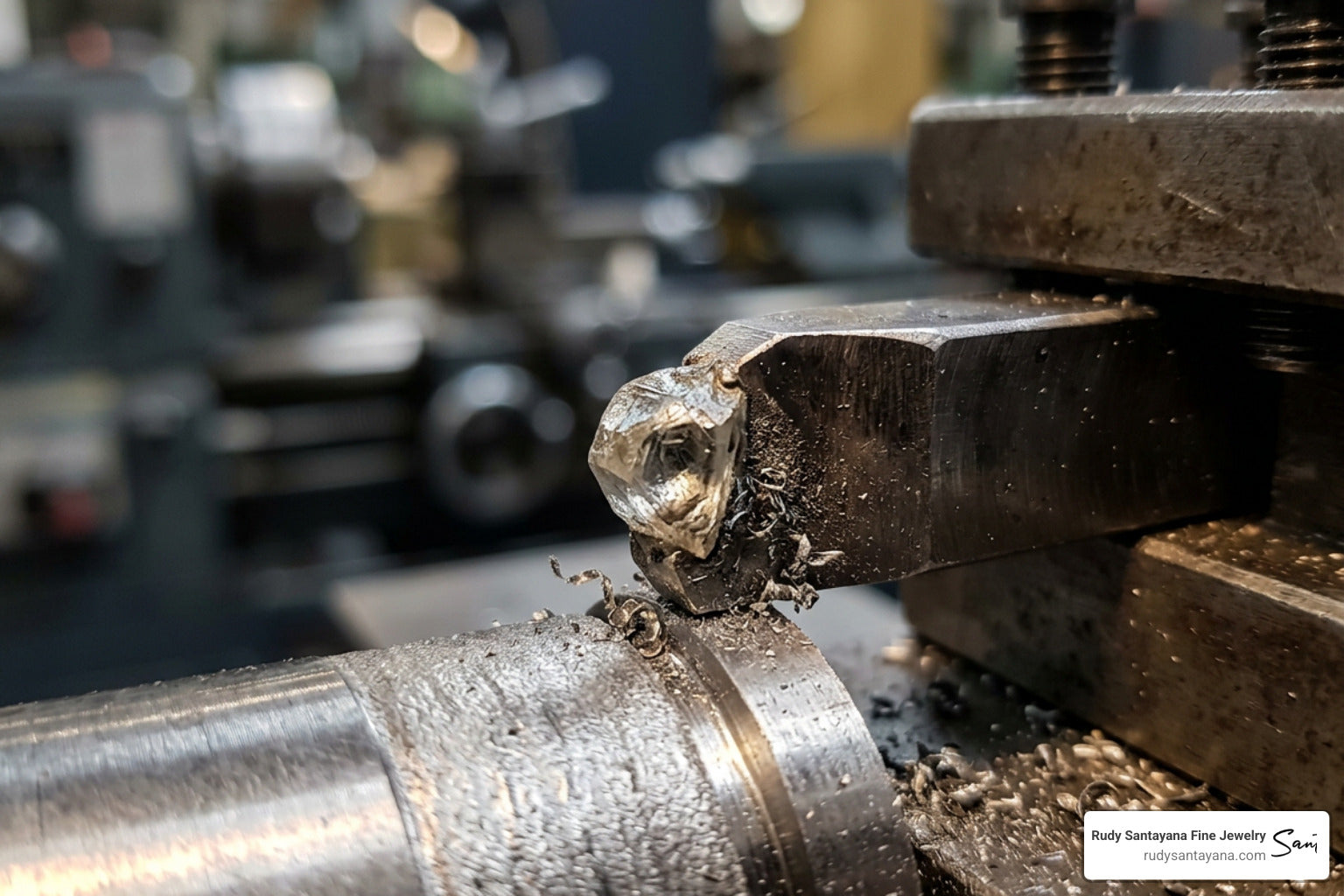
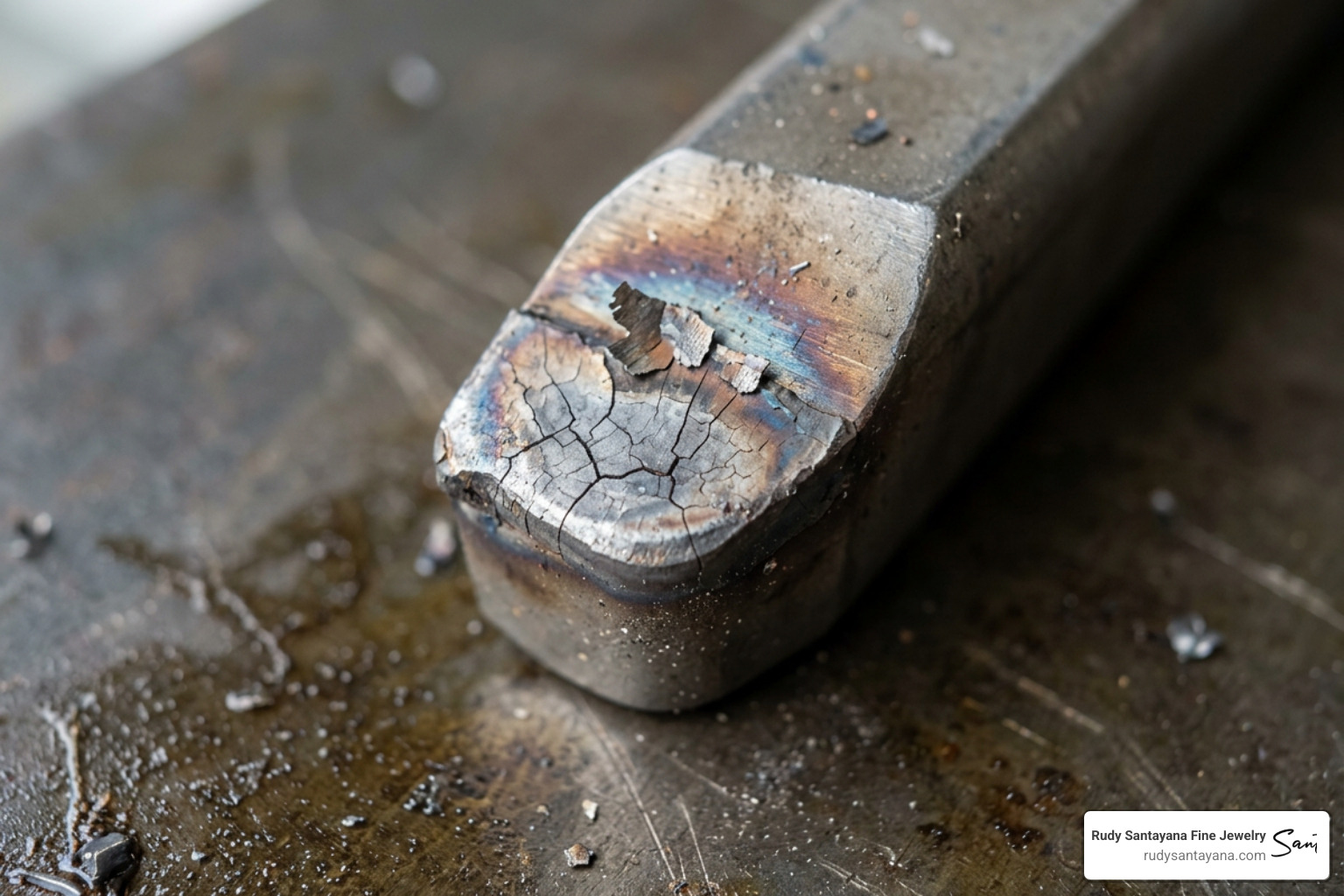
The answer lies in chemistry, not hardness. Steel and cast iron are ferrous metals, meaning they are primarily composed of iron. At elevated temperatures—specifically above 700°C (1,292°F)—the carbon atoms in the diamond develop a strong chemical affinity for the iron atoms in the workpiece.
Under the intense heat and pressure of high-speed cutting, a chemical reaction occurs: the carbon atoms in the diamond migrate and dissolve into the iron, forming Iron Carbide ($Fe_3C$). This chemical reaction causes the diamond's rigid, three-dimensional crystal lattice to collapse. Essentially, the diamond tool chemically dissolves into the steel, leading to rapid wear, structural cratering, and immediate tool failure. For this reason, machinists must use CBN or carbide tools when working with ferrous metals.
Synthetic Diamonds (PCD, MCD, CVD) and Their Thermal Properties
To optimize diamond for different cutting applications, the industry utilizes three main types of synthetic diamond, each with unique thermal and structural characteristics:
- Polycrystalline Diamond (PCD): PCD is the industry workhorse. It is made by sintering together thousands of microscopic diamond particles (ranging from 2 to 30 microns) with a metal binder—usually cobalt—under extreme high-pressure, high-temperature (HPHT) conditions. PCD is incredibly tough because its randomly oriented crystals prevent cracks from propagating. However, because it contains about 5% cobalt binder, its thermal limit is lower (around 700°C), as the cobalt can cause thermal expansion and microcracking at high temperatures.
- Monocrystalline Diamond (MCD): MCD consists of a single, continuous diamond crystal. Because it has no grain boundaries, it can be polished to an incredibly sharp, flawless edge, making it the premier choice for ultra-precision "mirror-finish" machining (such as finishing aluminum computer hard drive platters). However, because it is a single crystal, it is more brittle than PCD and can cleave if subjected to heavy impacts or vibrations.
- Chemical Vapor Deposition (CVD) Diamond: CVD diamond is grown atom-by-atom in a vacuum chamber, creating a pure, binder-free diamond coating on a tungsten carbide substrate. Because CVD diamond contains no metallic binders like cobalt, it is chemically inert and exhibits superior thermal conductivity and wear resistance compared to PCD, making it highly effective for machining extremely abrasive non-metallic materials like graphite.
Practical Temperature Limits and Graphitization
In practical industrial applications, the real-world temperature limits of diamond tools depend heavily on the cutting environment:
- In the presence of oxygen: Diamond tools should not exceed 700°C to 800°C. Beyond this point, the diamond will begin to oxidize (burn), rapidly degrading the cutting edge.
- In an inert gas or vacuum environment: Diamond can safely operate up to 1,400°C to 1,500°C before graphitization begins to compromise its structural integrity.
To maximize tool life, industrial operations utilize high-pressure flood cooling or minimum quantity lubrication (MQL) systems to keep the cutting zone well below these critical thermal thresholds.
Laser Processing and Diamond Melting Point Cutting Techniques
Because diamonds are so hard, cutting and shaping them into finished gemstones or industrial tool blanks is a highly specialized craft. Historically, this was done by rubbing diamonds against other diamonds using abrasive powders—a slow, labor-intensive process.
Today, the industry relies heavily on advanced laser cutting systems. Rather than trying to melt the diamond, lasers utilize localized thermal energy to vaporize or graphitize the carbon along a highly precise path.
According to the comprehensive study Characterization of laser processing of single-crystal natural diamonds using micro-Raman spectroscopic investigations, the choice of laser parameters is critical. The research compared several laser setups and found that Q-switched Nd:YAG and diode-pumped solid-state lasers are superior for processing natural diamonds. They offer the lowest breakage rates, minimal weight loss, and excellent surface finishes.
The laser energy induces a localized phase transformation, converting the diamond's outer layer into graphite, which can then be easily cleaned away. Using micro-Raman spectroscopy, scientists can analyze the cut surfaces to ensure no microcracking or unwanted structural damage has occurred during the process.
Frequently Asked Questions about Diamond Melting and Cutting
Can you melt a diamond at normal atmospheric pressure?
No, you cannot melt a diamond at normal atmospheric pressure. If you heat a diamond in the open air, it will react with oxygen and burn into carbon dioxide gas at around 800°C. If you heat it in a vacuum, it will undergo a phase transition called graphitization—turning directly into solid graphite—at around 1,500°C without ever turning into a liquid. To achieve a true liquid state, you must apply pressures exceeding 120,000 atmospheres (12 GPa) alongside extreme heat.
Why do diamond tools fail when cutting steel?
Diamond tools fail when cutting steel because of a high-temperature chemical reaction between carbon and iron. At cutting temperatures above 700°C, the carbon atoms in the diamond rapidly dissolve into the iron of the steel to form Iron Carbide ($Fe_3C$). This chemical diffusion causes the diamond's crystal structure to collapse, leading to rapid wear and immediate tool failure.
What is the difference between PCD and CVD diamond tools?
Polycrystalline Diamond (PCD) tools consist of microscopic diamond particles fused together with a metallic cobalt binder (about 5% cobalt). This makes them highly resistant to impact but limits their thermal threshold due to the cobalt's expansion. Chemical Vapor Deposition (CVD) diamond tools feature a pure, binder-free diamond coating grown directly on a carbide substrate. Because CVD diamond is 100% pure carbon, it has higher thermal conductivity, greater chemical inertness, and superior wear resistance compared to PCD.
Conclusion
The science of diamond melting point cutting dynamics reveals a fascinating truth: the very properties that make diamonds the ultimate symbol of enduring love also make them the ultimate tool for heavy industry. From the extreme physics of planetary cores to the high-speed precision of modern manufacturing, diamond's relationship with heat and pressure is truly extraordinary.
While we don't melt diamonds in our workshop—which, as science shows, would only leave us with a very expensive pile of pencil lead—we do understand how to harness their incredible physical properties. At Rudy Santayana Fine Jewelry, located in the heart of Coral Gables and serving the greater Miami area, we combine state-of-the-art precision cutting techniques with master craftsmanship to shape these resilient gemstones into breathtaking, custom-designed works of art.
Whether you are looking to design a bespoke engagement ring or want to learn more about the incredible durability of these natural wonders, we invite you to explore our custom design process. To dive deeper into the science of carbon phases, check out our detailed guide on Can You Melt Diamonds? or visit us today in Coral Gables to experience the brilliant beauty of masterfully cut diamonds firsthand.