Finding Your Dream 2 Carat Oval Lab Grown Diamond Ring on a Budget
Why Choose a 2 Carat Oval Lab Grown Diamond Ring?
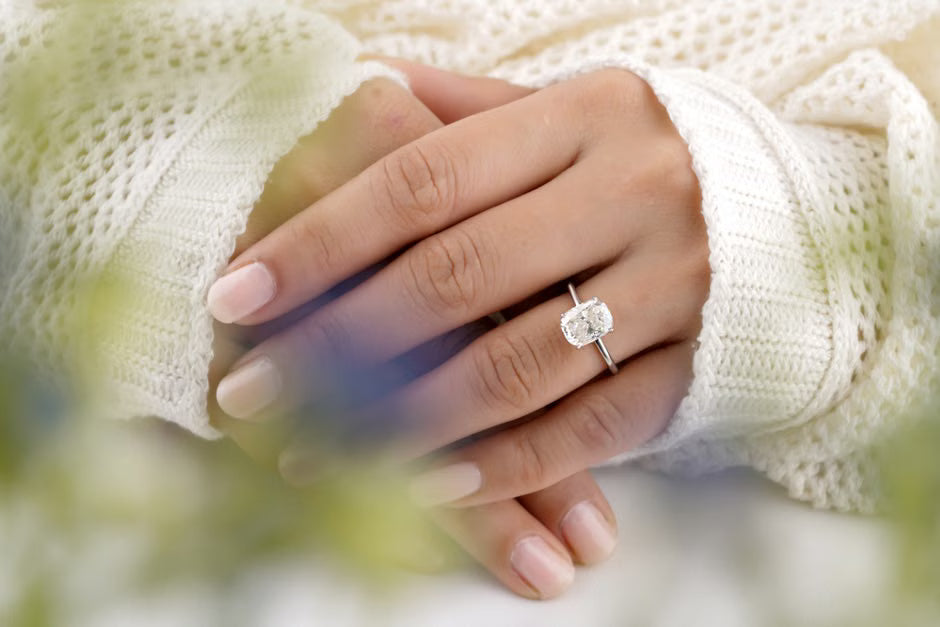
Finding the ideal 2 carat oval lab grown diamond ring on a budget comes down to targeting the sweet spot of value: choose an eye-clean VS1–VS2 clarity, an F–G near-colorless grade, and a balanced 1.35–1.50 length-to-width ratio. Opting for a Lab Diamond Engagement Ring delivers 70% to 85% savings compared to mined diamonds while providing 10% to 15% greater face-up surface area than a round cut of identical weight. This allows you to maximize finger coverage, optical brilliance, and budget without sacrificing quality.
From an ethical and environmental perspective, lab-grown gems provide complete transparency. Created inside advanced laboratories using Chemical Vapor Deposition (CVD) or High Pressure High Temperature (HPHT) processes, these diamonds replicate the earth's natural growth environment over weeks rather than billions of years. This eliminates large-scale earth displacement and heavy mining machinery, resulting in a cleaner footprint and fully traceable origin.
The cost advantage allows you to secure a striking, high-grade two-carat center stone for a fraction of the price, freeing up your budget to invest more into handcrafted metals, intricate side stones, or even a memorable honeymoon.
Maximizing Brilliance with a 2 Carat Oval Lab Grown Diamond Ring
There is a common misconception that lab diamonds are mere imitations or cubic zirconias. In reality, lab-grown diamonds share the exact chemical composition, crystalline structure, and physical properties of mined stones. They register a 10 on the Mohs hardness scale, making them the hardest substance known and perfectly suited for daily wear.
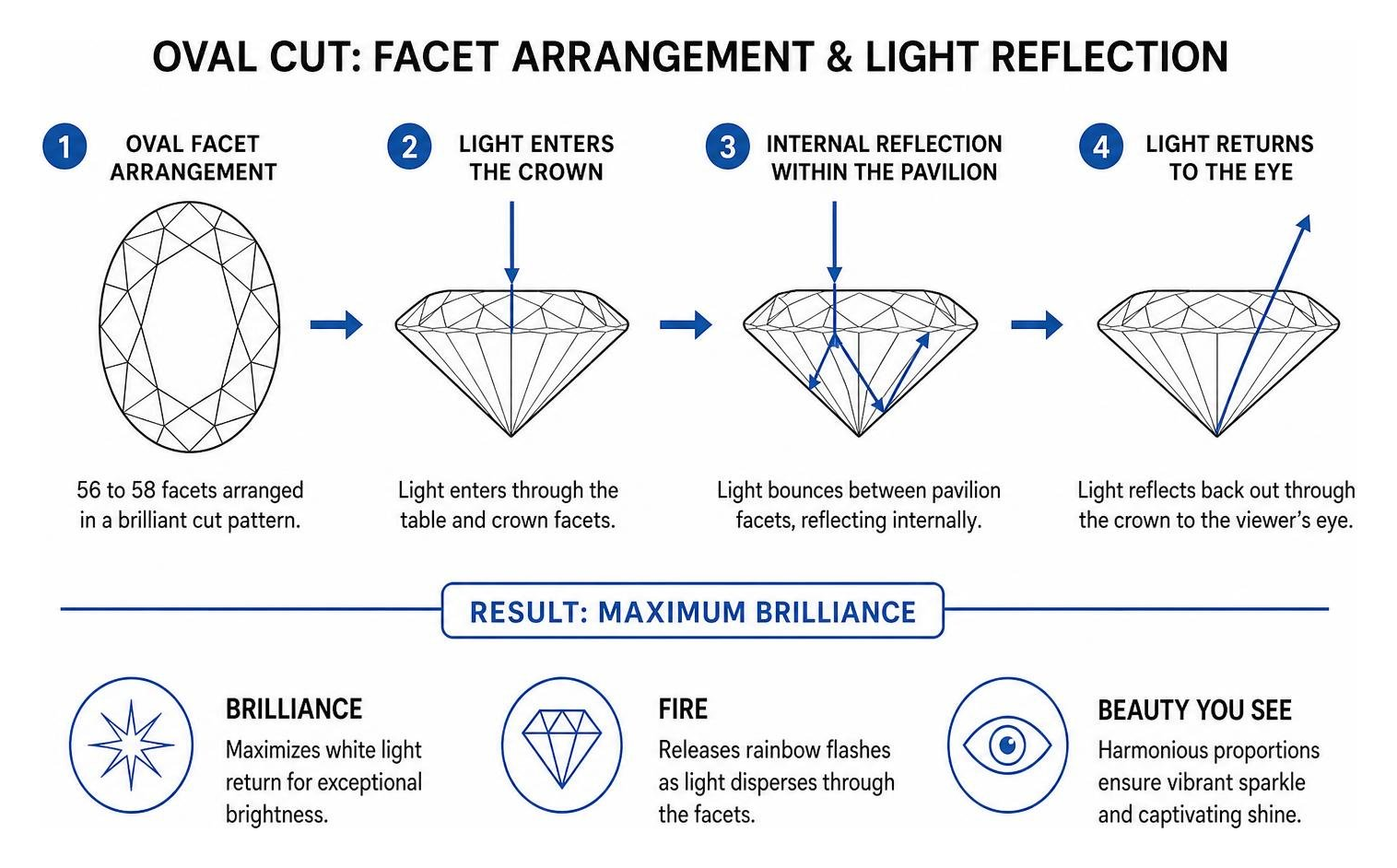
An oval cut diamond features 56 to 58 carefully aligned facets that mirror the brilliant cutting style of a round diamond. This arrangement maximizes light return, throwing off vibrant flashes of white sparkle (brilliance) and rainbow reflections (fire). When an oval is cut with harmonious proportions, light enters the crown, bounces internally between the pavilion facets, and reflects back to the viewer's eye with exceptional fire.
Visual Size and Finger Coverage Compared to Other Cuts
One of the greatest benefits of the oval shape is its generous surface area. Because of its elongated profile, an oval cut distributes more of its total carat weight across the top surface (table) rather than hiding it in the depth (pavilion).
This geometry allows a two-carat oval diamond to appear approximately 10% to 15% larger face-up than a traditional round brilliant cut of identical carat weight. The vertical elongation also creates a slimming, lengthening effect on the wearer's finger. For those searching for an Oval Engagement Ring in Coral Gables FL, this combination of generous finger coverage, elegant lines, and high-energy sparkle makes the oval an undeniably flattering choice.
Evaluating Cut, Color, and Clarity on a Budget
When shopping for an oval diamond on a budget, knowing where to focus your dollars makes all the difference. Unlike round brilliant diamonds, gemological laboratories do not issue a single standardized cut grade for oval diamonds. Therefore, evaluating proportions requires understanding key dimensions. For in-depth purchasing advice, our Lab Diamond Ring Buying Guide breaks down how each attribute impacts visual presence.
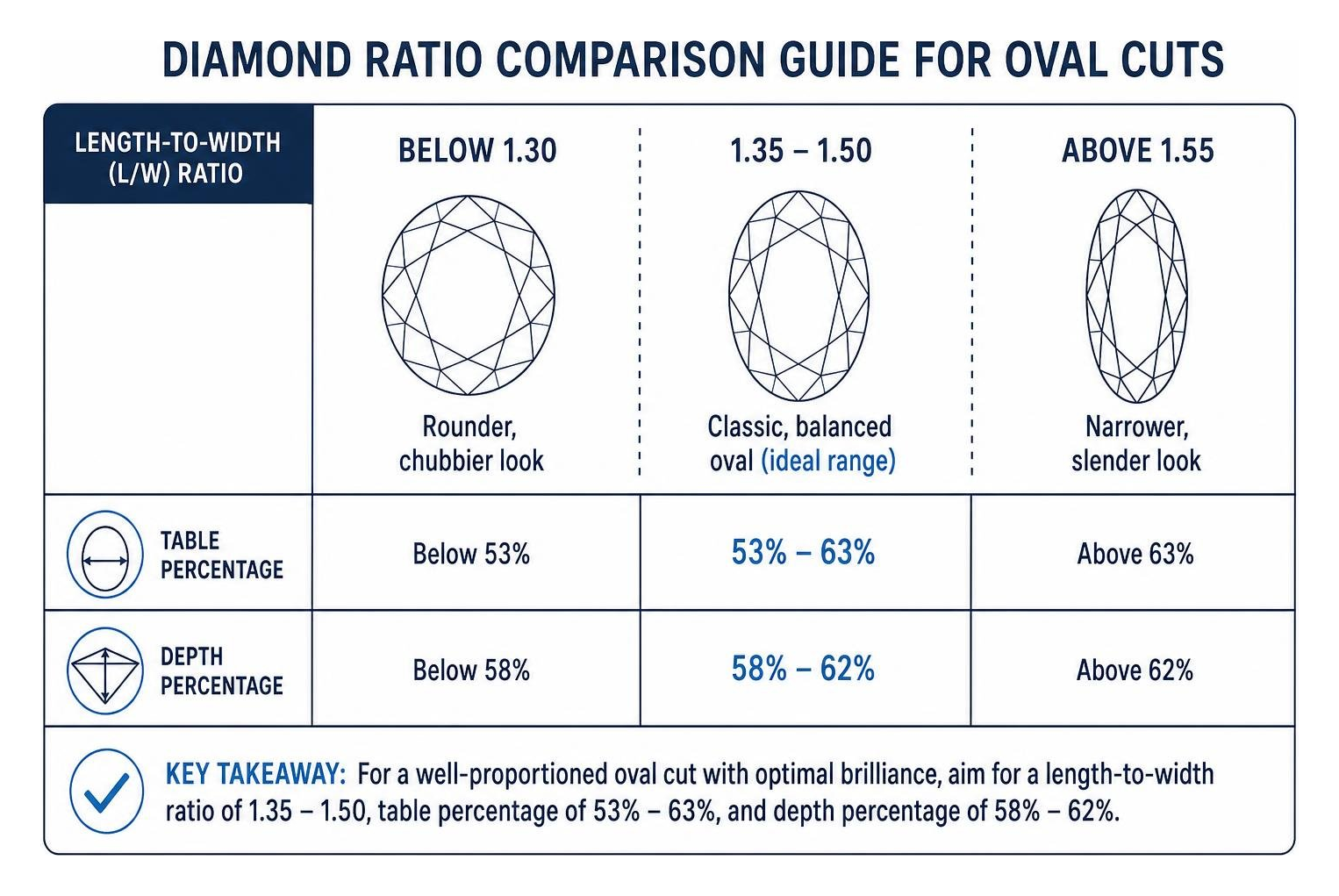
For a classic, balanced oval, aim for a length-to-width (L/W) ratio between 1.35 and 1.50. A ratio below 1.30 looks rounder and chubbier, while a ratio above 1.55 appears narrow and slender. Keep table percentages between 53% and 63%, with overall depth percentages between 58% and 62% to maintain proper light dispersion.
Avoiding the Bow-Tie Effect and Ensuring Sparkle
Every oval diamond exhibits some degree of a "bow-tie" effect—a dark, bowtie-shaped shadow running across the center width of the stone. This phenomenon occurs because light passing through the center can cast a shadow from the viewer's head.
- Subtle Bow-Tie: A faint shadow that transitions smoothly into bright sparkle as the stone moves is normal and provides contrast.
- Severe Bow-Tie: A solid, dark obstruction that remains visible across all lighting conditions indicates poor facet alignment and deep angles that trap light.
To avoid a distracting bow-tie, ensure the diamond's pavilion angles are neither too steep nor too shallow. Evaluating stones in multiple lighting environments helps verify that center facets bounce light actively rather than staying dormant.
Choosing the Ideal Color and Clarity Sweet Spot
Because oval diamonds reflect light across a spread-out surface, they can reveal body color and inclusions more readily than round stones. However, you do not need to pay for flawless clarity or completely colorless grades to enjoy an exquisite center stone. Review our Engagement Rings Ultimate Guide 2026 for deeper color pairing frameworks.
- Color: The sweet spot is F to G. These stones face up pure white to the naked eye. If you plan to set your stone in yellow or rose gold, you can comfortably drop to an H or I grade because the warmer metal naturally complements subtle undertones.
- Clarity: A VS1 or VS2 clarity grade offers peak value. At this level, inclusions are microscopic and completely invisible without 10x magnification. Opting for a VVS or Flawless grade adds cost without noticeable visual improvements.
Best Settings and Metal Types for Oval Diamonds
The setting of your ring serves two essential purposes: protecting your center stone and framing its silhouette. A stunning Oval Cut Lab Diamond Ring requires precise craftwork to keep the elongated edges secure against everyday wear.
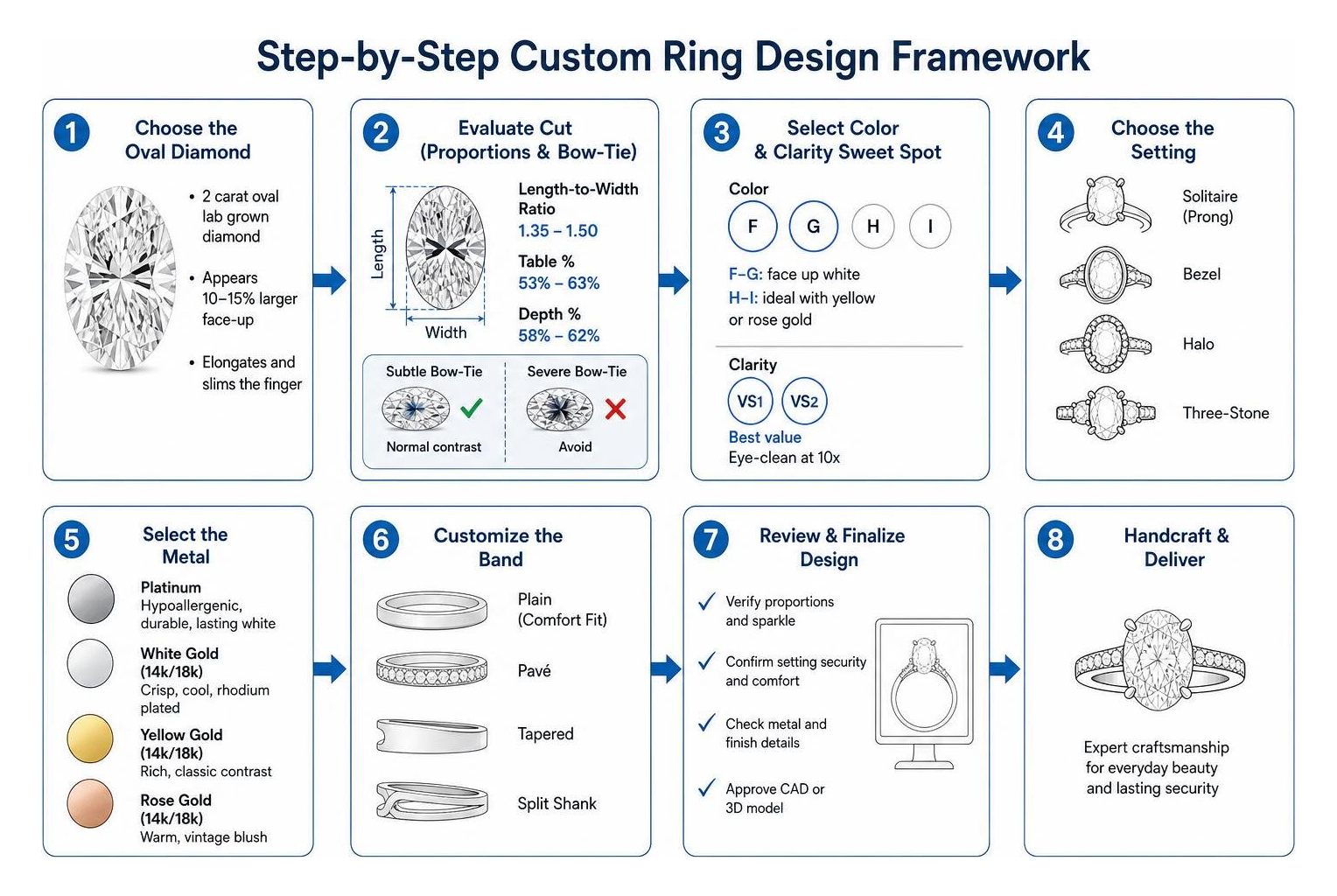
Platinum and 14k or 18k gold remain the gold standards in fine jewelry:
- Platinum: Naturally hypoallergenic, dense, and exceptionally durable. Its silvery-white sheen never fades, making it ideal for holding center prongs secure.
- 14k/18k White Gold: Offers a crisp, cool aesthetic that matches platinum visually, finished with rhodium plating for added shine.
- 14k/18k Yellow Gold: Provides a rich, classic contrast against bright white lab diamonds.
- 14k/18k Rose Gold: Delivers a warm, vintage-inspired blush tone that highlights unique design elements.
Selecting the Best Metal and Setting for a 2 Carat Oval Lab Grown Diamond Ring
The way an oval diamond is set can completely alter its aesthetic personality.
- Four-Prong vs. Six-Prong Solitaire: Four prongs leave more diamond visible, giving a modern, airy feel. Six prongs provide enhanced mechanical security and accentuate the curved outline.
- Hidden Halo: Micro-pavé diamonds sit just beneath the main stone's girdle, offering a subtle flash of brilliance from side profiles without cluttering the top view.
- Bezel Setting: A fine metal rim wraps entirely around the perimeter. This provides maximum protection against bumps, making it an outstanding choice for active lifestyles.
| Setting Style | Best Paired Metal | Visual Benefit | Price Range (Setting Only) |
|---|---|---|---|
| Classic Solitaire (4 or 6 Prong) | Platinum / 14k Gold | Minimalist, keeps full focus on diamond size | $800 – $1,400 |
| Hidden Halo Solitaire | 14k or 18k Two-Tone Gold | Delicate sparkle visible from side profiles | $1,100 – $1,800 |
| Pavé Band Setting | Platinum / 18k White Gold | Amplifies overall hand brilliance | $1,400 – $2,300 |
| Full or Half Bezel | 14k Yellow Gold / Platinum | Ultra-secure, modern architectural silhouette | $1,200 – $2,000 |
Ring Care and Long-Term Maintenance
Even though diamonds are exceptionally hard, daily wear leaves behind residues of lotion, hand soap, and natural skin oils that cloud light reflection.
- Home Cleaning: Soak the ring in warm water mixed with a few drops of mild dish soap for 15 minutes. Gently scrub under the table and around the prongs using an extra-soft toothbrush, rinse with clean warm water, and dry with a lint-free cloth.
- Professional Care: Bring your ring into our workshop every six to twelve months. We inspect prong tension, check for stone shifting, and provide professional ultrasonic cleaning and polishing.
Price Trends, Value, and Certification in 2026
The market for lab-grown diamonds has matured significantly, with the global sector projected to reach nearly $50 billion by 2030. Improved growth technologies allow gemologists to produce larger, cleaner crystals with lower energy inputs, translating into accessible luxury for consumers.
While mined diamonds carry higher upfront retail costs due to limited supply chains, lab-grown diamonds deliver unrivaled personal value by letting you purchase the exact proportions and clarity you want today.
Understanding IGI and GIA Lab Diamond Grading
Independent grading certification is crucial when purchasing fine jewelry. The International Gemological Institute (IGI) and the Gemological Institute of America (GIA) are the premier authorities on lab diamond grading.
- 4Cs Analysis: The certificate details precise measurements, carat weight, color grade, and clarity characteristics.
- Laser Inscription: Reputable lab diamonds feature a microscopic laser inscription on the girdle matching the grading report number, guaranteeing you receive the exact stone you evaluated.
- Growth Method Disclosure: The report confirms whether the diamond was grown via CVD or HPHT and notes any post-growth treatments.
Frequently Asked Questions About Oval Lab-Grown Diamonds
How much does a 2 carat oval lab diamond cost?
In 2026, a high-quality 2-carat oval lab-grown diamond (graded F–G in color and VS1–VS2 in clarity) typically ranges between $1,500 and $3,500 for the loose stone. Complete rings, including custom handcrafted settings in gold or platinum, generally range from $2,500 to $5,500 depending on setting complexity.
Does an oval diamond look larger than a round brilliant?
Yes. Due to its shallow pavilion weight distribution and elongated shape, a 2-carat oval diamond covers roughly 10% to 15% more surface area on the finger than a 2-carat round brilliant diamond, giving it the visual presence of a much larger gem.
How do you maintain and clean an oval diamond ring?
Clean your ring weekly at home using warm water, mild degreasing soap, and a soft-bristled brush. Avoid wearing your ring during heavy lifting or contact sports, and visit a professional jeweler annually for prong inspections.
Conclusion
Finding the perfect engagement ring does not require compromising on size, beauty, or financial goals. By focusing on harmonious proportions, an eye-clean VS clarity, and near-colorless F-G grades, you can acquire an unforgettable showpiece that shines brilliantly for a lifetime.
At Rudy Santayana Fine Jewelry, we believe fine jewelry should be as personal as the love story it represents. From hand-selecting exceptional lab-grown diamonds to crafting bespoke metal mountings in our Coral Gables design studio, our artisans ensure every detail meets heirloom standards. Explore our educational guides on Lab Diamonds to begin crafting your ideal ring today.