Article: Emerald Cut Lab Grown Diamond Rings: The Art Deco Lover's Buying Handbook
Emerald Cut Lab Grown Diamond Rings: The Art Deco Lover's Buying Handbook
How to Shop for Emerald Cut Lab Grown Diamond Engagement Rings
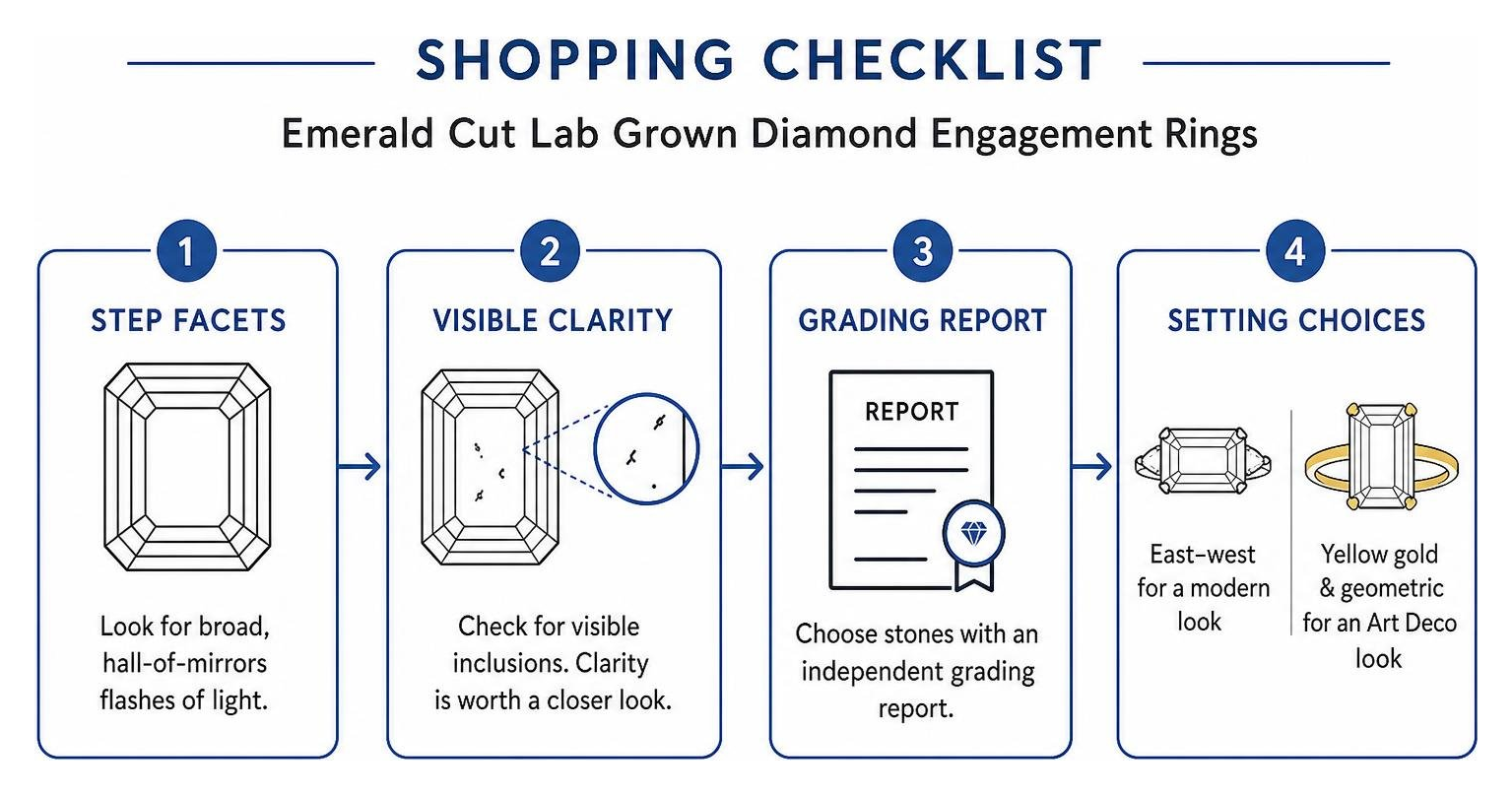
The best emerald cut lab grown diamond engagement rings start with a center stone you love seeing up close. Check for visible inclusions, pleasing proportions, and an independent grading report. Then choose a setting that suits your style: an east-west design feels modern, while yellow gold and geometric details bring out the cut's Art Deco look.
Emerald cuts show broad flashes of light rather than the busy sparkle of a radiant or oval cut. Their open facets also make clarity worth a closer look, even when two stones have the same grade. For a broader overview of how laboratory creation methods affect quality and value, the Gemological Institute of America explains the science behind lab-grown diamonds.
I'm Rudy Santayana, a Miami fine jewelry designer with experience in custom bridal jewelry and redesign. That work shapes how I assess emerald cut lab grown diamond engagement rings, from the stone's appearance to the details that make a setting feel personal.
Why Choose Emerald Cut Lab Grown Diamond Engagement Rings
Choosing a lab-created gemstone offers an undeniable blend of modern engineering and classic beauty. Lab-grown diamonds share the exact same optical, chemical, and physical properties as mined stones. They are made of pure carbon crystallized in an isometric cubic system, boasting a 10 on the Mohs hardness scale.
Opting for an emerald cut created in a controlled environment means you benefit from exceptional crystal purity without the severe environmental disruption associated with traditional earth mining. Because advanced techniques like Chemical Vapor Deposition (CVD) and High Pressure High Temperature (HPHT) streamline the supply chain, these stones offer an extraordinary cost advantage. You can allocate your budget toward higher clarity grades, larger carat weights, or a more intricate custom setting handcrafted right in our Coral Gables workshop.
| Feature | Lab-Grown Emerald Cut | Mined Emerald Cut |
|---|---|---|
| Chemical Composition | 100% Carbon (Pure Diamond) | 100% Carbon (Pure Diamond) |
| Hardness (Mohs Scale) | 10 | 10 |
| Optical Character | Step-cut flashes & hall of mirrors | Step-cut flashes & hall of mirrors |
| Price Point (Approx. 2 ct) | Accessible (~$2,000–$3,500 set) | High Premium (~$12,000–$20,000+ set) |
| Origin Traceability | Controlled laboratory growth | Earth-mined extraction |
| Grading Standards | IGI / GIA Certified | IGI / GIA Certified |
Before deciding on your dream setting, taking time to review a comprehensive guide to lab diamond rings will help you understand how laboratory creation methods allow master jewelers to produce larger, more visually striking center stones.
Essential 4Cs and Quality Criteria for Step Cuts
Evaluating a step cut is fundamentally different from judging a round brilliant stone. While brilliant cuts use triangular and kite-shaped facets to scatter light and mask internal imperfections, emerald cuts feature long, parallel rectangular facets arranged in a stepped sequence.

Because of the vast, open table facet at the center of the stone, an emerald cut acts like a clean window into the diamond’s crystalline body. Independent certification from reputable laboratories like the International Gemological Institute (IGI) or the Gemological Institute of America (GIA) is essential. An IGI report verifies the diamond's exact growth method, confirms color and clarity grades, and maps out internal inclusions so you know precisely what you are acquiring. Exploring our curated collection of lab diamonds can give you a clear baseline of what top-tier symmetry and light performance look like in person.
Clarity and Color Standards in Emerald Cut Lab Grown Diamond Engagement Rings
Step cuts do not tolerate poorly placed inclusions. In an emerald cut, an imperfection situated directly beneath the large center table will reflect across the step facets, multiplying its appearance.
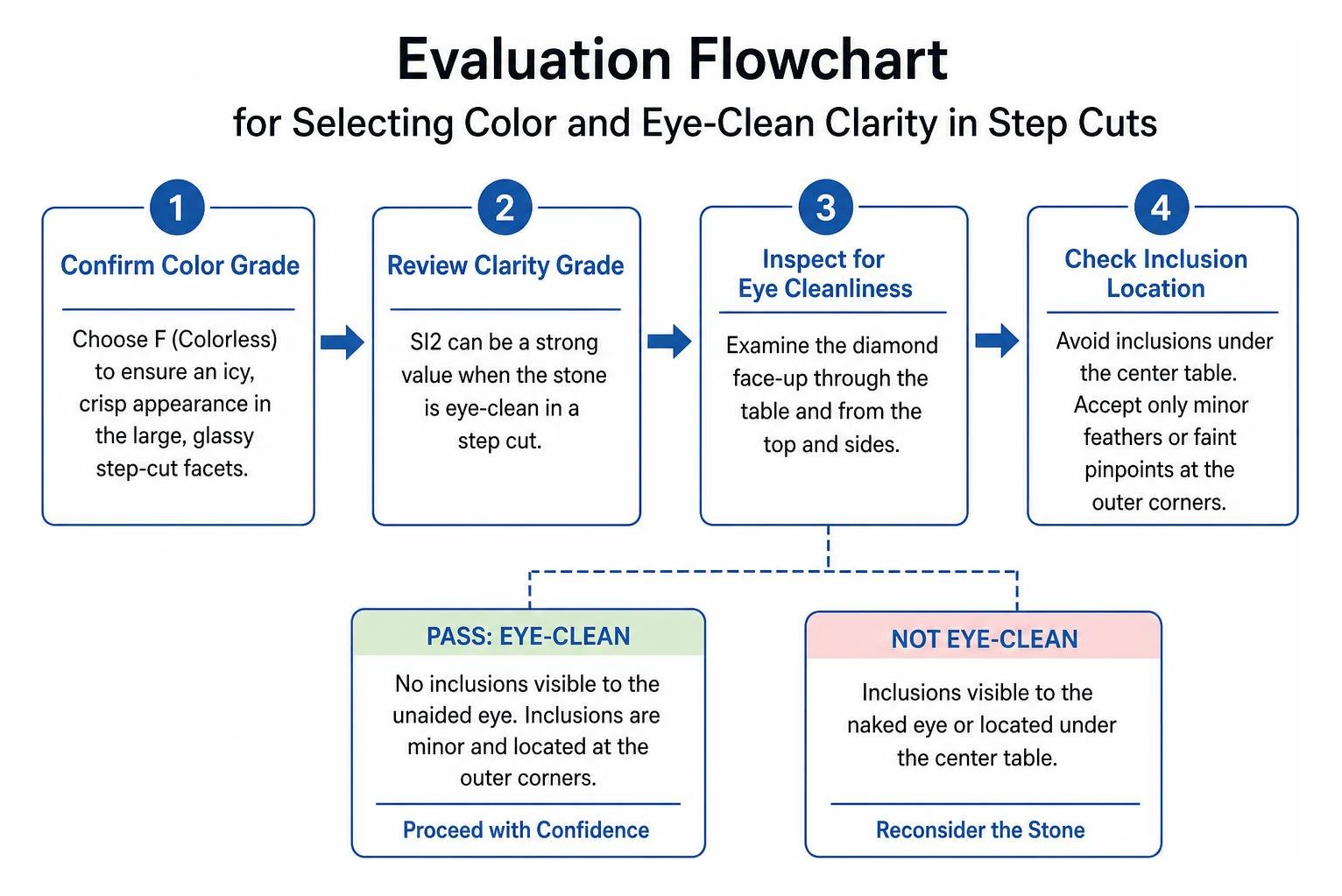
- Color Considerations: A color grade of F falls into the "Colorless" bracket (D-E-F). Because emerald cuts have large, glassy facets that pool body color more readily than brilliant shapes, choosing an F grade guarantees an icy, crisp look, especially when set against the warm contrast of yellow gold.
- Clarity Realities: A clarity grade of SI2 can offer outstanding value, provided the stone is strictly eye-clean. In step cuts, an SI2 grade must be evaluated carefully to confirm that inclusions consist of minor feathers or faint pinpoint clouds along the outer corners rather than dark carbon spots in the middle of the table facet.
Carat Weight and Proportions (2-1/3 ct tw Breakdown)
When browsing fine jewelry, you will often see pieces designated by their total carat weight (ct tw). Understanding how this weight is distributed across the entire piece helps you evaluate the scale and presence of the design.
For instance, a ring boasting a 2-1/3 ct tw typically pairs a substantial 2.00-carat emerald cut center stone with approximately 0.33 carats of supporting accent stones along the band or hidden gallery. The 2-carat center provides that coveted elongated profile, while the accent diamonds add shimmer.
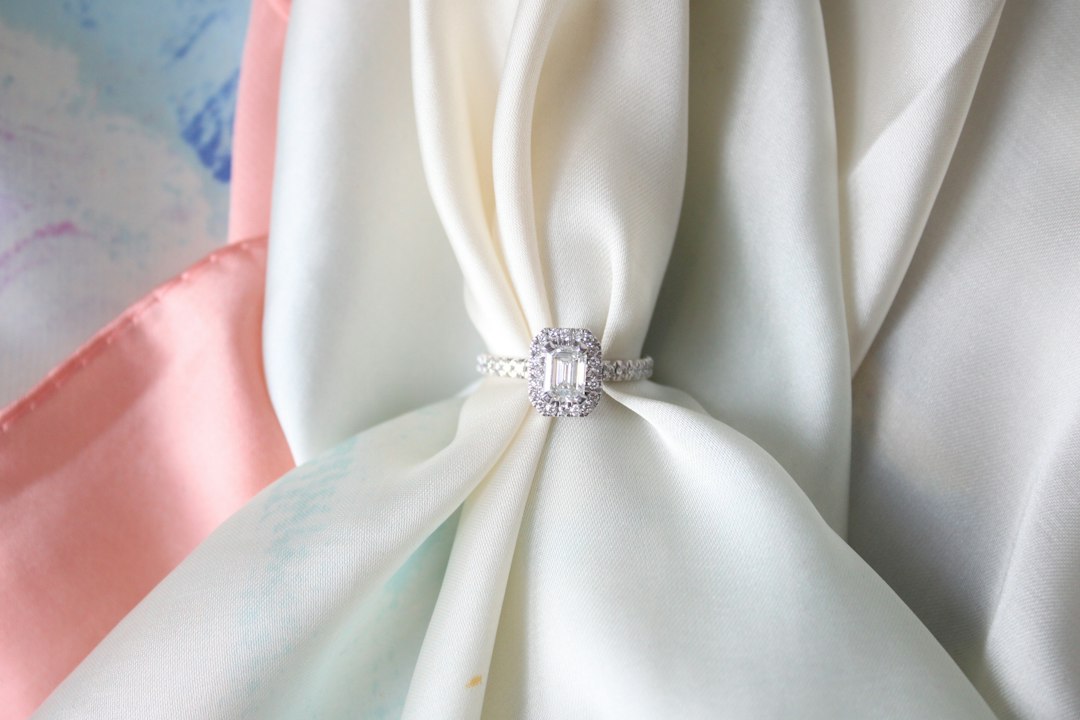
For the most balanced silhouette, aim for an emerald cut length-to-width ratio between 1.35 and 1.50. Proportions within this classic range prevent the diamond from looking overly square (like an Asscher cut) or excessively narrow. Pairing these proportions with a depth percentage between 60% and 68% ensures the stone maximizes light return rather than suffering from "windowing," where light passes straight through the diamond instead of bouncing back to your eye. You can see this visual balance demonstrated in a well-proportioned emerald cut lab diamond engagement ring design.
Art Deco Setting Styles and Metal Choices
The emerald cut flourished during the 1920s Art Deco era, when architecture and fine jewelry celebrated bold geometric lines, symmetry, and architectural grandeur.
Choosing 14K yellow gold delivers vintage warmth that accentuates the crisp, step-cut geometry of the stone. Composed of 58.3% pure gold alloyed with durable metals like copper, silver, and zinc, 14K gold offers superior resistance to daily scratches and bending compared to softer 18K alloys, making it ideal for everyday wear.
When designing your ring, consider how the setting style interacts with the diamond’s shape:
- Traditional North-South Prongs: The classic vertical orientation flatters the finger by creating an elongated, slender appearance.
- Modern East-West Setting: Mounting the emerald cut horizontally across the band gives the ring an architectural, contemporary look while maintaining vintage character.
- Bezel Framing: A fine metal rim outlines the clipped corners of the stone, providing maximum security and emphasizing the cut's stepped edges.
If you are drawn to timeless styles, browsing fine emerald engagement rings illustrates how distinct mounting techniques elevate rectangular center gems.
Trending Settings for Emerald Cut Lab Grown Diamond Engagement Rings
Today's bridal trends celebrate personalized touches that elevate the clean silhouette of a step cut. One popular design features graduating round diamonds set along the shank, leading the eye directly toward the central gem. Adding round accent stones creates a visual contrast: the lively brilliance of the round diamonds complements the calm, mirror-like flashes of the emerald cut center.
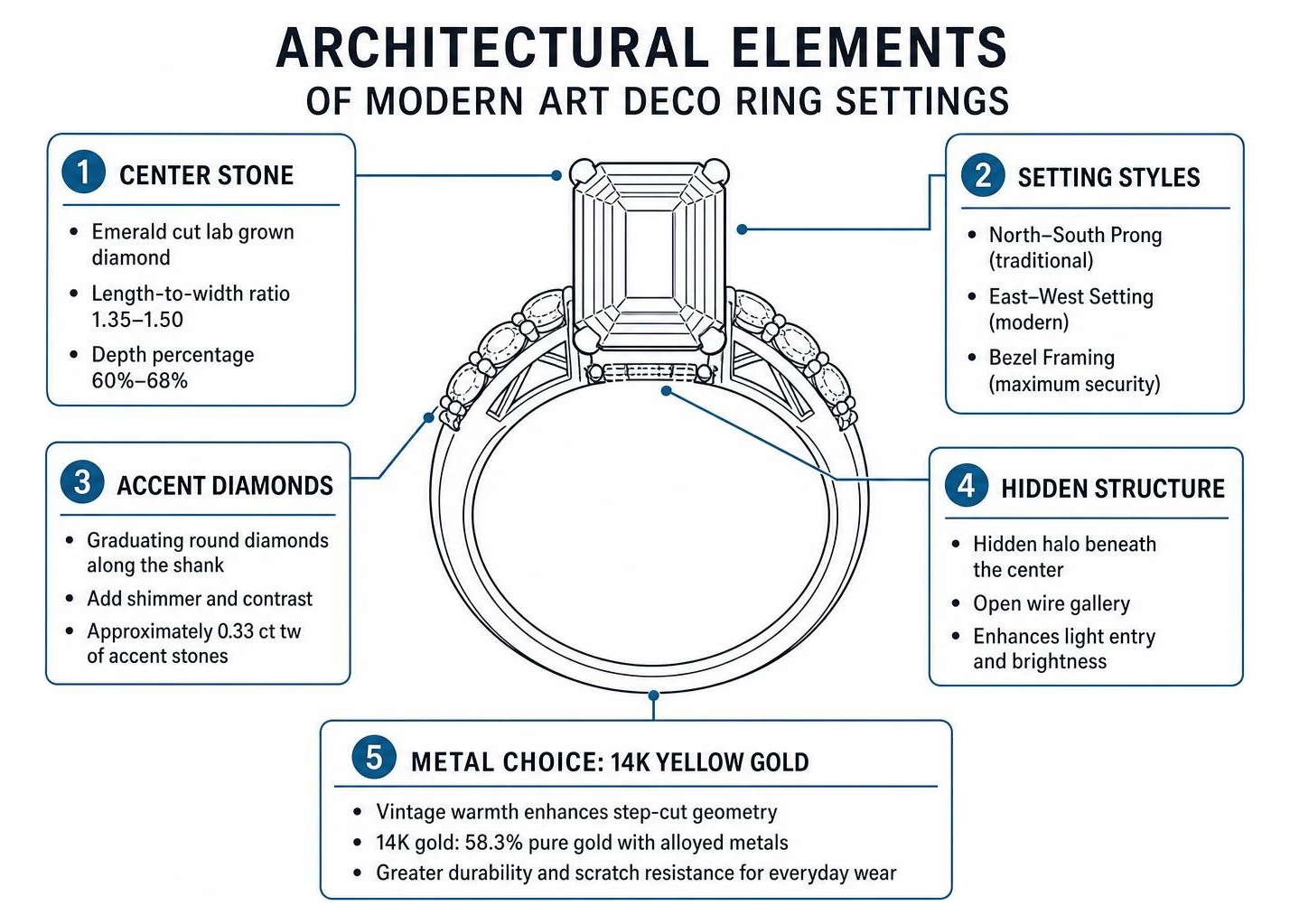
Subtle structural enhancements like hidden halos beneath the center basket or open wire galleries allow light to enter the lower facets freely, enhancing the stone's overall brightness. Couples looking for balanced vintage aesthetics often choose handcrafted lab diamond engagement rings that unite historic geometric profiles with modern, low-profile band designs.
Buyer’s Guide: Sizing, Policies, and Maintenance
Purchasing an engagement ring involves both aesthetic and practical considerations. Because wide bands and heavier center stones sit differently on the hand, obtaining a professional sizing using calibrated metal sizing rings is crucial. Step-cut rings with accent diamonds along the shank can generally be resized up or down by one full size, but designs with stones extending all the way around the band require precise initial sizing.
Always verify the jeweler’s policies before finalizing your purchase:
- Return Windows: Look for clear 30-day return or exchange periods to inspect the ring thoroughly in different lighting environments.
- Trade-In Options: Comprehensive trade-in policies allow you to apply the value of your lab-grown stone toward future upgrades or custom redesigns.
- Routine Care: Because step cuts have broad, open facets, everyday oils, hand creams, and dust show quickly on the table surface. Clean your ring weekly using warm water, mild dish soap, and a soft-bristle baby toothbrush, paying special attention to the space beneath the prongs.
For a deeper look into selecting settings and long-term ring maintenance, consult our engagement rings ultimate guide 2026.
Frequently Asked Questions About Emerald Cut Engagement Rings
How does an emerald cut differ from oval and radiant cuts?
An emerald cut is a step cut featuring parallel rectangular facets that produce distinct flashes of light, known as a "hall-of-mirrors" effect. In contrast, oval and radiant cuts are brilliant cuts engineered with triangular and kite-shaped facets designed to maximize continuous sparkle and scintillation. While radiants share the emerald cut's rectangular silhouette, their internal faceting scatters light rapidly, whereas an emerald cut emphasizes architectural clarity, symmetry, and depth.
Is an SI2 clarity grade acceptable for an emerald cut diamond?
An SI2 clarity grade can be acceptable for an emerald cut diamond, provided the stone is verified as eye-clean by a trained gemologist. Because step cuts have broad, transparent tables that do not hide inclusions under busy sparkle, any dark crystals or heavy clouds located centrally will be readily visible. An ideal SI2 emerald cut will feature faint, scattered inclusions near the outer girdles or clipped corners where setting prongs can conceal them.
How much can you save choosing a lab grown emerald cut ring?
Choosing a lab-grown diamond allows buyers to save between 70% and 85% compared to an earth-mined diamond of identical carat weight, color, clarity, and cut grade. A complete 2-1/3 ct tw engagement ring with a certified 2-carat lab center stone in a 14K gold setting often retails around $2,700 to $3,400. A mined diamond ring with comparable specifications and certification frequently ranges from $15,000 to over $22,000, allowing buyers to maximize their stone size and setting details within their target budget.
Conclusion
An emerald cut lab-grown diamond ring brings together the bold geometry of the Art Deco era and the precision of modern diamond cultivation. Its clean parallel facets offer an understated, aristocratic elegance that stands apart from standard brilliant cuts.
Whether you prefer a minimalist east-west setting in warm 14K yellow gold or a vintage-inspired design adorned with graduating accent diamonds, selecting a stone with verified proportions and certified quality ensures an heirloom-worthy piece. As you embark on your bridal journey, discover our educational guide on lab diamonds to find the perfect center gem tailored to your personal aesthetic.