Why Smart Diamond Buyers Always Insist on GIA Princess Cut Certification
How to Buy a GIA-Certified Princess-Cut Diamond
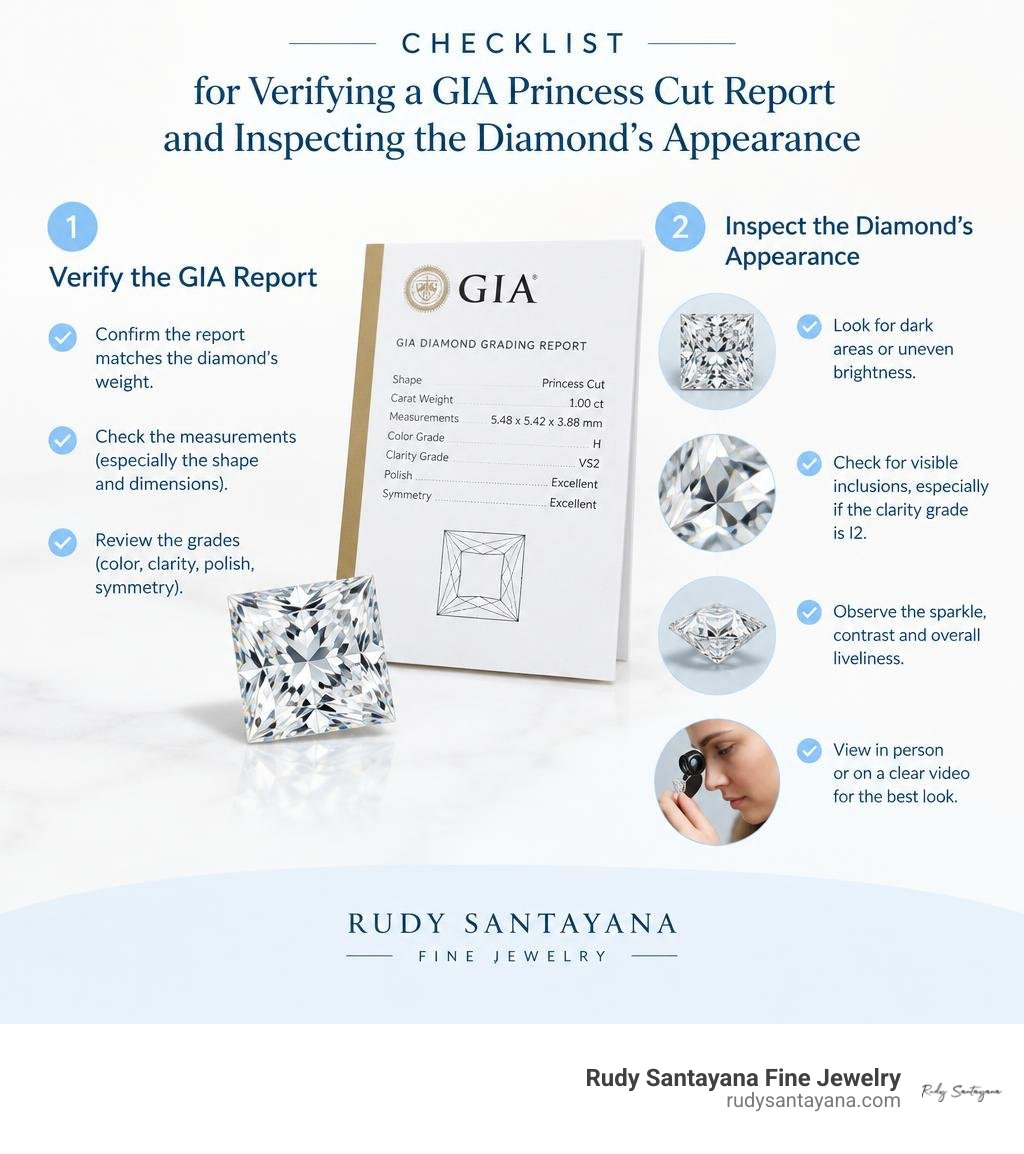
To buy a gia certified princess cut diamond, start by checking that its GIA report matches the stone's weight, measurements, and grades. Then look at the diamond in person or on clear video. GIA does not assign an overall cut grade to princess cuts, so the report alone cannot tell you how lively the stone looks. Check for dark areas and visible inclusions, especially if its clarity grade is I2.
I'm Rudy Santayana, a fine jewelry designer in Coral Gables with experience in custom jewelry, bridal design, and redesign. I help clients decide whether a gia certified princess cut diamond suits the piece they want to create.
Why GIA Certification Matters for Princess Cut Diamonds
When shopping for fine jewelry, the grading report accompanying your gemstone serves as its official blueprint. The Gemological Institute of America (GIA) established the universal standard for diamond grading, creating an objective system that protects consumers and jewelers alike. Because natural gems represent significant milestones, having an impartial evaluation from the world's most trusted gemological laboratory ensures total peace of mind.
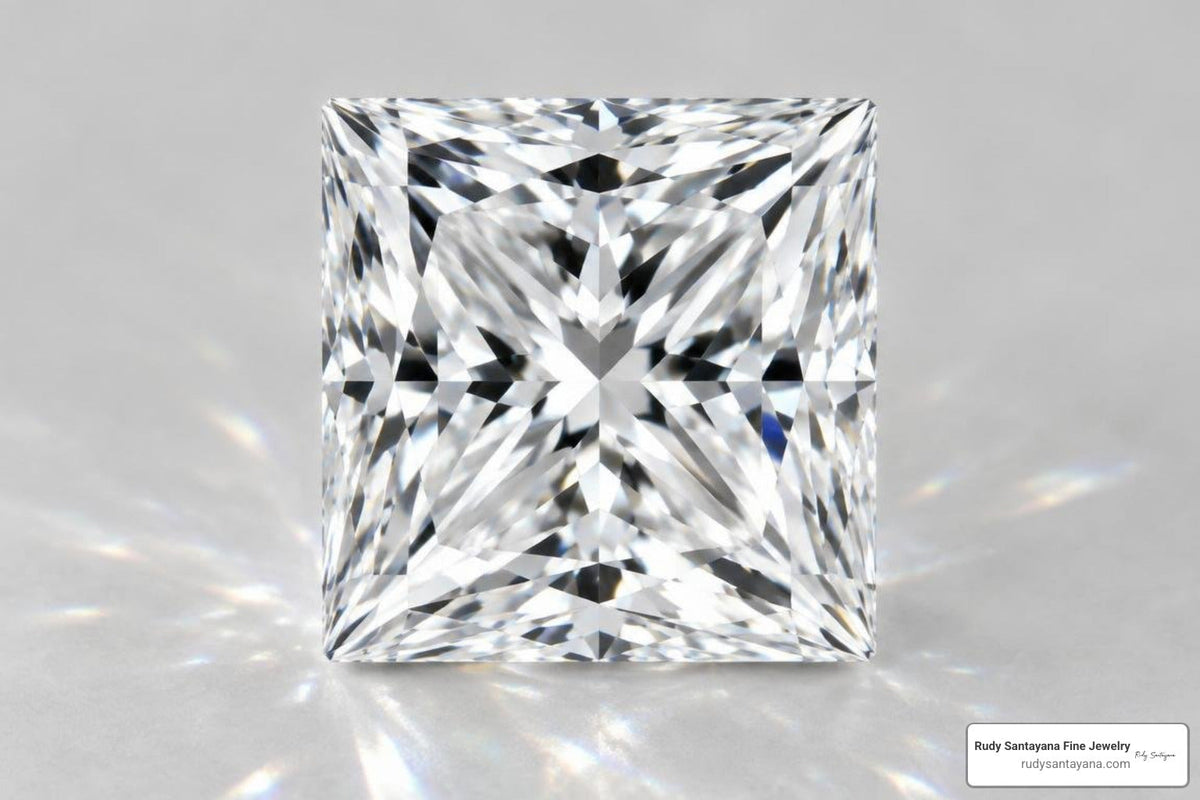
Unlike round brilliant diamonds, which receive a standardized overall cut grade from Excellent to Poor, fancy shapes like the square modified brilliant (the technical term for a princess cut) do not receive an overall cut grade on a GIA report. This makes independent lab credibility even more critical. GIA provides exact measurements, polish ratings, symmetry evaluations, and an unvarnished plot of internal characteristics rather than subjective marketing grades.
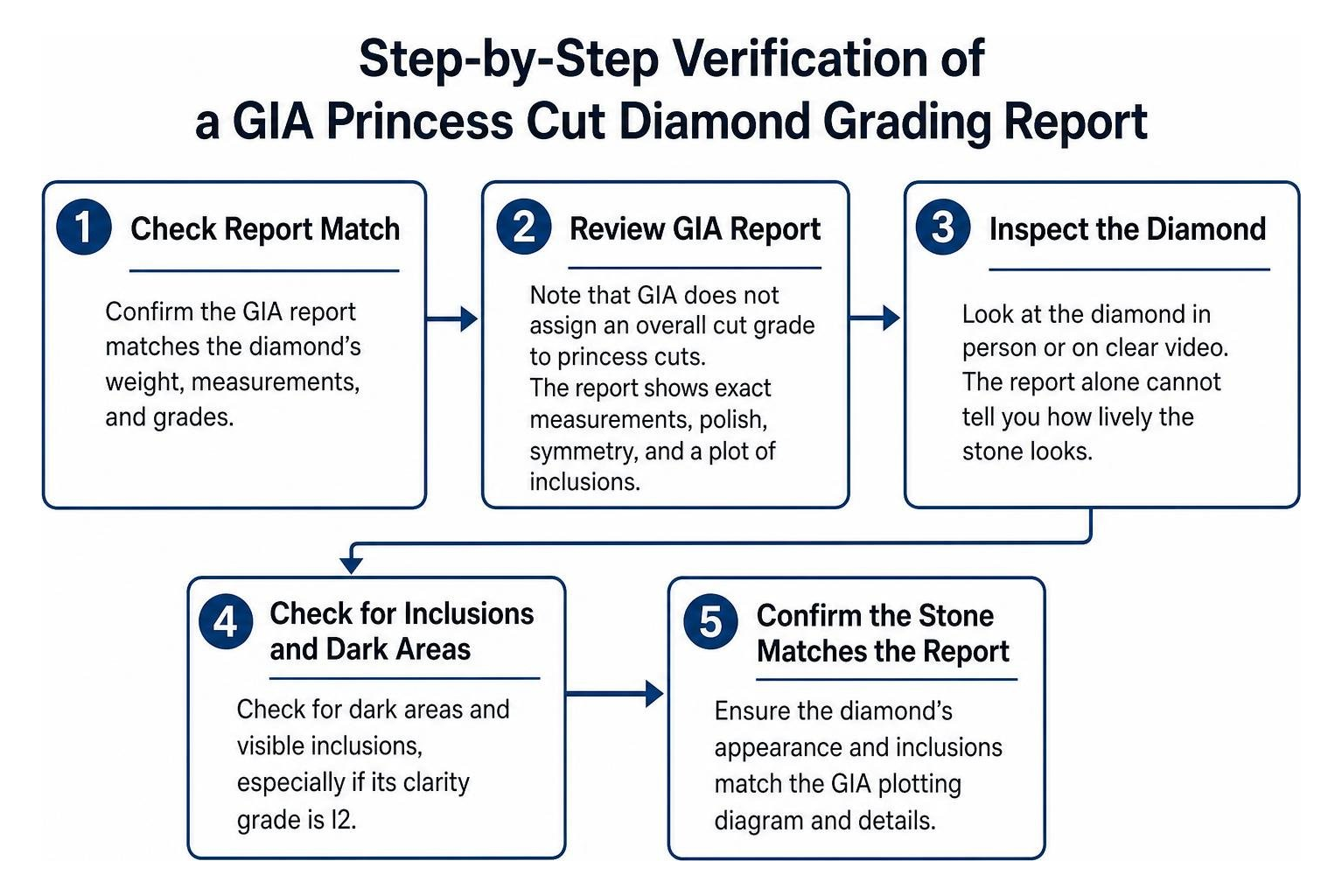
Understanding these parameters is essential when you evaluate loose gems. If you are learning how to buy a loose diamond, you quickly discover that pricing transparency relies entirely on reliable grading. A stone labeled as having an H color and I2 clarity by GIA is held to stringent scientific criteria. Lesser laboratories often over-grade stones by one or two full tiers, making a low-quality diamond look like a bargain on paper when it is actually overpriced.
Furthermore, having an authentic GIA dossier provides resale and insurance security. It validates your ownership details and accurately maps clarity characteristics. Knowing what inclusions in diamonds are helps you read the report's plotting diagram effectively, ensuring the physical stone matches its digital documentation perfectly.
Evaluating the 4Cs of a GIA Certified Princess Cut Diamond
The 4Cs—Carat, Color, Clarity, and Cut—apply to every diamond shape, but princess cuts interact with light in distinct ways due to their unique geometry. Developed in the late 1970s and early 1980s, the princess cut combines the brilliance of a round cut with a modern, crisp square outline.
When balancing your budget against visual beauty, understanding how these four pillars intersect is crucial:
| Feature | Specification Example | Visual Impact & Market Reality |
|---|---|---|
| Carat Weight | 0.53 ct | Delivers an appealing half-carat presence without jumping into higher price-per-carat threshold tiers. |
| Color Grade | H Grade | Near-colorless; looks exceptionally bright face-up, especially when set in white gold or platinum. |
| Clarity Grade | I2 Grade | Inclusions are noticeable under 10x magnification and often visible to the naked eye; budget-friendly. |
| Cut Proportions | 76% Table / 77.4% Depth | Creates a distinctive, shallower crown profile that emphasizes face-up spread while shifting brilliance outward. |
How Table and Depth Influence a GIA Certified Princess Cut Diamond
Because GIA does not issue a single cut grade for square modified brilliants, you must examine the specific proportions listed on the dossier:
- Table Percentage: The flat facet on the very top of the stone. While traditional princess cuts often feature tables between 65% and 72%, stones with a 76.00% table have an expansive top facet that lets in broad rays of light.
- Depth Percentage: The measurement from the table down to the culet relative to the diamond's width. A depth of 77.40% paired with a wide table creates a distinct light path, concentrating brilliance around the perimeter of the stone.
- Length-to-Width Ratio: For a classic square outline, look for a ratio between 1.00 and 1.05. A measurement profile of 4.41 × 4.23 × 3.27 mm yields a ratio of 1.04, delivering a crisp square appearance on the finger.
For clients exploring alternative gemstone avenues with pristine cut proportions, exploring modern lab-grown princess cut diamonds offers another path toward achieving specific dimensional parameters.
Navigating Color, I2 Clarity Grades, and Market Value
Understanding color and clarity trade-offs allows smart buyers to maximize their purchasing power. An H color grade sits comfortably in the near-colorless bracket. It provides exceptional value because it appears bright and icy white when viewed from the top, especially once mounted in jewelry, avoiding the premium attached to D-F color stones.
The I2 clarity grade represents diamonds with prominent inclusions. In a brilliant-style cut with numerous chevron facets on the pavilion, smaller crystalline inclusions and feathers are broken up visually by the stone’s scintillation.
In terms of real-world value, consider a natural 0.53-carat GIA-certified stone priced at approximately £994.77 per carat, resulting in an accessible total loose diamond cost of £527.23. This demonstrates how lower clarity grades make authentic, certified natural diamonds accessible for personalized jewelry designs, custom pendants, and accent-rich engagement rings without sacrificing certification integrity.
Assessing Proportions, Polish, Symmetry, and Fluorescence
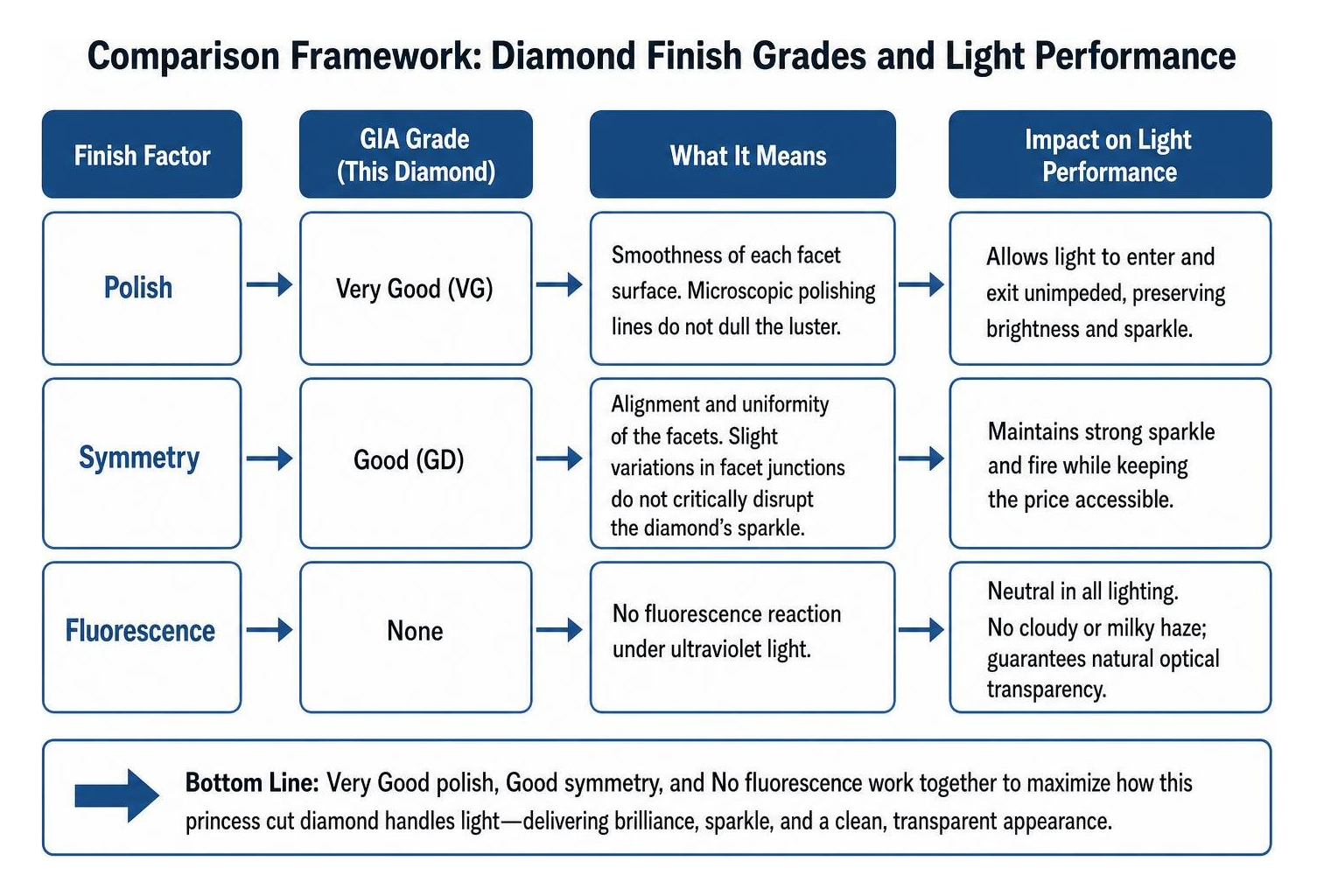
Beyond the baseline 4Cs, a GIA report details critical finish characteristics that dictate how effectively a diamond handles ambient light:
- Polish (Very Good): The smoothness of each facet surface. A grade of Very Good (VG) ensures that microscopic polishing lines do not dull the luster, allowing light to enter and exit unimpeded.
- Symmetry (Good): The alignment and uniformity of the facets. A Good (GD) symmetry rating indicates slight variations in facet junctions that do not critically disrupt the diamond's sparkle, keeping the price accessible.
- Fluorescence (None): When a diamond exhibits no fluorescence, it reacts completely neutrally under ultraviolet light. It will not show a cloudy or milky haze in direct sunlight, guaranteeing natural optical transparency. For curious buyers, our guide on whether diamonds glow under black light explains how trace elements influence UV luminescence.
How to Select Settings for Maximum Value and Protection
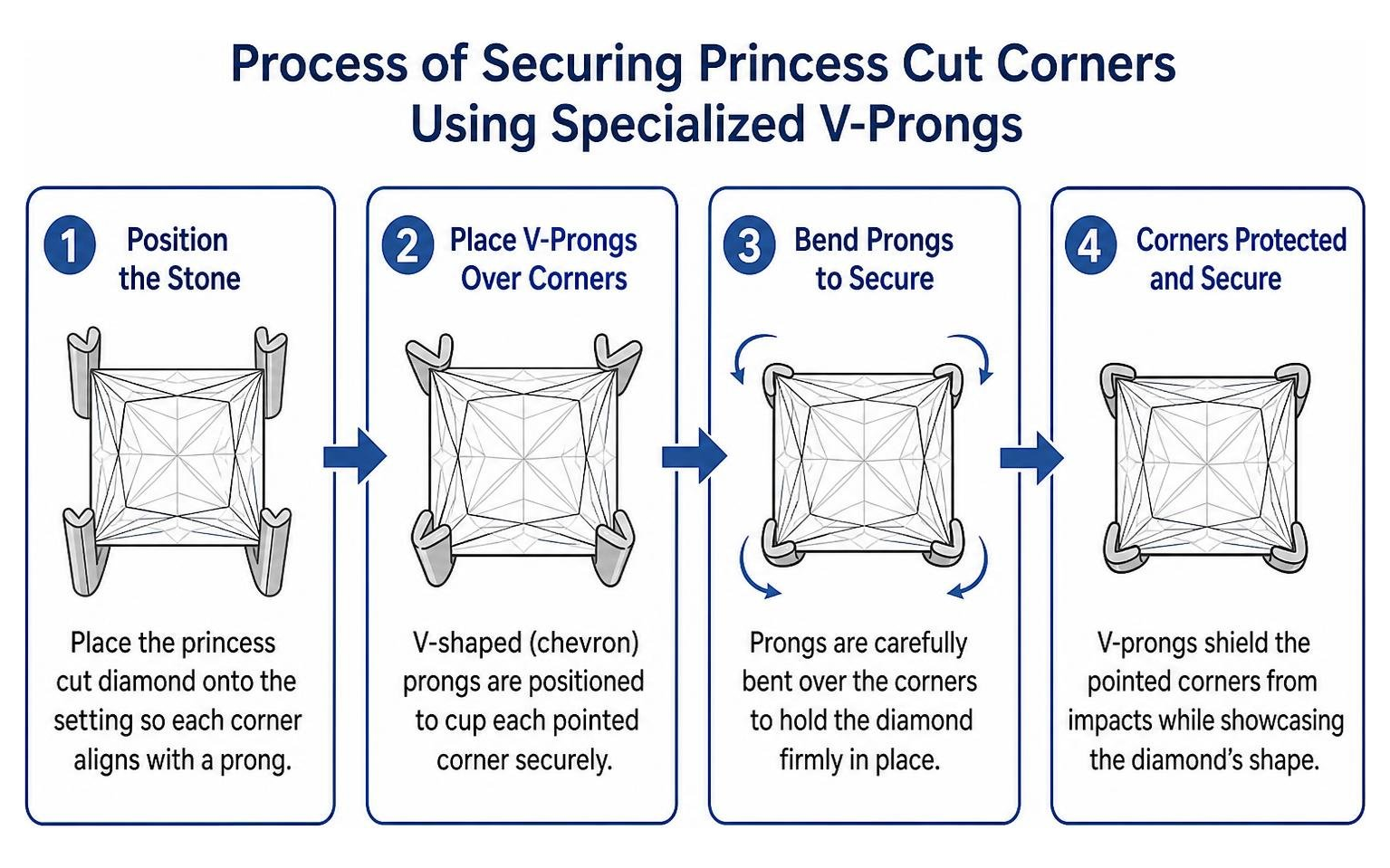
The geometric beauty of a princess cut comes with one vital structural consideration: its four pointed corners. Because natural diamonds have cleavage planes that make sharp 90-degree corners vulnerable to accidental impacts, choosing the right mounting is essential.
When designing princess-cut engagement rings in Coral Gables, FL, we emphasize protective prong engineering. V-shaped prongs (also called chevron prongs) cup each corner securely, shielding the stone from everyday knocks while highlighting its architectural shape.
Consulting our expert guide on how to choose a diamond ring setting will help you balance safety, metal color, and light exposure.
Setting and Styling Your GIA Certified Princess Cut Diamond
A 0.53 ct princess cut diamond works beautifully across a range of bespoke settings:
- Classic Solitaire: Highlights clean geometric lines with V-prongs on a tapered band.
- Three-Stone Architectural Ring: Flank your center stone with tapered baguettes or smaller princess cuts for classic balance.
- Halo & Bezel Mounts: An all-metal bezel or micro-pavé halo protects the edges while visually expanding the center stone's footprint.
If you are coordinating matching wedding bands, creating custom bridal sets or browsing modern engagement rings allows you to tailor every design detail to your personal style.
Frequently Asked Questions About GIA Princess Cut Diamonds
How does GIA grade the cut quality of a princess cut diamond?
GIA does not provide a single cut grade for princess cuts. Instead, the institute evaluates cut quality through specific metrics: table percentage, depth percentage, length-to-width ratio, girdle thickness, polish grade, and symmetry grade.
What is the ideal length-to-width ratio for a square princess cut?
The standard length-to-width ratio for a square princess cut ranges from 1.00 to 1.05. Ratios between 1.00 and 1.04 appear completely square to the naked eye. Ratios above 1.08 lean visibly rectangular.
Does an I2 clarity grade ruin the sparkle of a princess cut diamond?
Not necessarily. While an I2 clarity diamond contains eye-visible inclusions, the modified brilliant facet pattern of a princess cut disperses light across numerous smaller facets. This natural scintillation helps break up the appearance of internal characteristics, preserving sparkle at an accessible price point.
Conclusion
A certified natural diamond offers enduring appeal, and an official GIA grading report ensures you understand every facet, proportion, and characteristic of your gemstone. Whether you are balancing color, carat weight, or clarity, certification gives you the transparency needed to invest with confidence.
At Rudy Santayana Fine Jewelry in Coral Gables, Florida, we combine fine craftsmanship with transparent diamond education. If you are comparing natural options with contemporary alternatives, review our comprehensive guide to lab diamonds, or schedule an appointment with us to begin crafting your custom fine jewelry piece.