Compare the Best Settings for Your Lab Grown Princess Cut Diamond
Choose a Setting That Shows Off and Protects a Lab Grown Princess Cut Diamond
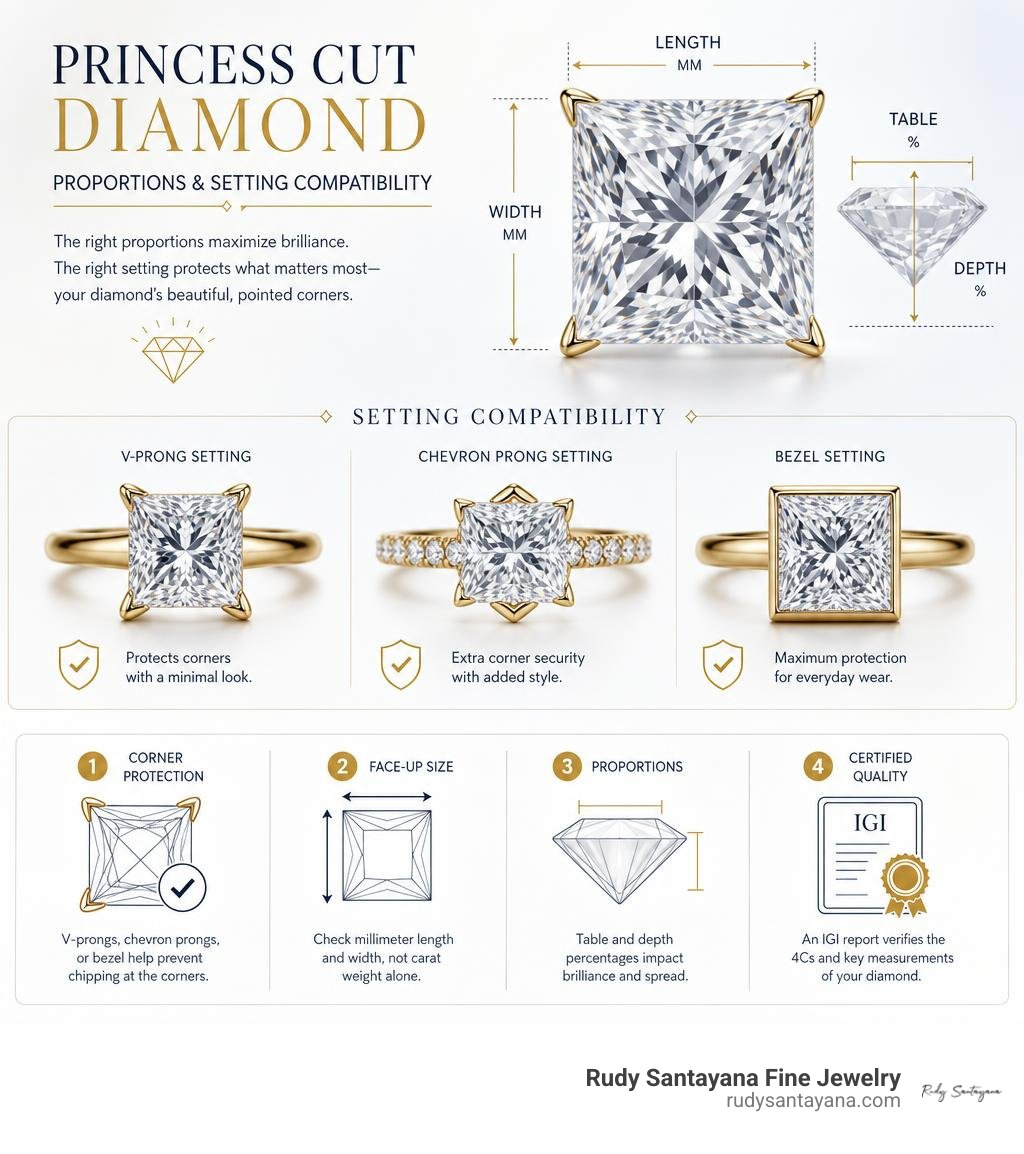
A lab grown princess cut diamond looks best in a setting that protects its four pointed corners without hiding its crisp, square shape. For everyday wear, start with V-prongs or a bezel setting. Then compare the stone's face-up measurements, depth, table, color, and clarity - not carat weight alone - so the diamond looks as large and bright as you expect.
Princess cuts are popular because they blend modern geometry with strong sparkle. Their corners need more protection than round diamonds, but the right setting can make that square silhouette feel elegant, distinctive, and secure.
Look for these essentials before choosing a mounting:
- Corner protection: V-prongs, chevron prongs, or a bezel reduce the risk of chipping at exposed corners.
- Face-up size: Check millimeter length and width alongside carat weight. A well-spread stone can look larger than another diamond of similar weight.
- Proportions: Table and depth percentages affect how the diamond returns light and whether weight is hidden below the surface.
- Certified quality: An IGI report verifies the listed 4Cs and key measurements of a lab-created diamond.
I am Rudy Santayana, a Miami fine jewelry designer specializing in custom bridal jewelry, redesigns, and personal service at the design bar. In this guide, I will help you compare the right proportions and settings for a lab grown princess cut diamond that fits your style and daily life.
Evaluating the 4Cs of a Lab Grown Princess Cut Diamond
When choosing the right stone for your ring, evaluating the 4Cs—Cut, Color, Clarity, and Carat weight—requires a tailored approach for square modified brilliant cuts. Unlike round brilliants that have standardized cut parameters, princess cut diamonds exhibit an inverted pyramid geometry beneath the surface. This architectural shape produces incredible scintillation and fire, but it also influences how color and clarity present to the naked eye.
Understanding how to assess cut proportions and light return helps you find a stone that performs at its peak. Our how to buy a loose diamond guide breaks down essential evaluation techniques, while our buying artificial diamonds guide 2026 offers in-depth analysis on modern lab-grown diamond production.
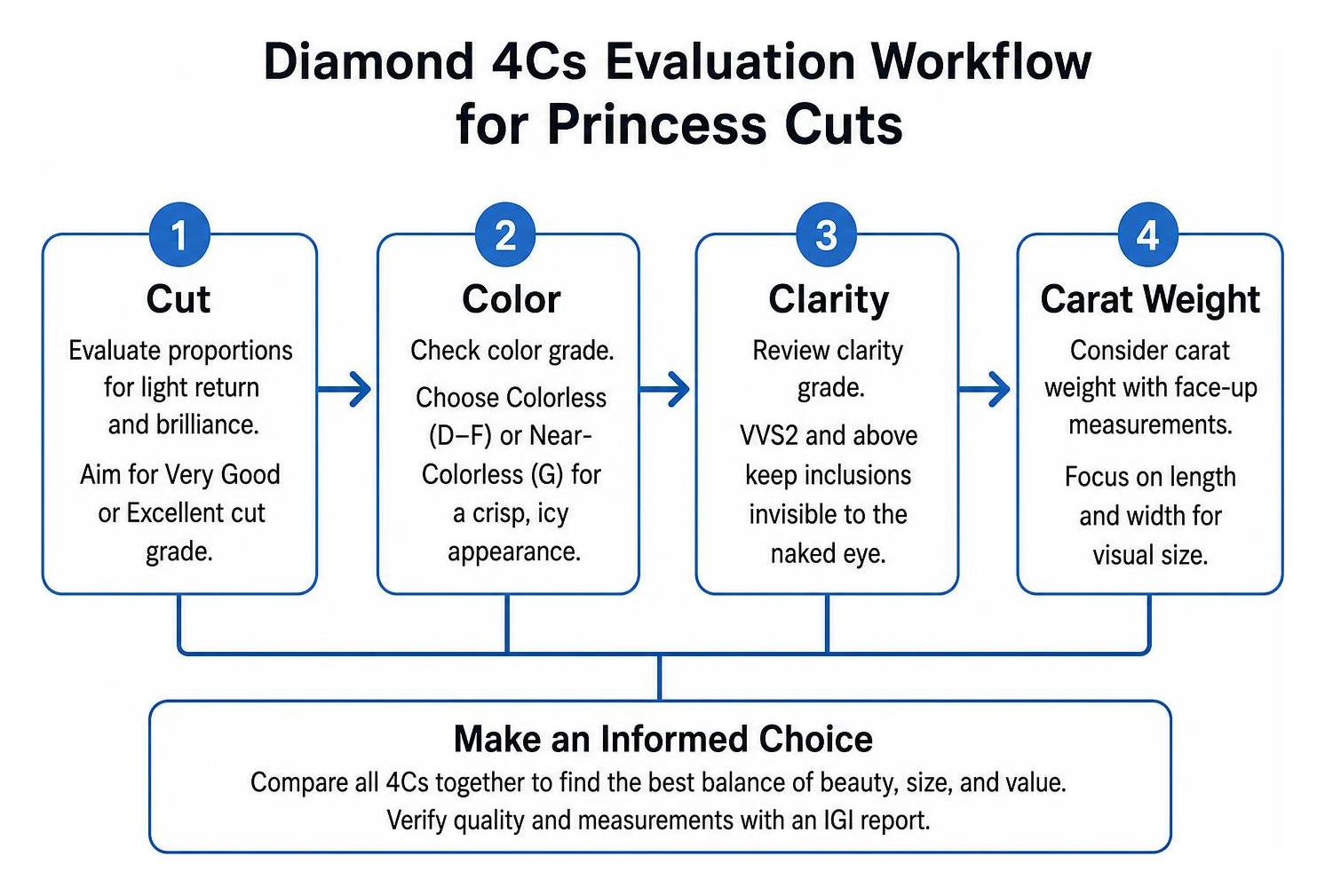
Here is how each of the 4Cs impacts a square brilliant gem:
- Cut Quality: The "make" of the stone governs brilliance and optical light return. A Very Good cut grade offers balanced proportions, delivering exceptional brightness and fire at a far more accessible price point than rare Excellent grades.
- Color Grades: Square cuts tend to concentrate subtle body color in their pointed corners. Selecting a stone in the Colorless (D–F) or top Near-Colorless (G) range ensures the stone appears crisp and icy once set.
- Clarity Characteristics: The brilliant faceting of a princess cut hides minute inclusions remarkably well. Grades such as VVS2 feature minute characteristics that remain completely imperceptible even under 30x magnification, giving you a pristine appearance.
- Carat Weight & Spread: Carat is simply a unit of mass, not a visual dimension. How that weight is distributed between the top table and lower pavilion determines how large the diamond appears from the top down.
Understanding Visual Carat and Dimensional Measurements

Carat weight tells you how much a gemstone weighs on a scale, but millimeter dimensions reveal its actual physical footprint. In the diamond industry, the concept of Visual Carat reflects how large a stone appears face-up compared to standard industry averages for that specific weight.
Because princess cuts are deep by nature, cutters sometimes conceal excessive weight in a thick pavilion (the bottom section of the diamond). When this happens, a stone may weigh more on paper while offering a smaller top surface area. Conversely, a diamond cut with balanced depth proportions displays a wider table and expansive face-up surface area, achieving a higher Visual Carat rating.
To ensure your square cut diamond looks balanced and expansive, examine these key dimensional metrics:
- Length-to-Width Ratio: A classic square silhouette features a length-to-width ratio between 1.00 and 1.02. A ratio of 1.01 provides an unmistakably crisp, symmetrical square outline.
- Table Percentage: The flat top facet should ideally measure between 68% and 77% of the total width.
- Depth Percentage: Total depth should typically range between 64% and 72% to balance internal reflection with face-up spread.
Comparing Specific Lab Grown Princess Cut Diamond Proportions
To see how cut proportions, color tiers, and surface dimensions affect visual presence and value in real-world scenarios, let us compare two certified stones with distinct proportion profiles:
| Specification | 1.01 Carat Princess Cut | 1.05 Carat Princess Cut |
|---|---|---|
| Color Grade | G (Near-Colorless) | F (Colorless) |
| Clarity Grade | VVS2 | VVS2 |
| Cut Grade | Very Good | Very Good |
| Physical Dimensions | 5.46 x 5.43 x 3.80 mm | 5.84 x 5.77 x 3.73 mm |
| Visual Carat Equivalent | 1.01 ct | 1.16 ct |
| Table Percentage | 77% | 73% |
| Depth Percentage | 70.0% | 64.6% |
| Length-to-Width Ratio | 1.01 (Square) | 1.01 (Square) |
| Polish & Symmetry | Excellent / Very Good | Excellent / Excellent |
| Price Point | ~$291.49 | ~$303.03 |
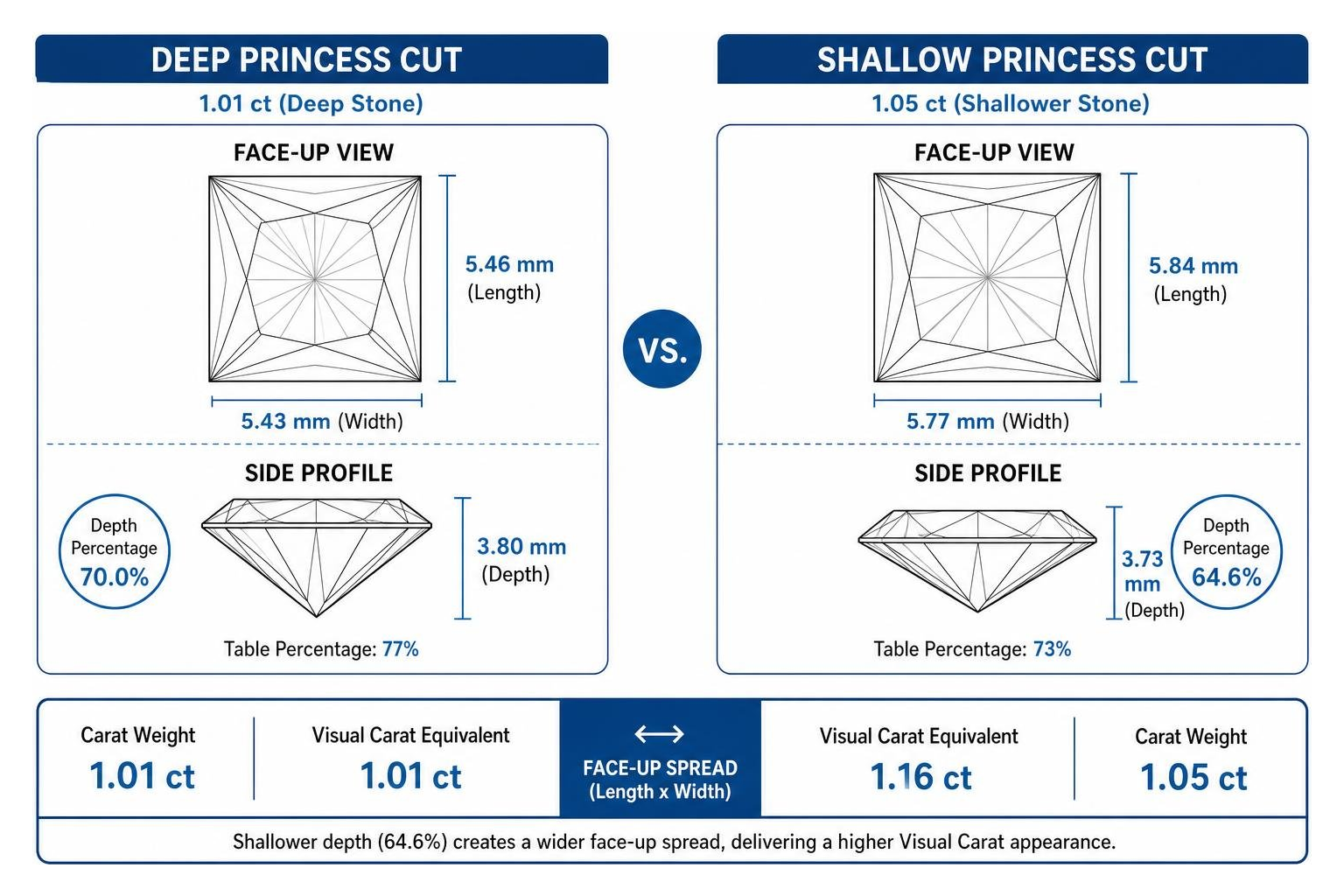
Looking at this direct comparison reveals valuable insights for savvy shoppers:
- Dimensional Spread: While the 1.05 ct stone represents only a 0.04-carat increase in actual mass, its shallower depth (64.6%) allows for a wider spread (5.84 x 5.77 mm). This provides a 1.16 ct Visual Carat presence, appearing visibly larger on the finger than the 1.01 ct stone (5.46 x 5.43 mm) with its 70.0% depth.
- Color Performance: The 1.05 ct stone sits within the prestigious Colorless tier (F Color), providing maximum brightness when mounted in white gold or platinum. The 1.01 ct stone offers a G Color grade, which remains virtually colorless to the unaided eye once set.
- Value Differential: With a price variance of roughly $11.54 between these two examples, analyzing depth percentages and face-up measurements ensures you get maximum visual impact for your budget.
Top Ring Styles and Mountings for Princess Cut Stones
Selecting a mounting for a square cut diamond is a blend of structural engineering and aesthetic harmony. Because the four corners of a princess cut terminate at sharp 90-degree points, they are the most vulnerable areas of the crystal structure. Everyday impacts can pose a risk of chipping if those corners remain exposed.
Choosing the right setting ensures the longevity of your piece. To explore mounting options in detail, read our guide on how to choose a diamond ring setting, or discover a bespoke princess cut engagement ring in Coral Gables FL tailored to your personal taste.
Popular Settings to Protect Your Lab Grown Princess Cut Diamond
When designing a daily-wear mounting, protective prong architecture is paramount. Here are the leading setting options designed to preserve your diamond:
- V-Prongs (Chevron Prongs): Specifically crafted for pointed gems, V-shaped prongs hug the diamond's corners on both sides. This creates a metal shield that absorbs peripheral bumps while highlighting the sharp geometry of the stone.
- Full Bezel Settings: A continuous rim of custom-shaped precious metal surrounds the entire perimeter of the diamond. This offers the ultimate defense against snagging and impacts, creating a sleek, ultra-modern silhouette.
- Semi-Bezel (Half-Bezel) Mountings: Metal wraps around two opposite sides or just the four corner angles, providing corner security while allowing light to flood into the open side pavilions.
Solitaire, Halo, and Modern Band Alternatives
Beyond protective engineering, the mounting defines the personality of your ring. We craft a wide range of designs for fine jewelry connoisseurs across South Florida:
- Architectural Solitaires: A minimalist four V-prong cathedral solitaire lifts the diamond, allowing light to enter from all angles while keeping the geometric profile front and center.
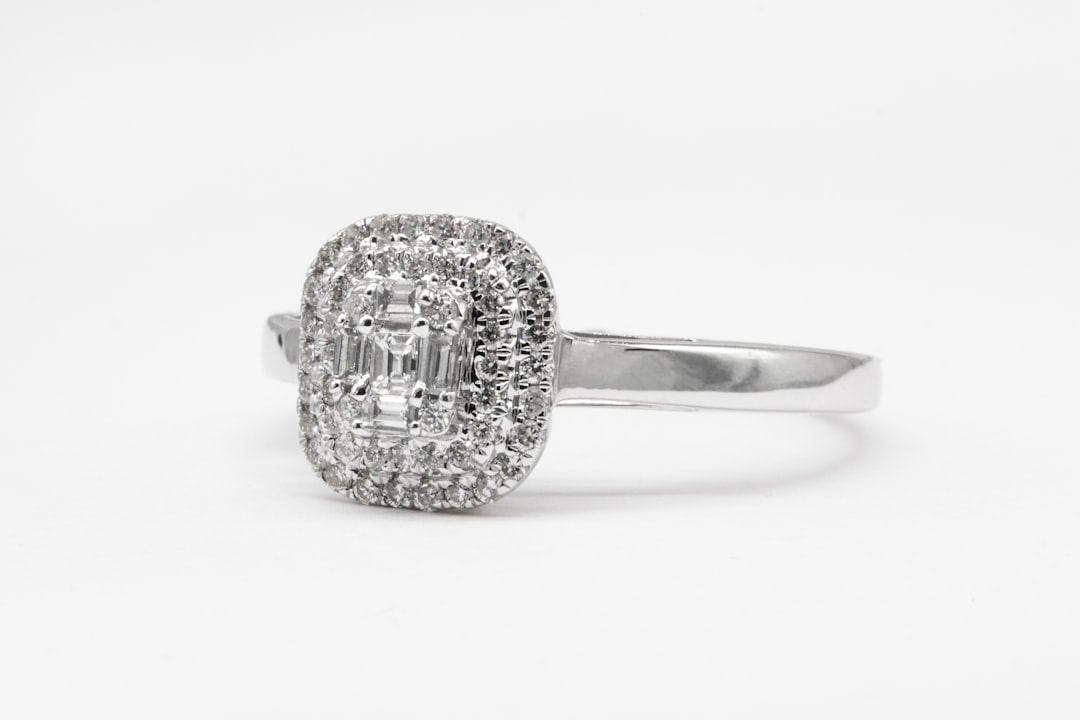
- Hidden Halo Mountings: For subtle brilliance, a delicate collar of micro-pavé lab diamonds encircles the base of the center stone just below the girdle, adding brilliance from profile views without altering the square outline.
- Framed Halos: A full geometric halo of round or baguette diamonds encloses the center stone, enhancing the face-up footprint and delivering vintage-inspired drama.
- Pavé & Channel Bands: Complement the center stone with accent diamonds set along the band. Channel settings offer a sleek, snag-free channel of light, while micro-prong pavé bands provide continuous shimmer.
Explore modern design variations in our curated collection of modern engagement rings, or consult our comprehensive lab diamond ring buying guide for pairing bands with geometric center stones.
Environmental Advantages and Certification Standards in 2026
As fine jewelry manufacturing evolves, lab-created diamonds have emerged as a premier choice for eco-conscious couples. Advanced technological facilities now produce high-purity gem diamonds utilizing 100% renewable energy sources, drastically minimizing the carbon footprint and environmental disruption associated with traditional earth mining.

When selecting a lab-grown gemstone, independent third-party verification is essential:
- International Gemological Institute (IGI) Certification: The International Gemological Institute is the global authority in grading lab-created diamonds. An IGI report documents the diamond's 4Cs, exact millimeter proportions, table and depth percentages, polish, symmetry, and growth method.
- Transparent Value Metrics: Modern analytical tools and deal-scoring algorithms assess market inventory to verify fair pricing, minimal markups, and direct sourcing advantages.
- Insurance Appraisals: Every finished bespoke piece from our atelier includes complete certification paperwork and professional insurance appraisal documentation, providing peace of mind from day one.
Frequently Asked Questions About Lab Grown Diamonds
What is the ideal table and depth percentage for a princess cut?
For optimal optical brilliance and balanced face-up dimensions, target a table percentage of 68% to 77% and a depth percentage of 64% to 72%. Stones with depths over 75% often hide carat weight in the pavilion, while stones with depths below 62% may exhibit light leakage through the center.
How do F and G color grades compare in square cuts?
F color belongs to the Colorless tier (D–F) and offers an icy appearance that pairs well with platinum and white gold. G color sits at the top of the Near-Colorless tier (G–J). To the unaided eye in everyday lighting, a G color princess cut appears bright and white once set, offering exceptional value without visible tint.
Why are lab grown diamonds significantly more affordable?
Lab-grown diamonds possess the exact physical, optical, and chemical properties of mined diamonds. They are more affordable because their supply chain is shorter, bypassing heavy excavation overhead, multiple broker markups, and lengthy transport networks. Advancements in crystal growth technology continue to make fine-quality stones accessible at honest, transparent prices.
Conclusion
Finding the ideal setting for your square brilliant diamond involves balancing dimensional proportions with protective jewelry design. By looking beyond carat weight to prioritize millimeter spread, proper depth, and V-prong security, you ensure your ring remains as brilliant and durable decades from now as it was on the day it was created.
At Rudy Santayana, we take pride in offering handcrafted custom engagement rings and fine jewelry tailored to your exact vision. Whether you are redesigning an heirloom or selecting a new centerpiece, we invite you to experience our personalized design services at our atelier.
Discover our bespoke services for custom jewelry in Coral Gables FL, or explore our complete guide on lab diamonds to begin crafting your dream ring today.