1 Ct Pear Shaped Diamond: Price Comparison and Buying Advice
How to Compare 1 Ct Pear Shaped Diamond Prices
A 1 ct pear shaped diamond has no single fair price. To judge a quote, first compare natural diamonds with natural diamonds or lab-grown diamonds with lab-grown diamonds. Then check the grading report, how large the stone looks from above, and whether it has a dark bow-tie across its center. A typical 1-carat pear measures about 9.05 × 5.45 mm, but two stones of the same weight can look quite different.
I’m Rudy Santayana, a fine jewelry designer in Coral Gables who creates custom pieces and helps clients choose stones for them. When evaluating a 1 ct pear shaped diamond, I look at its shape and sparkle alongside its price.
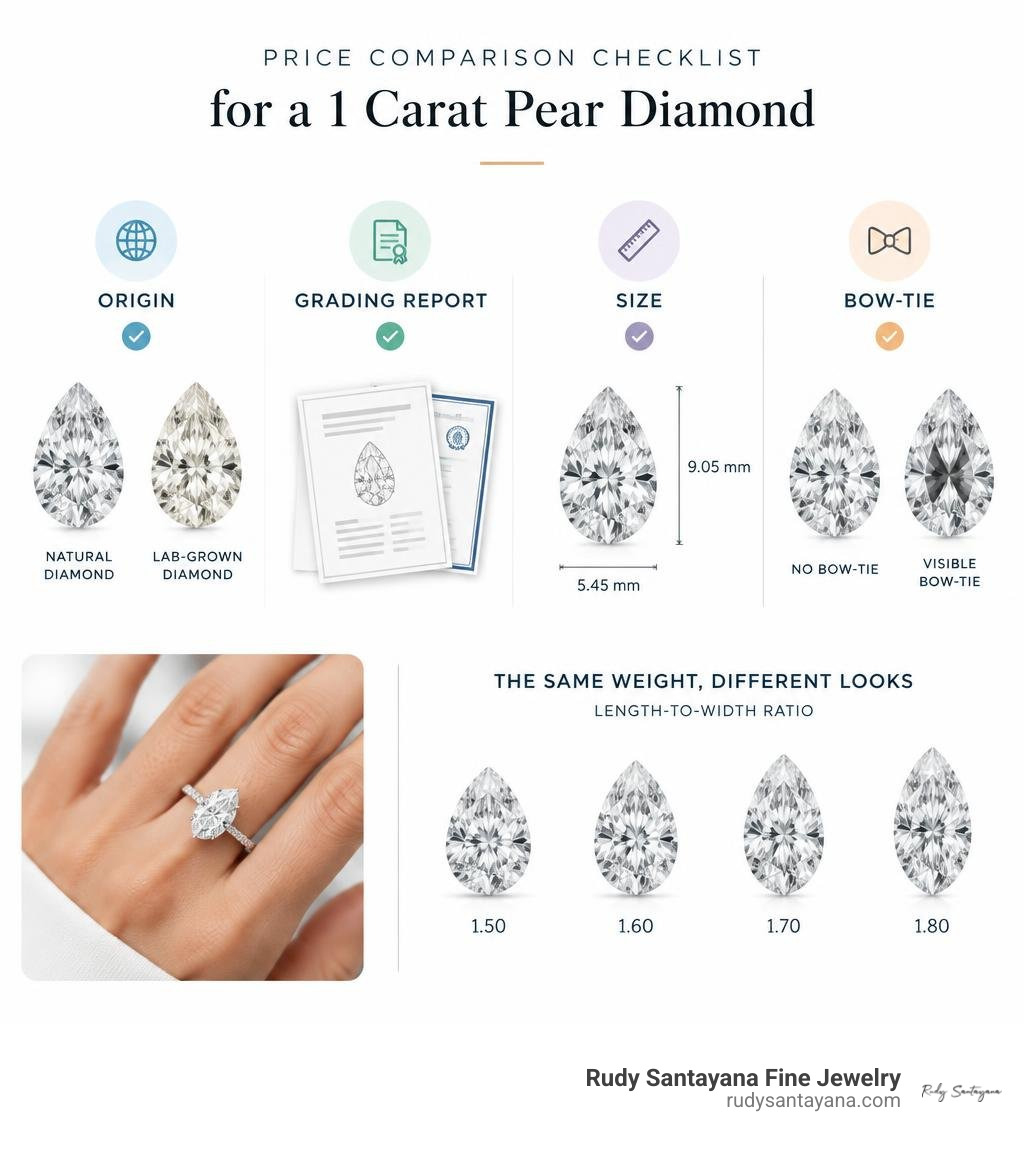
Understanding the Dimensions and Cut Quality of a 1 Ct Pear Shaped Diamond
Unlike standard round brilliant cuts, fancy shapes like the pear cut do not have a single, rigid grading standard issued by major laboratories. Because a pear cut merges the fiery brilliance of a round cut with the sleek elegance of a marquise, evaluating cut quality requires examining geometric balance, outline symmetry, and light distribution.
A well-proportioned pear diamond creates a delicate teardrop shape with smooth, curved wings, balanced shoulders, and an aligned point. If the symmetry is off, the diamond can appear crooked or unevenly weighted. Evaluating polish and symmetry ensures that facet junctions meet cleanly, bouncing light across the crown rather than letting it leak out the bottom.
Evaluating the True Size of a 1 Ct Pear Shaped Diamond
One of the greatest benefits of selecting a pear cut is its exceptional face-up spread. A well-cut 1 ct pear diamond typically measures around 9.05 × 5.45 mm (plus or minus 6%), with an average total depth of 3.32 mm. This gives the diamond a face-up surface area of approximately 36.01 mm² and an internal volume of 56.82 mm³.
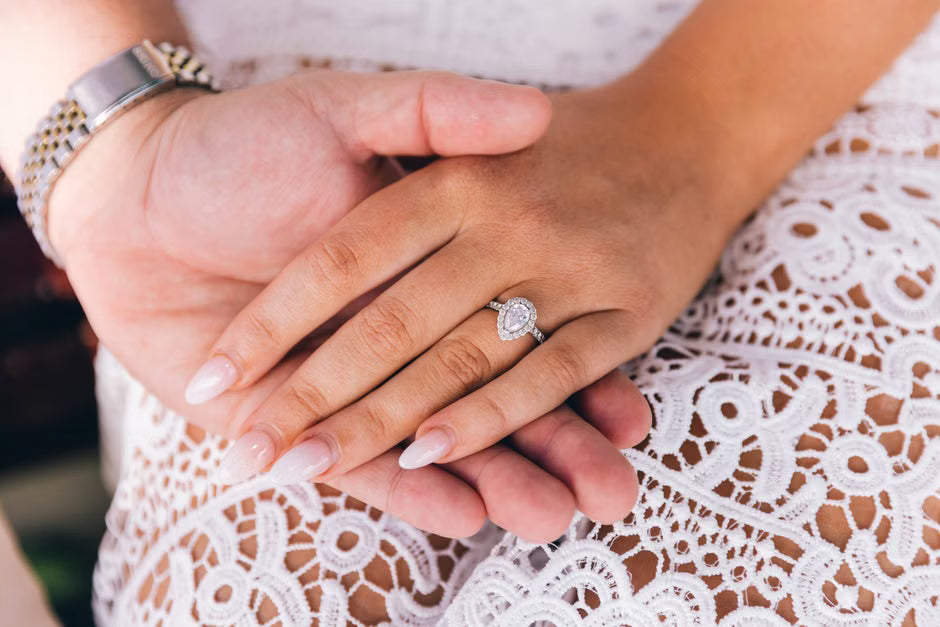
Because a significant amount of diamond rough is distributed across the stone’s length rather than hidden in its base, a pear diamond looks larger than many other cuts of the identical carat weight. When set into a classic pear shaped ring, the elongated shape covers more of the finger, creating a slimming and graceful appearance.
| Diamond Shape (1.00 Carat) | Typical Measurements (mm) | Approximate Face-Up Area (mm²) | Perceived Visual Size |
|---|---|---|---|
| Pear Cut | 9.05 × 5.45 mm | 36.01 mm² | Significantly Larger |
| Round Brilliant | 6.45 × 6.45 mm | 32.67 mm² | Standard Baseline |
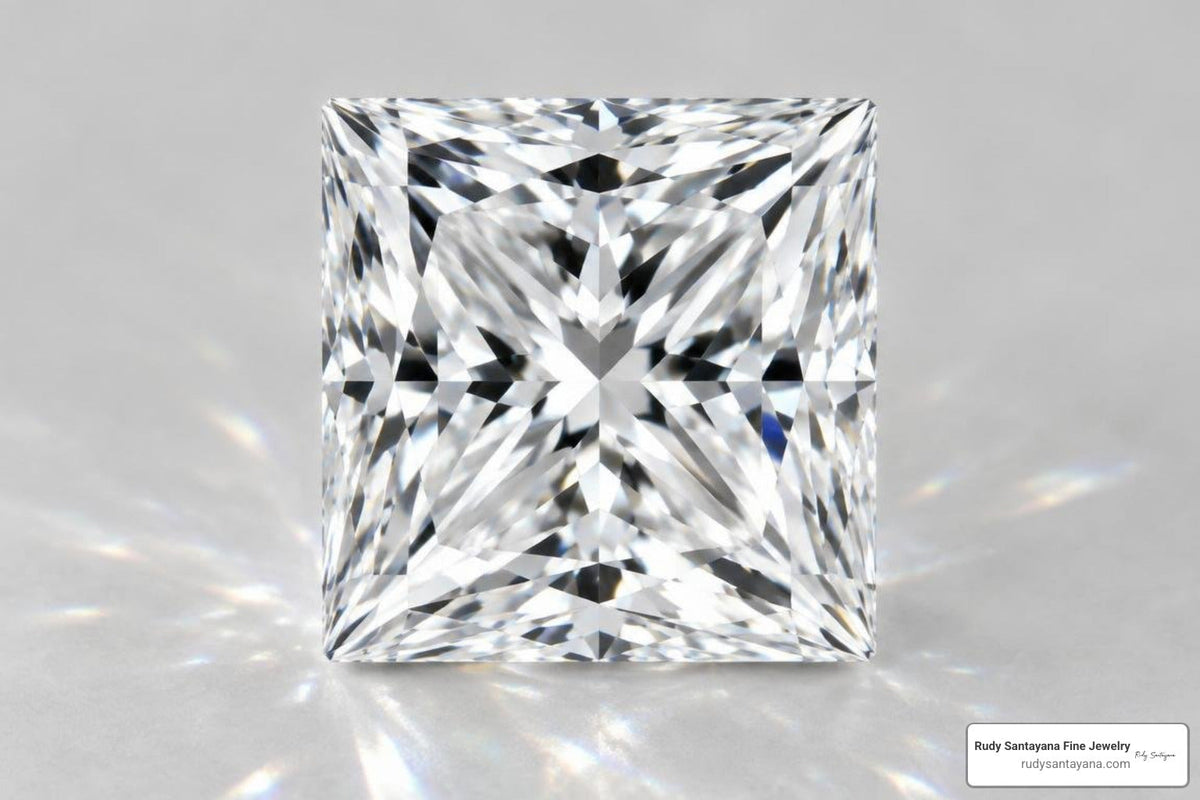
| Princess Cut | 5.50 × 5.50 mm | 30.25 mm² | Compact / Smaller |
| Cushion Cut | 5.80 × 5.80 mm | 33.64 mm² | Moderate |
| Oval Cut | 7.70 × 5.30 mm | 32.09 mm² | Elongated / Large |
| Emerald Cut | 6.50 × 4.50 mm | 29.25 mm² | Modest / Deep |
As shown in the data, the pear diamond commands more surface presence than a round or princess cut, offering greater visual spread for your investment.
Ideal Proportions: Depth, Table, and Symmetry
To achieve maximum brilliance without unnecessary weight retention, specific proportion parameters should guide your selection. A stone cut too shallow will suffer from light leakage, creating a dull center, while a stone cut too deep will look much smaller from the top because excess carat weight is trapped underneath.
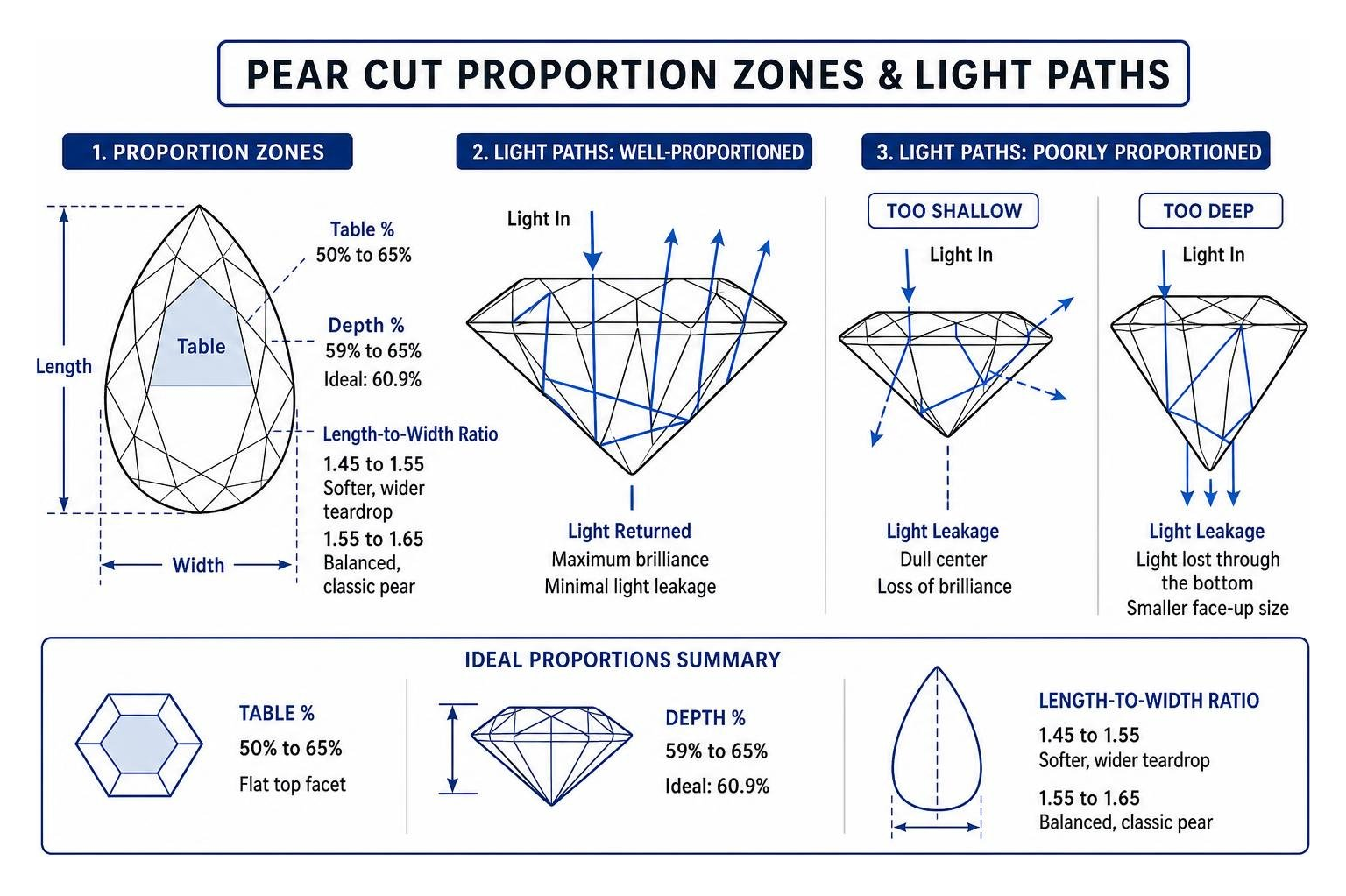
The depth percentage reflects the ratio of the stone's depth to its width. For a pear cut, the sweet spot falls between 59% and 65%, with a 60.9% depth benchmark representing an ideal balance. The table percentage—the flat top facet—should ideally range between 50% and 65%.
The length-to-width ratio defines the stone's personality:
- 1.45 to 1.55: Produces a softer, wider, and rounder teardrop silhouette.
- 1.55 to 1.65: Delivers balanced, classic pear proportions.
- 1.66 to 1.75: Offers an elongated, slender outline that accentuates finger length.
| Proportion Metric | Ideal / Excellent Range | Acceptable Range | Avoid (Suboptimal) |
|---|---|---|---|
| Depth Percentage | 59.0% – 63.5% | 63.6% – 65.0% | Below 58% or Above 66% |
| Table Percentage | 53.0% – 62.0% | 50.0% – 65.0% | Below 49% or Above 68% |
| Length-to-Width Ratio | 1.55 – 1.68 | 1.45 – 1.75 | Below 1.40 or Above 1.80 |
| Polish / Symmetry | Excellent | Very Good | Good, Fair, or Poor |
| Girdle Thickness | Thin to Slightly Thick | Medium to Thick | Extremely Thin or Extremely Thick |
1 Carat Pear Diamond Pricing and Value Factors
Pricing for a 1 ct pear shaped diamond varies based on market origin (natural vs. lab-grown), cut quality, color, and clarity. Rather than assessing price on carat weight alone, smart buyers evaluate the price per carat alongside light performance.
When evaluating current 1 carat pear diamond price trends, a natural 1-carat pear diamond certified by a premier laboratory typically ranges from $3,500 to $7,500 depending on color and clarity grades. Meanwhile, shoppers comparing the cost of lab diamonds will find that lab-grown pear diamonds offer the same physical, chemical, and optical properties at a fraction of the cost, often ranging between $800 and $1,600 for exceptional qualities.
Color and Clarity Grades for Maximum Value
The brilliant faceting pattern of a pear cut is forgiving when it comes to clarity. The complex facet arrangement easily masks minor microscopic features, making it simple to find an eye-clean stone without paying for flawless clarity.
For the best balance of beauty and budget, an SI1 or SI2 clarity grade is generally ideal. Unless you are looking through a 10x jeweler's loupe, internal inclusions in an eye-clean SI stone remain completely invisible to the naked eye. When identifying what are inclusions in diamonds, always ensure that flaws are located near the center facets or edges where prongs can cover them, rather than near the pointed tip, where they can weaken the structure.
Color behaves differently in elongated shapes. The pointed tip of a pear diamond acts like a light prism and tends to concentrate body color slightly more than the rounded base.
- White Gold / Platinum Settings: An H color grade is the sweet spot. It faces up crisp and white without the premium cost of D–F colorless grades.
- Yellow Gold / Rose Gold Settings: A J color grade provides outstanding value. The warm tones of the gold setting complement any faint natural tint, making the diamond look bright and harmonious.
Smart Budgeting Strategies for a 1 Ct Pear Shaped Diamond
If you want to stretch your budget without sacrificing size or sparkle, these practical buying strategies deliver real results:
- "Buying Shy": Diamond pricing rises sharply at full-carat milestones (0.50 ct, 1.00 ct, 1.50 ct). By choosing a diamond weighing 0.90 to 0.95 carats, you bypass the 1.00-carat pricing jump while keeping virtually identical millimeter dimensions and visual spread.
- Utilize Faint Fluorescence: In diamonds graded in the near-colorless range (H, I, or J), faint to medium blue fluorescence can make the stone appear whiter in natural daylight, often at a 2% to 5% pricing discount.
- Prioritize Cut and Spread Over Clarity: Never pay extra for VVS or VS clarity if an eye-clean SI1 is available. Reinvest those savings into excellent symmetry and polish to maximize brilliant light return.
Best Settings to Enhance and Protect a Pear Cut Diamond
Setting a pear diamond requires careful craftsmanship to ensure both aesthetic balance and physical protection. The pointed tip represents the stone's most vulnerable area, where internal crystal planes meet, making it prone to accidental chipping if struck against hard surfaces.
When deciding how to choose a diamond ring setting, always ensure your jeweler incorporates a protective V-prong or an angular claw over the tip. This protects the vulnerable point from daily wear while preserving the clean silhouette.
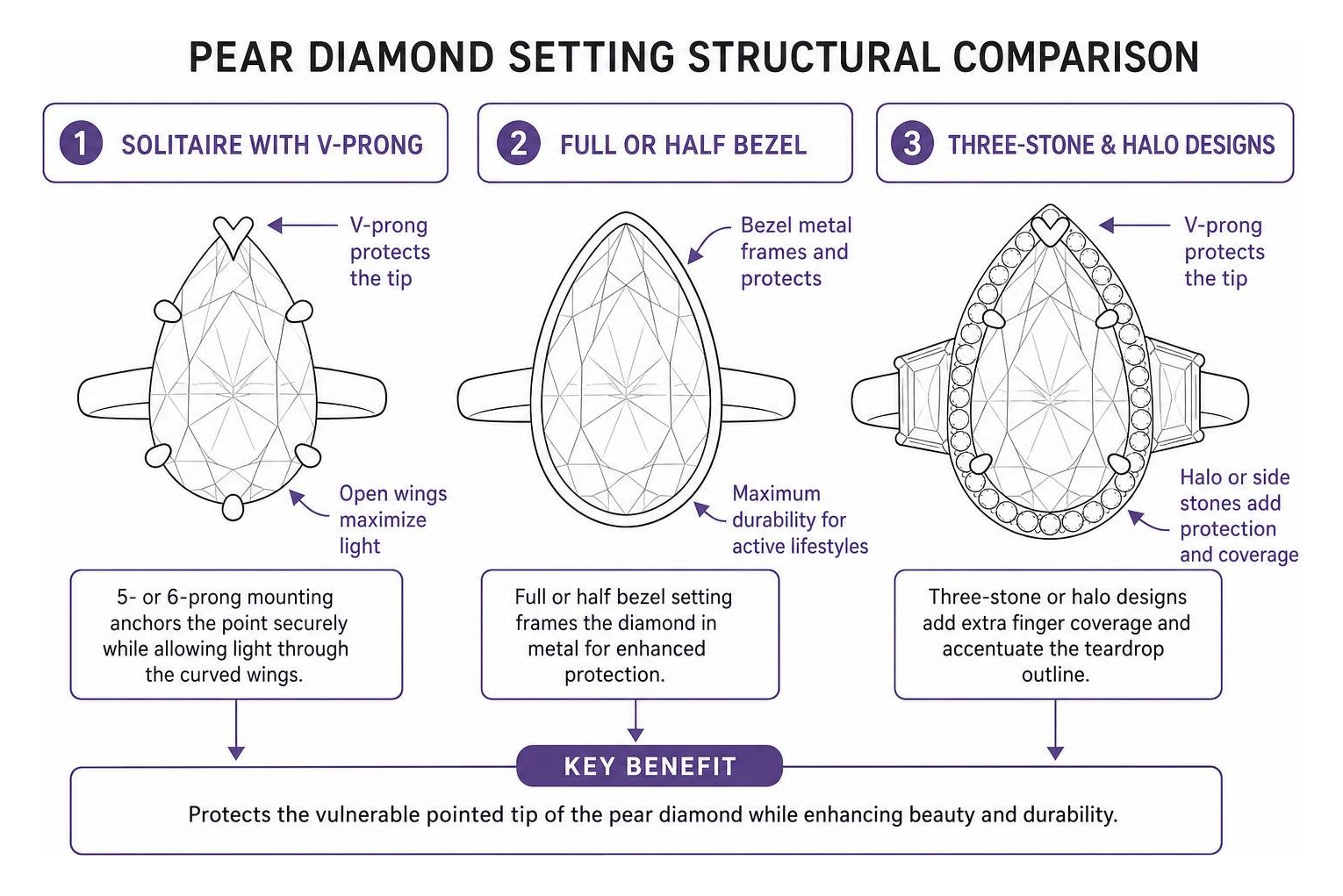
Popular mounting options include:
- Solitaire with V-Prong: A classic 5- or 6-prong mounting that leaves the curved wings open to catch light while anchoring the point securely.
- Full or Half Bezel: A modern, sleek protective bezel pear engagement ring frames the diamond in solid metal, offering maximum durability for active lifestyles.
- Three-Stone and Halo Designs: Pairing a 1 ct center pear with tapered baguettes or a delicate pavé halo creates extra finger coverage and accentuates the teardrop outline.
Metal selection should also complement the diamond’s color grade. Cool metals like platinum and white gold highlight icy E–G stones, while warm yellow and rose golds flatter stones in the I–K range.
Common Pitfalls to Avoid When Selecting a Pear Cut
Fancy-cut diamonds require careful evaluation to avoid cut irregularities that can compromise their appearance. Watch out for these common issues:
- Severe Bow-Tie Effect: All elongated fancy shapes feature some light variation in the center, appearing as two dark triangular wings resembling a bow-tie. A subtle bow-tie adds contrast and depth, but an overly dark, opaque shadow indicates light leakage and poor pavilion faceting.
- Uneven Shoulders and Flat Wings: The rounded end should form a smooth semi-circle. Look out for flat spots along the curved wings or asymmetrical shoulders that make one side look heavier than the other.
- Overly Thick or Knife-Edge Girdles: An extremely thick girdle hides unusable dead weight that inflates the price without adding face-up size. Conversely, an extremely thin girdle around the tip increases the risk of chipping during daily wear.
- Inconsistent Grading Reports: Always purchase diamonds with independent laboratory certification from the GIA (Gemological Institute of America) or AGS (American Gem Society). Lesser-known grading labs often inflate color and clarity grades by one to two levels, leading buyers to overpay for lower-quality diamonds.
Frequently Asked Questions About 1 Carat Pear Diamonds
Does a 1 carat pear diamond look bigger than a 1 carat round diamond?
Yes. Thanks to its elongated shape and balanced depth-to-spread ratio, a 1 ct pear diamond offers a face-up surface area of roughly 36.01 mm², compared to 32.67 mm² for a 1 ct round brilliant. This gives the pear cut a visibly larger footprint on the hand.
What is the most flattering length-to-width ratio for a pear diamond?
The classic sweet spot is between 1.55 and 1.68, with 1.66 serving as a benchmark. This proportion strikes an elegant balance between a full, rounded bottom and a slender, tapered point, offering an elongating effect on the finger without appearing too narrow.
Why is lab certification from GIA or AGS essential for pear cuts?
Because fancy cuts do not receive standardized cut grades from most laboratories, accurate grading for color, clarity, polish, and symmetry is critical. GIA and AGS provide strict, reliable standards, ensuring you pay a fair market price for verified diamond characteristics.
Conclusion
A 1 ct pear shaped diamond combines timeless elegance with an elongated silhouette that maximizes finger coverage and brilliance. By focusing on a balanced depth (59%–65%), eye-clean SI clarity, an H or J color grade matched to your metal choice, and reliable GIA or AGS certification, you can find an exceptional stone that balances beauty and value.
At Rudy Santayana Fine Jewelry in Coral Gables, we handcraft custom engagement rings designed around your individual style and stone preferences. To explore styling tips and find the right orientation for your ring, review our guide on how you wear a pear shaped diamond ring or contact our design team to begin creating your custom piece.