Real Sparkle on a Budget and What You Should Fairly Pay
What Should You Fairly Pay for a Lab Diamond in 2026?
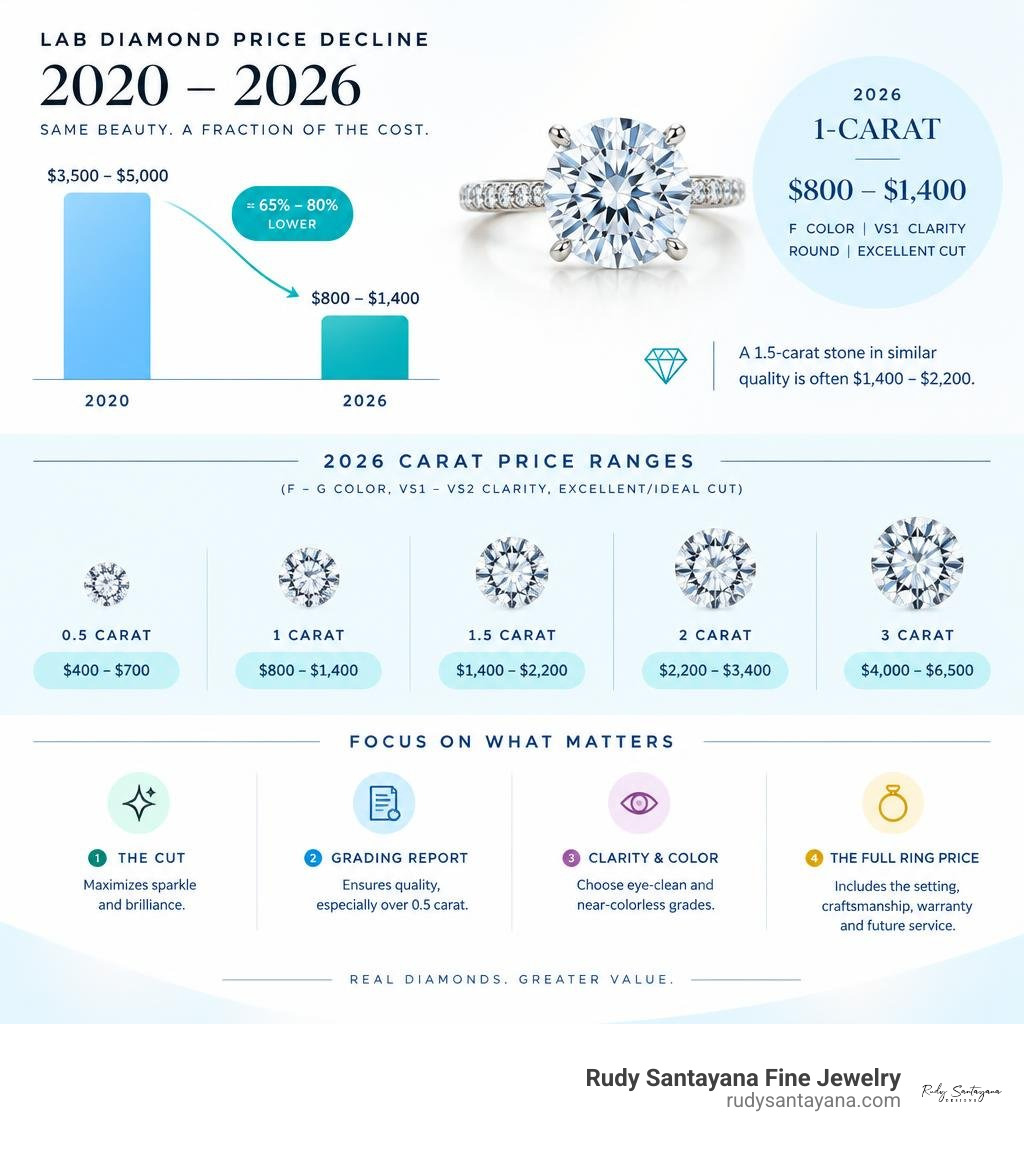
The cost of lab diamonds is far lower than it was a few years ago. In 2026, a well-cut 1-carat round lab diamond with F color and VS1 clarity commonly sells for about $800 to $1,400, versus roughly $3,500 to $5,000 in 2020. A 1.5-carat stone in similar quality is often $1,400 to $2,200.
For the best value, prioritize these factors in order:
- Excellent or Ideal cut, because it has the biggest effect on sparkle.
- A reliable grading report, especially for diamonds over 0.5 carat.
- Eye-clean clarity and near-colorless color, rather than paying extra for grades most people cannot see.
- The full ring price, including the setting, craftsmanship, warranty, and future service.
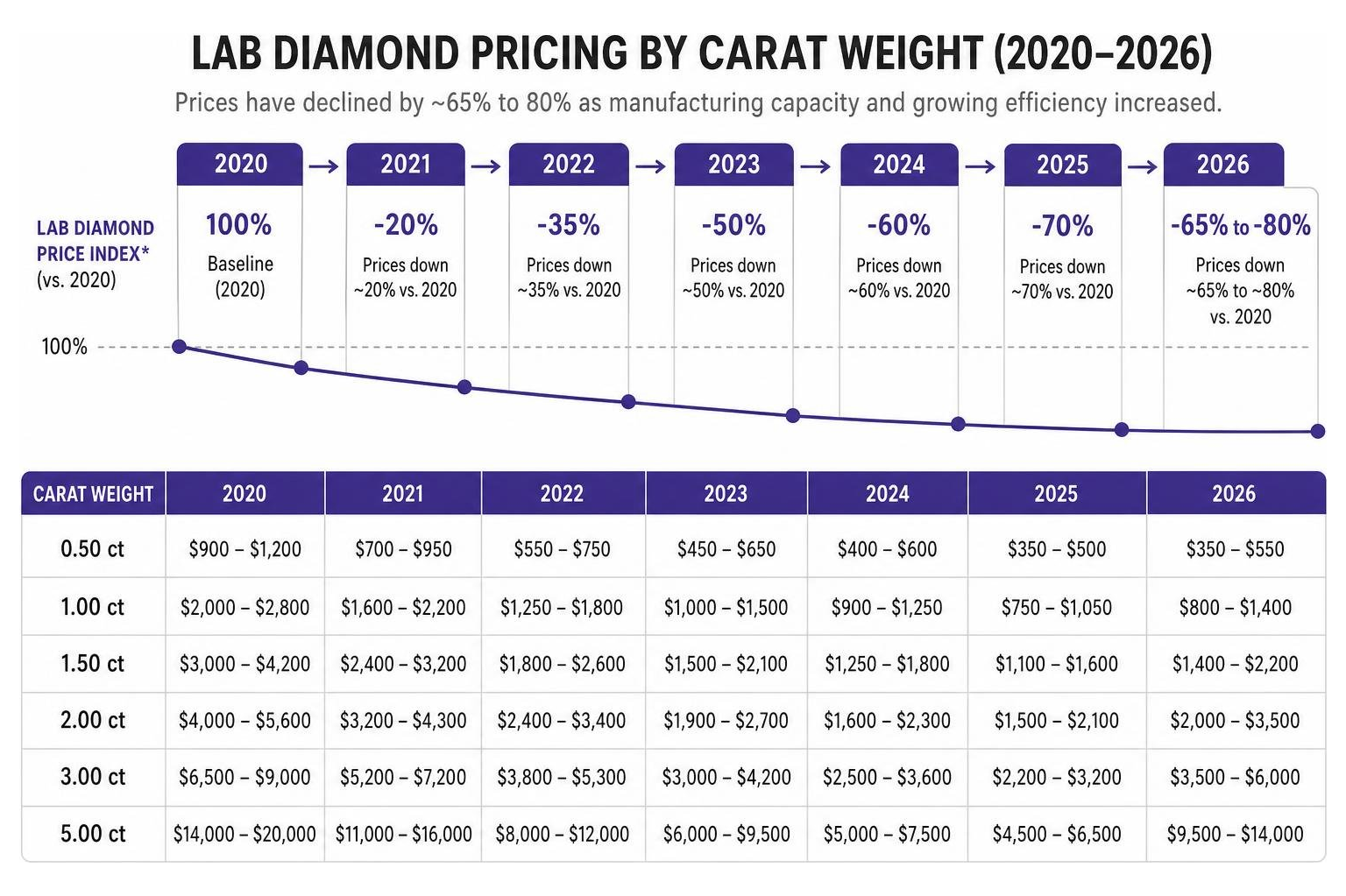
Lab diamonds are real diamonds: they have the same carbon structure, hardness, and visual fire as mined diamonds. Their lower price reflects scalable production, not a lesser material. Since 2020, expanding manufacturing capacity and lower growing costs have pushed lab diamond prices down by roughly 65% to 80%, giving buyers more size and quality for the same budget.
I am Rudy Santayana, a Miami fine jewelry designer specializing in custom jewelry, bridal pieces, redesigns, and personal guidance on the cost of lab diamonds. The next sections explain what changes the price, what a fair range looks like by carat weight, and how to choose a stone that feels as exceptional as it looks.
Understanding the Current Cost of Lab Diamonds by Carat Weight
The market for created gems has fundamentally shifted how we budget for fine jewelry. Today, the price difference between lab-grown and mined gems widens exponentially as carat weight climbs. While natural diamonds climb in price at an accelerating, non-linear rate due to the sheer rarity of large rough crystals found in nature, lab-created diamonds scale at a much more predictable rate based on furnace run times and cutting labor.
To give you a clear view of where the market stands in September 2026, here is how typical price ranges compare across carat weights for benchmark-quality stones (F–G color, VS1–VS2 clarity, Excellent/Ideal Cut):
| Carat Weight | Average Lab Diamond Price (2026) | Average Natural Diamond Price (2026) | Typical Savings (%) |
|---|---|---|---|
| 0.50 ct | $350 – $550 | $1,200 – $1,900 | ~71.6% |
| 1.00 ct | $800 – $1,400 | $4,200 – $6,500 | ~78% – 80% |
| 1.50 ct | $1,400 – $2,200 | $9,000 – $15,000 | ~82% – 85% |
| 2.00 ct | $2,000 – $3,500 | $16,000 – $26,000 | ~85% – 87% |
| 3.00 ct | $3,500 – $6,000 | $45,000 – $75,000 | ~88% – 90% |
| 5.00 ct | $9,500 – $14,000 | $105,000 – $140,000 | ~89% – 91% |
As outlined in recent industry data such as the Lab Diamond Prices in 2026 report, wholesale shifts have compressed retail margins. A benchmark 1-carat G/VS2 round brilliant diamond that trades at roughly $1,060 in the lab-grown market sits against a $4,850 natural counterpart—a 78.1% discount. At the extreme luxury tier (such as a 1-carat D/IF stone), a lab gem sells near $2,180 compared to over $14,800 for a natural diamond.
Key Factors Influencing the Cost of Lab Diamonds Today
While carat weight sets the baseline, several technical variables determine where an individual stone falls on the pricing spectrum:
- The 4Cs (Cut, Color, Clarity, Carat): Just like mined gems, lab stones are graded on the universal 4Cs scale. However, because growing diamonds allows for higher baseline purities, you should never overpay for technical perfection. A stone graded F-G in color and VS1-VS2 in clarity offers an identical face-up appearance to a flawless stone at a fraction of the cost.
- Independent Certification: Always demand an independent grading report from reputable laboratories such as the International Gemological Institute (IGI) or the Gemological Institute of America (GIA). IGI certifies the vast majority of lab-grown diamonds, while GIA provides digital reports verifying growth origin and cut specifications.
- Growth Method (CVD vs. HPHT): Diamonds are grown using either Chemical Vapor Deposition (CVD) or High Pressure High Temperature (HPHT). HPHT can sometimes leave subtle metallic flux inclusions or faint blue nuances (the "blue nuance" effect), while CVD diamonds might exhibit internal strain graining or require post-growth heat treatment to remove brownish undertones. Top-tier stones from both methods look identical once cut, but untreated, high-transparency crystals command a small market premium.
For a deeper dive into optimizing these specifications, explore our comprehensive lab diamond ring buying guide.
Popular Cuts and Settings: From Princess to Oval Stones
Diamond shape plays a subtle but noticeable role in final pricing. Round brilliant cuts require the most rough diamond crystal to be polished away (often losing up to 60% of the raw stone), making them slightly more expensive per carat than fancy shapes.
Fancy shapes utilize rough crystal geometry more efficiently:
- Square cuts like the lab grown princess cut diamond offer crisp geometry and great brilliance at roughly 10% to 15% less per carat than rounds.
- Elongated shapes like ovals, radiants, and emerald cuts maximize surface spread, giving you a visually larger appearance per carat. A ring featuring a 2 carat oval lab grown diamond ring will often appear noticeably larger on the finger than a 2-carat round brilliant while costing virtually the same or slightly less.
When budgeting for a finished piece, the mounting and artisanal setting labor remain consistent regardless of diamond origin. A handcrafted 18k gold or platinum mounting generally ranges from $900 to $2,500 depending on complexity, metal weight, and accent stones.
Why Have Lab-Grown Diamond Prices Dropped Since 2020?
The dramatic price collapse of lab-grown diamonds—falling roughly 68% between 2020 and 2026—is a classic story of technological maturity, industrial scaling, and manufacturing efficiency. In 2020, growing gem-quality diamonds was a specialized, energy-intensive process with limited global reactor capacity.
Between 2020 and 2025, massive capital investment in major manufacturing hubs in India and China changed everything:
- Explosive Synthesis Capacity: Rough diamond production in facilities across India surged by an estimated 400%, flooding the wholesale pipeline with consistent rough material.
- Collapsing Production Costs: The cost to grow a 1-carat gem-quality diamond fell from $300–$400 in 2022 to under $100 per carat today.
- Reactor Efficiency: Modern microwave plasma CVD reactors can grow dozens of high-carat crystals simultaneously with lower electricity consumption and significantly shorter cycle times.
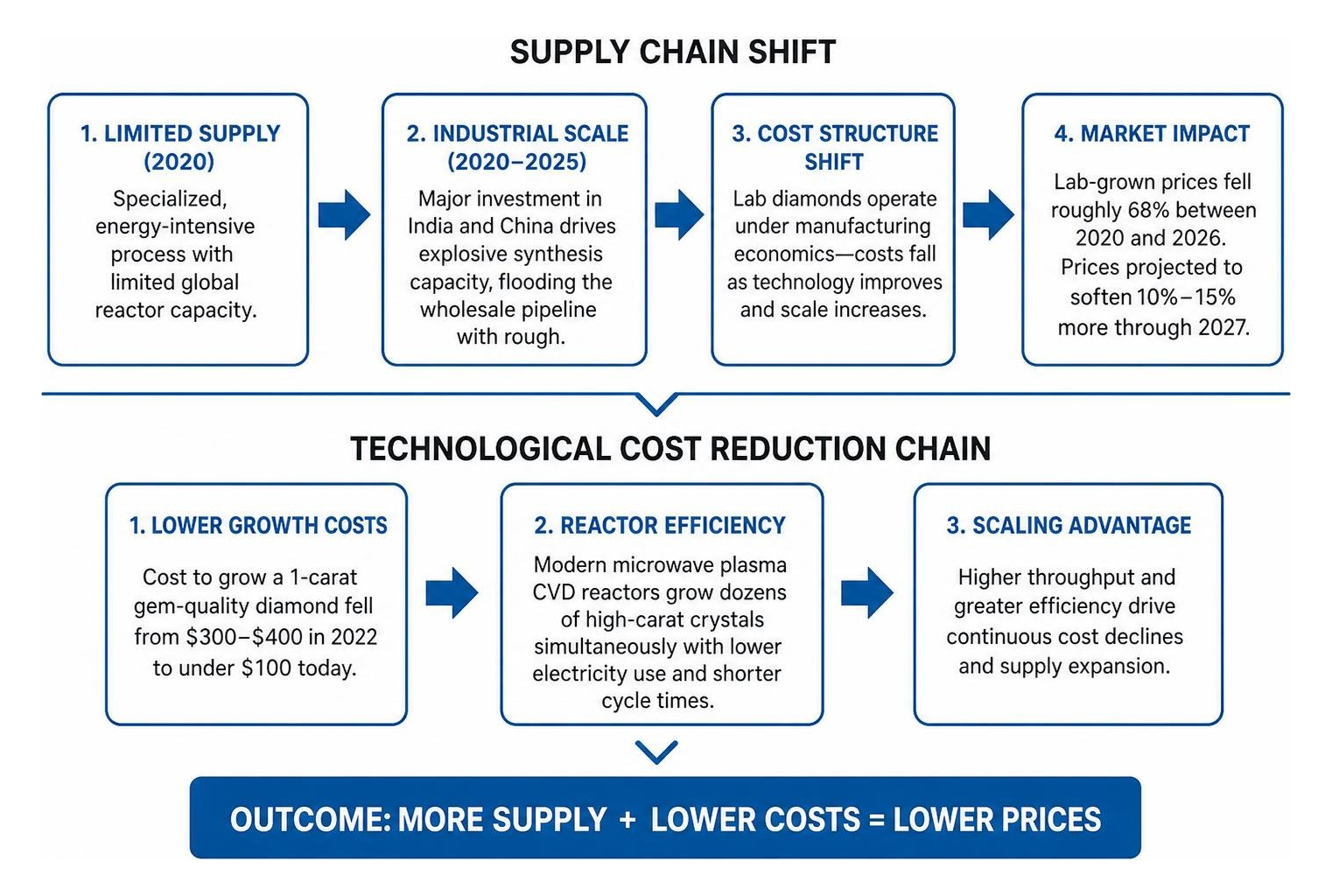
While natural diamond supply is constrained by geological discovery and expensive mining operations (with mining leaders cutting output by over 20% since 2022 to balance inventory), lab diamonds operate under manufacturing economics. As technology improves, production costs decline.
Market Trends and Future Price Projections Through 2027
Are we heading toward zero? No. While prices are projected to experience modest softening of around 10% to 15% through 2027—eventually stabilizing retail discounts around 82% to 85% compared to natural diamonds—the market is rapidly reaching its structural floor.
The cost of precision diamond cutting, laser sawing, master stone setting, independent lab grading fees ($40 to $100 per certificate), and precious metal mountings cannot be automated away. As wholesale margins compress, manufacturers are already beginning to curtail excess production runs to defend baseline profitability. If you are navigating current market conditions, reviewing our guide to buying artificial diamonds in 2026 will help you make a well-timed decision.
Lab vs. Natural Diamonds: Price, Quality, and Resale Comparison
The fundamental reality behind lab-grown stones is that they are chemically, physically, and optically identical to diamonds pulled from the Earth. Both consist of carbon atoms arranged in a tight cubic crystalline lattice, both measure a maximum 10 on the Mohs hardness scale, and both possess an identical refractive index of 2.42.
Under the Federal Trade Commission (FTC) guidelines, a diamond is a diamond regardless of origin. Even an experienced master jeweler using a standard gemological microscope cannot tell them apart without specialized spectroscopy equipment designed to analyze nitrogen aggregation patterns.
According to the comprehensive Natural vs Lab Diamond Price Report 2026, the primary distinction lies entirely in price structure and secondary market dynamics. For a complete look at these differences, read our breakdown comparing lab diamond rings vs real mined stones.
Evaluating the Resale Cost of Lab Diamonds vs. Mined Diamonds
If there is one area where buyers need absolute transparency, it is resale value. Diamonds—whether lab or mined—should never be purchased purely as financial investments. However, their secondary market behaviors differ significantly:
- Natural Diamonds: Retain roughly 45% to 55% of their original wholesale cash value on the secondary market over time due to genuine geological scarcity and established global auction networks.
- Lab-Grown Diamonds: Generally retain only 5% to 15% of their initial purchase price on resale. Because new stones are constantly grown at lower manufacturing costs, jewelers and diamond wholesalers will rarely buy back pre-owned lab diamonds at retail levels.
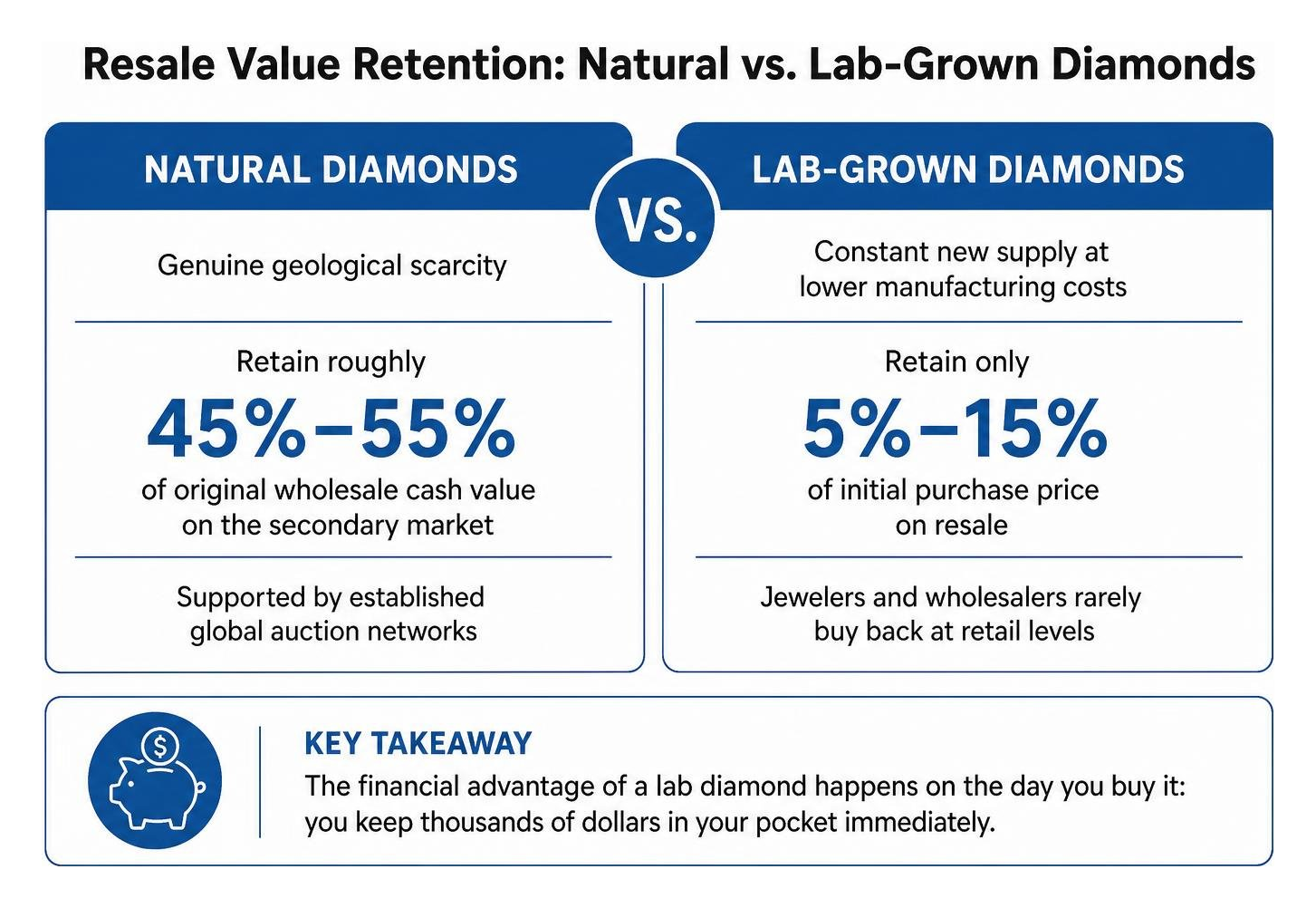
The financial advantage of a lab diamond happens on the day you buy it: you keep thousands of dollars in your pocket immediately rather than locking that capital into an asset hoping for future value retention.
Choosing the Right Diamond for Your Budget and Purpose
Choosing between natural and lab-grown comes down to your personal values, aesthetic desires, and long-term intentions:
Choose Lab-Grown If:
- You want the largest, most visually impressive diamond possible within your target budget.
- You prefer to allocate your savings toward a home down payment, honeymoon, or wedding celebration.
- You love modern fine jewelry staples like daily-wear sparkling artificial diamond studs or full-circle eternity rings with lab grown diamonds.
- You want a show-stopping custom 2 carat man made diamond ring without paying five figures.
Choose Natural If:
- You value geological rarity, ancient history (stones formed billions of years ago), and provenance.
- You are creating an heirloom piece intended to preserve intrinsic tangible value across generations.
- Cultural or family traditions place significant sentimental weight on natural origins.
Smart Buying Strategies: Maximizing Value in 2026
To get the most visual beauty for every dollar spent, follow these jeweler-approved strategies:
- Prioritize Cut Above All Else: Cut quality controls 90% of a diamond's brilliance, fire, and scintillation. An Excellent or Ideal cut diamond will mask minor inclusions and appear whiter than a poorly cut stone with superior clarity grades. Never compromise on cut proportions, table percentage (54–57% for rounds), and depth percentage (61–62.5%).
- Aim for the Clarity Sweet Spot (VS1–VS2): In lab diamonds, VS1 and VS2 grades are virtually always 100% eye-clean, meaning no imperfections are visible to the naked human eye. Paying a premium for VVS1 or Flawless (FL) grades adds cost that can only be seen under a 10x gemological microscope.
- Opt for Near-Colorless (F to H): Once mounted in white gold, yellow gold, or platinum, an F, G, or well-selected H color diamond faces up brilliantly white. Unless you are setting a large diamond over 3 carats in a delicate platinum halo, there is rarely a need to pay the premium for D-color perfection.
- Invest in Custom Craftsmanship: Because the loose stone is far more affordable today, you can invest the difference into heavy, bespoke metalwork. Explore our collection of custom bespoke lab diamond jewelry to see how custom prongs, bezel settings, and balanced ring shanks elevate an affordable stone into a true luxury masterpiece.
Frequently Asked Questions About Lab Diamond Pricing
Will lab diamond prices keep dropping if I wait to buy?
While forecasters predict modest price declines of roughly 10% to 15% through 2027, the era of massive 50%+ annual drops is over. Today, the rough stone represents a smaller portion of the overall finished jewelry piece compared to precious metals, custom design labor, and retail certification. Waiting six to twelve months to save $100 on a $1,000 diamond is rarely worth delaying an engagement or milestone celebration.
Are lab diamonds chemically and visually identical to natural diamonds?
Yes. Lab diamonds are composed of pure carbon crystallized in the isometric crystal system. They exhibit identical physical, thermal, chemical, and optical characteristics. They will test as real diamonds on standard thermal and electrical diamond testers. The only difference is that lab diamonds feature a microscopic laser inscription on the girdle from the grading laboratory (IGI or GIA) noting their synthetic origin.
Why do larger carat lab diamonds offer bigger percentage discounts?
In nature, diamond crystals grow over billions of years under chaotic mantle conditions; finding a clean, gem-quality rough crystal large enough to yield a 3-carat or 5-carat cut diamond is extraordinarily rare, commanding an exponential rarity premium. In a laboratory, keeping a growth chamber running for an extra week allows a crystal to grow larger with minimal added expense. Consequently, the discount on lab stones widens from ~71% at half a carat to over 89% at 5 carats.
Conclusion
The evolution of the diamond market has handed unprecedented power to jewelry lovers. You no longer need to compromise on diamond size, clarity, or design beauty to stay comfortably within your budget. By focusing on cut quality, selecting practical color and clarity sweet spots, and pairing your stone with master bench craftsmanship, you can create a piece of fine jewelry that delivers exceptional daily luxury.
At Rudy Santayana Fine Jewelry in Coral Gables, we combine custom design innovation with personalized, transparent guidance. Whether you are designing an engagement ring or redesigning a family piece, we invite you to visit our Coral Gables studio or explore bespoke lab diamonds with our master jewelers today.