Why Smart Shoppers Are Choosing 2 Carat Emerald Cut Lab Grown Diamond Rings
Why Choose a 2-Carat Lab-Grown Emerald-Cut Diamond Ring?
A 2-carat lab-grown emerald-cut diamond ring gives you a bold, clean-lined look without paying natural-diamond prices. Start with a diamond that looks clear to the eye, often VS2 clarity or higher. Look for a length-to-width ratio of 1.30 to 1.50, then compare videos and face-up measurements before choosing a setting. Listed prices for the center diamond range from $206 to $2,829; the setting adds to the final cost.
Emerald cuts show broad flashes of light rather than the busy sparkle of a round diamond. Their large, open center also makes it worth checking each stone in person or on video. Because the step-cut facets act like a series of mirrors, the stone's optical performance depends heavily on precise alignment and polish. A well-cut emerald displays alternating light and dark planes that create the signature hall-of-mirrors effect, while a poorly proportioned stone can appear glassy or windowed in the center.
I'm Rudy Santayana, a Miami fine jewelry designer with experience in custom bridal jewelry. If you are researching how to choose a 2-carat emerald-cut lab-grown diamond ring, I can help you turn that idea into a personal design, starting with the diamond's value. Many shoppers are surprised to learn that a lab-grown emerald-cut diamond can offer the same physical, chemical, and optical properties as a mined diamond at a fraction of the cost. The key is understanding how cut quality, proportions, and clarity interact in a step-cut stone, which is exactly what this guide covers.
Understanding the Value of a 2-Carat Emerald-Cut Lab-Grown Diamond Ring
When exploring modern engagement rings, choosing a 2 carat man-made diamond ring offers exceptional value. Lab-grown diamonds share the identical chemical, optical, and physical composition of mined gems—they consist of pure carbon crystallized in a cubic lattice, scoring a 10 on the Mohs hardness scale. According to the Gemological Institute of America, grading standards for color, clarity, and cut apply equally to lab-grown and mined stones.
Because lab diamonds are cultivated in specialized laboratories using advanced High Pressure High Temperature (HPHT) or Chemical Vapor Deposition (CVD) processes, they bypass traditional mining overhead. As a result, man-made gems can be as much as 50% less expensive than mined diamonds of identical carat, color, and clarity. This price advantage extends across the entire quality spectrum, meaning you can often step up in color, clarity, or carat weight while staying within the same budget you might otherwise have allocated to a smaller or lower-grade stone.
Beyond cost, many shoppers appreciate the ethical and environmental considerations of lab-grown diamonds. Because these stones are created in controlled laboratory environments, they avoid the land disruption and supply-chain concerns sometimes associated with traditional diamond mining. For couples who value transparency in sourcing, a lab-grown emerald cut offers peace of mind alongside its architectural beauty.
| Metric / Factor | Excellent / Recommended Target | Budget / Commercial Standard | What to Watch Out For |
|---|---|---|---|
| Price (2ct Center Stone) | $1,200 – $2,829 (Top Color/Clarity) | $206 – $1,199 (Mid Tier) | Sub-$200 stones with structural tinting |
| Color Grade | D – F (Colorless) | G – H (Near Colorless) | I – K (Shows tint readily through step cuts) |
| Clarity Grade | VVS1 – VS1 | VS2 | SI1 – I1 (Inclusions visible under table) |
| Polish & Symmetry | Excellent | Very Good | Good or Fair (Distorts light reflection) |
| Cut Score | 8.5 – 10.0 (10-Point Scale) | 7.5 – 8.4 | Below 7.5 (Dull or windowed appearance) |
Price Analysis of a 2-Carat Emerald-Cut Lab-Grown Diamond Ring
In October 2026, pricing for a 2-carat emerald-cut lab diamond typically ranges between $206 and $2,829 depending on specific cut grades, optical performance, and growth purity. This accessible pricing means a 2-carat emerald-cut lab-grown diamond ring can deliver the same visual presence on the finger while leaving room in your budget for a custom setting, higher-quality accent stones, or a platinum band.
By taking advantage of our detailed emerald cut lab diamonds guide, smart shoppers can allocate significant savings toward custom metalwork, intricate halo details, or platinum mountings without compromising on center-stone presence. The market for lab-grown diamonds has matured considerably over the past several years, with improved growth technology producing stones that rival the finest mined emerald cuts in clarity and color consistency.
Visual Carat Weight vs Actual Carat Weight
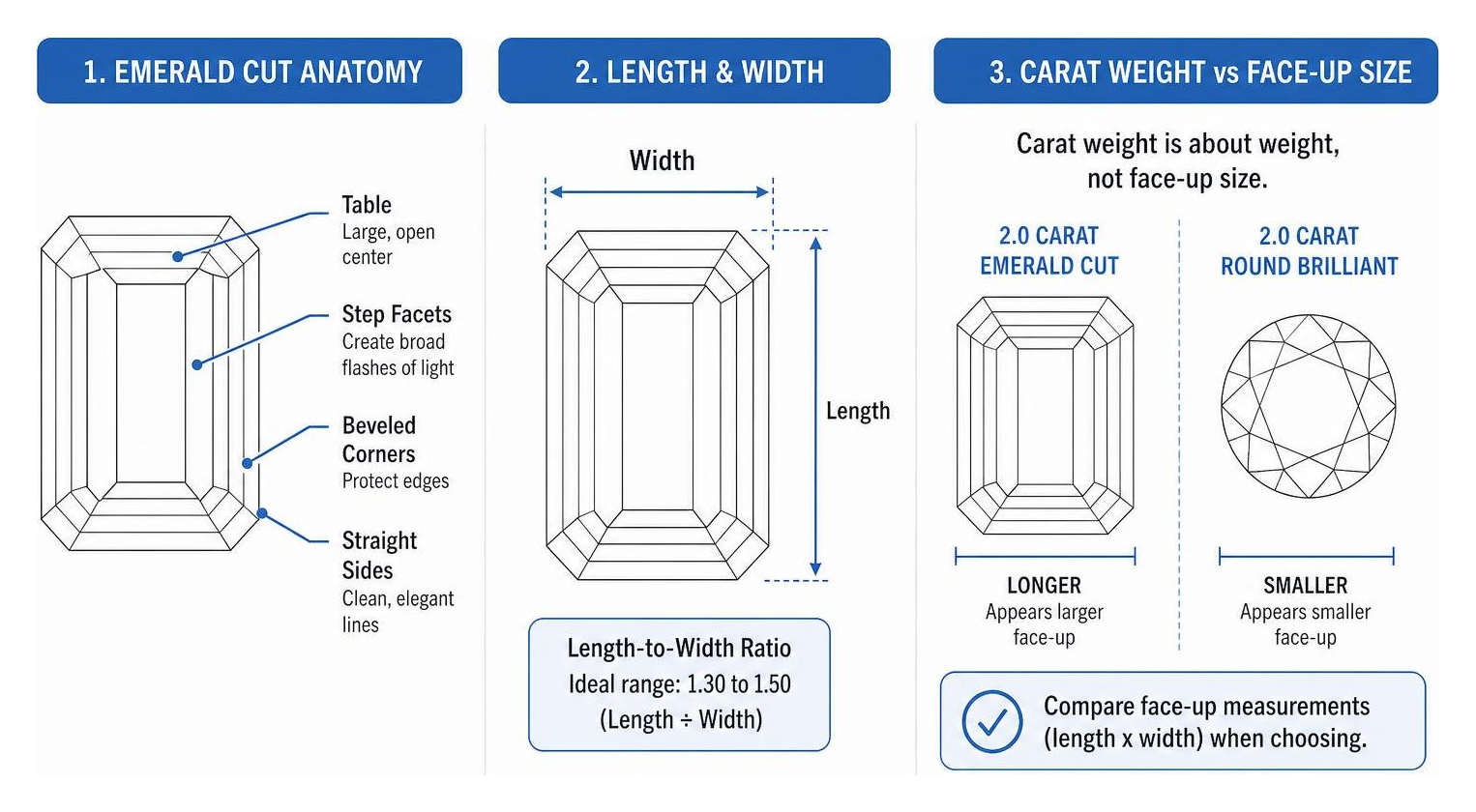
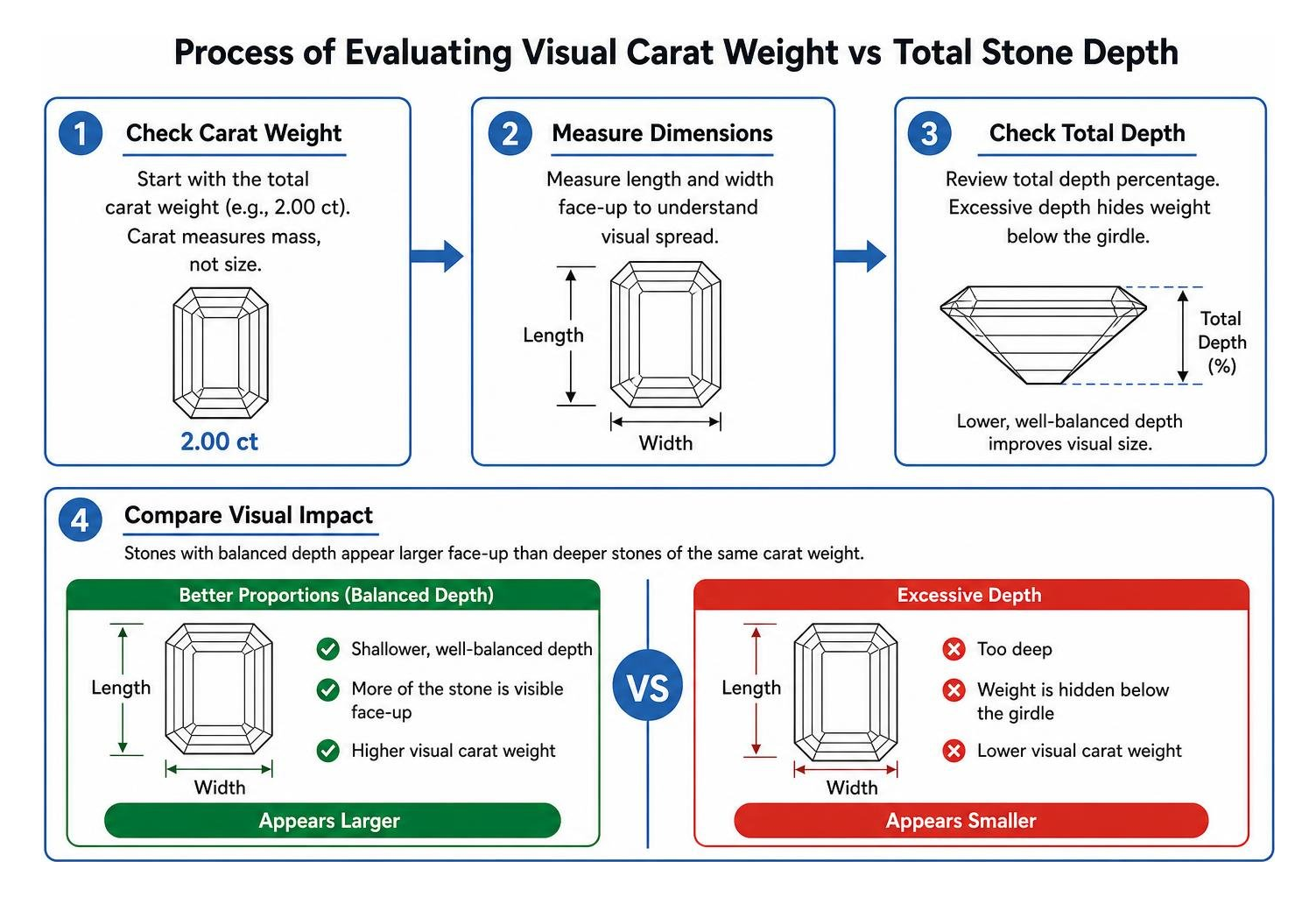
Carat weight measures diamond mass, not outer dimensions. Emerald cuts distribute weight differently across their rectangular geometry. Because they feature a large, open top table and step-cut facets, a well-proportioned 2-carat stone provides an impressive visual spread across the finger.
However, if an emerald cut has excessive depth, hidden carat weight sits below the girdle where nobody sees it. Choosing a stone with balanced depth gives you a higher "visual carat" measurement—delivering the appearance of a larger stone without paying for unseen bulk. When comparing stones, always check the face-up measurements in millimeters rather than relying on carat weight alone. Two 2-carat emerald cuts can differ noticeably in apparent size depending on how their weight is distributed between the table surface and the pavilion depth.
Diamond Quality Criteria for Emerald Cuts: Cut, Proportions, and Clarity
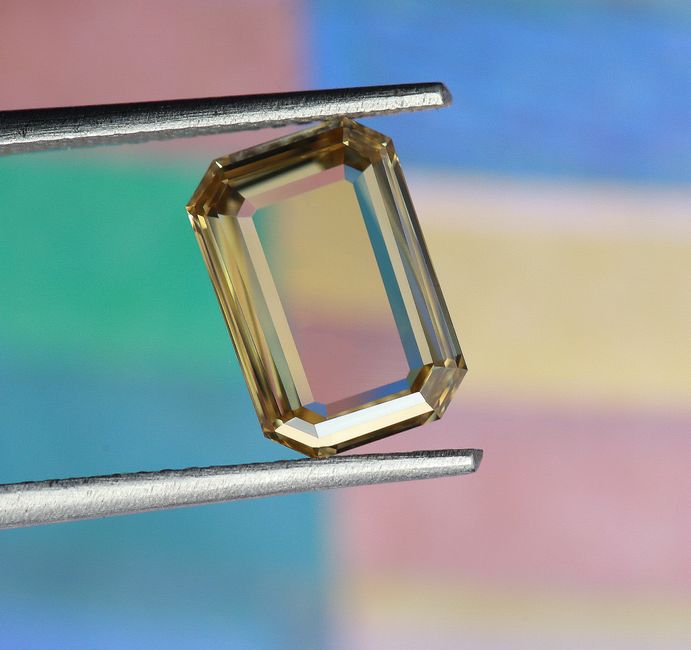
Unlike brilliant cuts designed to scatter light in countless directions, emerald cuts produce a distinctive "hall-of-mirrors" effect. This step-cut architecture requires careful attention to precision grading:
- Cut Score: While round diamonds carry standard GIA cut grades, fancy shapes rely on dimensional scoring. Aim for an algorithmic cut score of 7.5 or better on a 10-point scale (with elite emerald cuts scoring over 8.3) to ensure optimal light return.
- Polish and Symmetry: Select "Excellent" or "Very Good" polish and symmetry so that parallel step facets align precisely, bouncing light evenly across the stone.
Because emerald cuts lack the dozens of small facets that help mask cutting imperfections in brilliant shapes, every proportion matters. A slight misalignment in the step facets can create a visible dark band or a washed-out area that disrupts the clean, geometric look that makes this shape so appealing. When evaluating stones, pay particular attention to how the light moves across the table in video footage—a well-cut emerald should show crisp, alternating flashes rather than a single static reflection.
Length-to-Width Ratios and Proportions
An emerald cut's length-to-width (L/W) ratio determines its outline on your finger. While round cuts favor a 1.00 to 1.05 ratio, classic emerald cuts thrive between 1.30 and 1.50:
- 1.30 to 1.40: A slightly wider, classic rectangular outline.
- 1.40 to 1.50: The traditional elongated emerald silhouette preferred for lengthening the finger.
- Over 1.55: A slender, modern look.
For optimal brilliance, look for a table percentage of 61% to 69% and a depth percentage of 61% to 67%. Our comprehensive lab diamond ring buying guide breaks down these geometric relationships to help you find maximum fire and luster. These proportion ranges work together: a table that is too large can create a glassy, see-through center, while a table that is too small reduces the stone's face-up presence. Similarly, depth that falls outside the recommended range either hides weight below the girdle or makes the stone appear flat and lifeless.
The Importance of Color, Clarity, and Fluorescence
Because emerald cuts feature broad, transparent facets, internal characteristics are easier to spot than in round or cushion cuts.
- Clarity: The most common engagement ring clarity grades are VS2 and SI1. However, with an open emerald table, we recommend selecting VS2 or higher to ensure the stone remains eye-clean. The large, flat table acts like a window into the stone, so any inclusion positioned directly beneath it will be more visible than it would be in a brilliant cut with its fragmented facet pattern.
- Color: While H color is the most popular choice for general engagement rings, step cuts reveal body color more readily. D through F grades ensure absolute icy whiteness, though a well-cut G or H stone mounted in yellow or rose gold looks stunning. The warm tones of yellow and rose gold can complement a near-colorless stone, while white gold and platinum settings tend to emphasize any residual tint.
- Fluorescence: About 1 in 3 diamonds exhibits fluorescence under UV light. While strong fluorescence can occasionally make a diamond look hazy, faint or medium blue fluorescence in an H-color stone can actually cancel out slight yellow undertones, making the gem appear whiter in daylight. For emerald cuts specifically, it is worth checking how fluorescence affects the stone's transparency, since the open table makes any haziness more apparent than it would be in a brilliant shape.
Popular Setting Options and Styling Ideas
Choosing the right setting enhances the geometric elegance of your emerald cut. Explore our diamond engagement rings collection to see how various band profiles, metal tones, and accent stones complement step-cut diamonds.
The clean, architectural lines of an emerald cut make it one of the most versatile center stones for engagement ring design. Whether you prefer a minimalist solitaire that lets the diamond speak for itself or an ornate vintage-inspired mounting with intricate detail work, the elongated silhouette of the emerald cut provides a strong foundation for creative styling. Metal choice also plays a significant role: platinum and white gold emphasize the stone's cool brilliance, while yellow and rose gold create a warm contrast that highlights the geometric outline.
Setting Styles for a 2-Carat Emerald-Cut Lab-Grown Diamond Ring
We craft diverse mounting designs in our Coral Gables and Miami workshops to match every aesthetic:
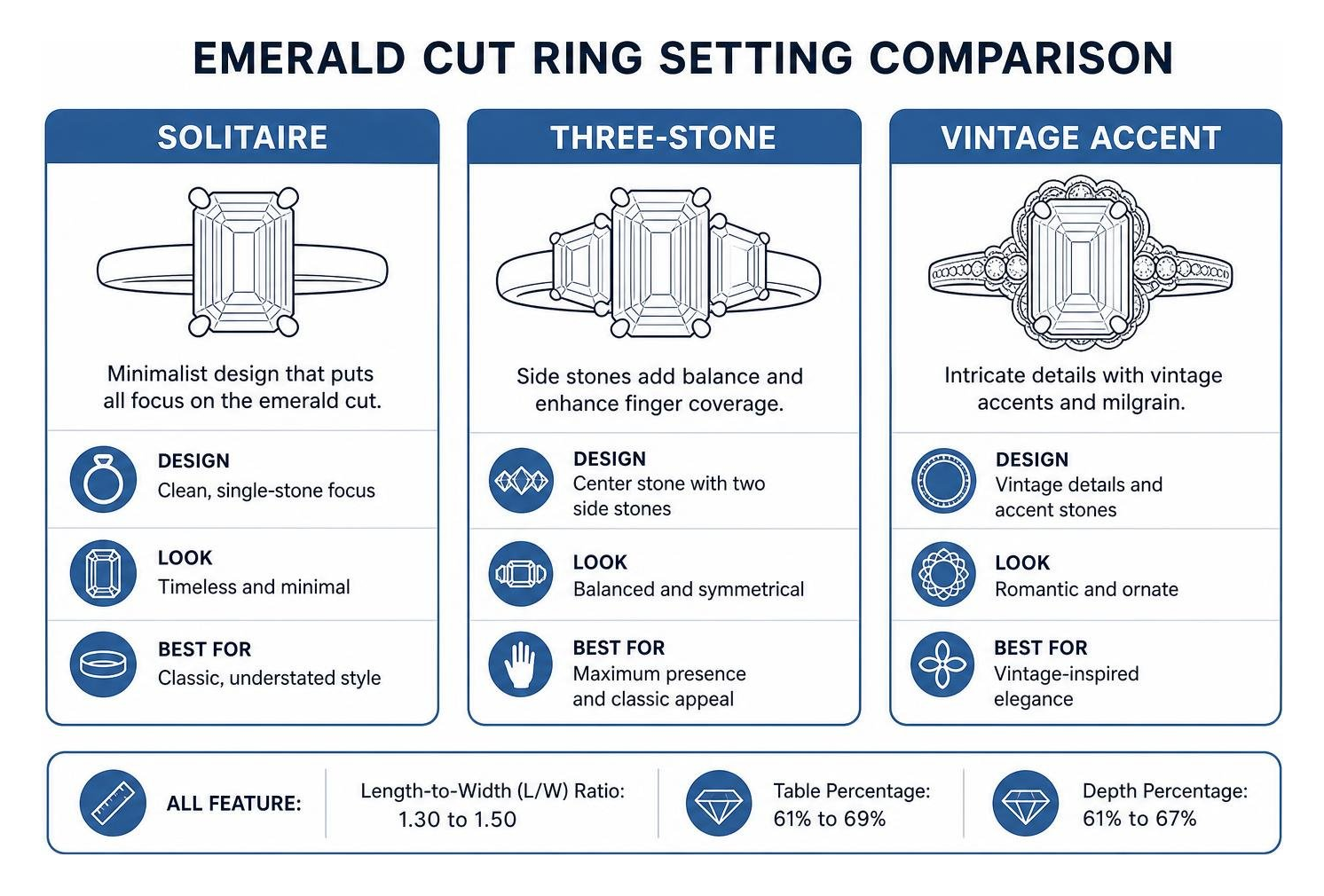
- Solitaire Mountings: A minimalist band puts full focus on the hall-of-mirrors effect. Our classic emerald cut lab diamond engagement ring showcases clean architectural lines in platinum or gold. The simplicity of a solitaire allows the step-cut facets to command attention without visual competition from accent stones.
- Three-Stone Arrangements: Flanking an emerald cut with trapezoids or tapered baguettes creates seamless balance. The three-stone emerald cut ring enhances finger coverage with classic Art Deco symmetry. Side stones that share the step-cut geometry of the center diamond create a continuous line of light across the finger.
- Vintage Accents: For ornate detail, our vintage emerald cut engagement ring incorporates delicate milgrain and hidden diamond halos. These hand-finished details add texture and personality while preserving the clean geometry of the center stone.
Frequently Asked Questions About 2 Carat Emerald Cut Lab Diamonds
What is the ideal length-to-width ratio for an emerald cut diamond?
The traditional ideal length-to-width ratio ranges from 1.30 to 1.50. A 1.40 ratio offers the classic rectangular silhouette, while ratios closer to 1.30 appear fuller and square-leaning. Ratios above 1.50 create a more slender, modern profile that can make the finger appear longer. The right choice depends on personal preference and hand proportions, but staying within the 1.30 to 1.50 range ensures the stone reads clearly as an emerald cut rather than a modified rectangle or elongated baguette.
Does a 2 carat emerald cut diamond look bigger than a round brilliant?
Yes, a 2-carat emerald cut often appears larger face-up than a 2-carat round brilliant. Because round cuts carry more depth in the pavilion, emerald cuts distribute weight across a wider top surface area, creating a larger visual spread. This is one of the reasons emerald cuts are so popular for engagement rings: they deliver impressive finger coverage without requiring a higher carat weight. When comparing stones, always look at the millimeter dimensions rather than carat weight alone to understand how large the diamond will actually appear.
What clarity grade is best for an emerald cut diamond?
We recommend VS2 clarity as the sweet spot for value and beauty. Because the broad table of an emerald cut creates a clear window into the stone, always verify that any inclusions in a VS2 diamond sit near the outer edges rather than directly beneath the center table. Inclusions positioned under the table are far more visible than those tucked near the girdle, where a prong or setting detail can mask them. For shoppers who want absolute peace of mind, a VS1 or VVS2 grade offers an extra margin of clarity while remaining significantly more affordable than a comparable mined diamond.
Conclusion
A 2-carat lab-grown emerald-cut diamond ring combines architectural elegance, high visual spread, and exceptional value. By paying close attention to length-to-width proportions, cut quality, and clean clarity grades, you can secure an heirloom-quality centerpiece at an accessible investment level. The step-cut geometry of the emerald shape rewards careful selection: a well-chosen stone delivers the dramatic hall-of-mirrors effect and impressive face-up presence that make this cut so enduringly popular.
At Rudy Santayana Fine Jewelry, we handcraft custom, innovative pieces with dedicated personal service in Coral Gables and Miami, Florida. Browse our curated lab grown diamond jewelry collection or schedule a consultation for custom lab grown diamond jewelry to design your bespoke ring today. Whether you are drawn to a minimalist solitaire, a three-stone arrangement with tapered baguettes, or a vintage-inspired mounting with hand-finished details, our team can guide you through every step of the process—from selecting the ideal 2-carat emerald-cut lab-grown diamond to crafting a setting that reflects your personal style.