Everything You Need to Know Before Buying an Eternity Ring with Lab Diamonds
Understanding Eternity Rings Lab Grown Diamonds: History and Meaning
Before buying an eternity ring with lab grown diamonds, focus on four key considerations: choose between a full or half eternity band, select a secure setting that suits your lifestyle, get an exact finger measurement since full eternity rings cannot be resized, and verify that every diamond is certified for consistent 4Cs quality. These decisions shape both the ring's daily comfort and its long-term durability.
The eternity ring has captivated wearers for centuries. Its signature silhouette—a seamless, unbroken loop of gemstones—symbolizes eternal love, lifelong devotion, and continuous celebration. Traditionally exchanged during momentous milestones such as a significant wedding anniversary, the birth of a child, or a major personal achievement, the eternity band remains one of the most romantic expressions in fine jewelry.
Eternity bands account for roughly 15% of all diamond ring purchases worldwide. In recent years, lab-grown variations have seen a remarkable 35% year-over-year surge in popularity. Modern couples and jewelry lovers are drawn to the aesthetic of an unbroken circle of brilliance without the steep price premiums historically tied to natural mined gems.
When selecting an eternity band, you will primarily encounter two structural designs:
- Full Eternity Rings: Diamonds encircle the entire band with no bare metal showing. This creates continuous sparkle from every single angle.
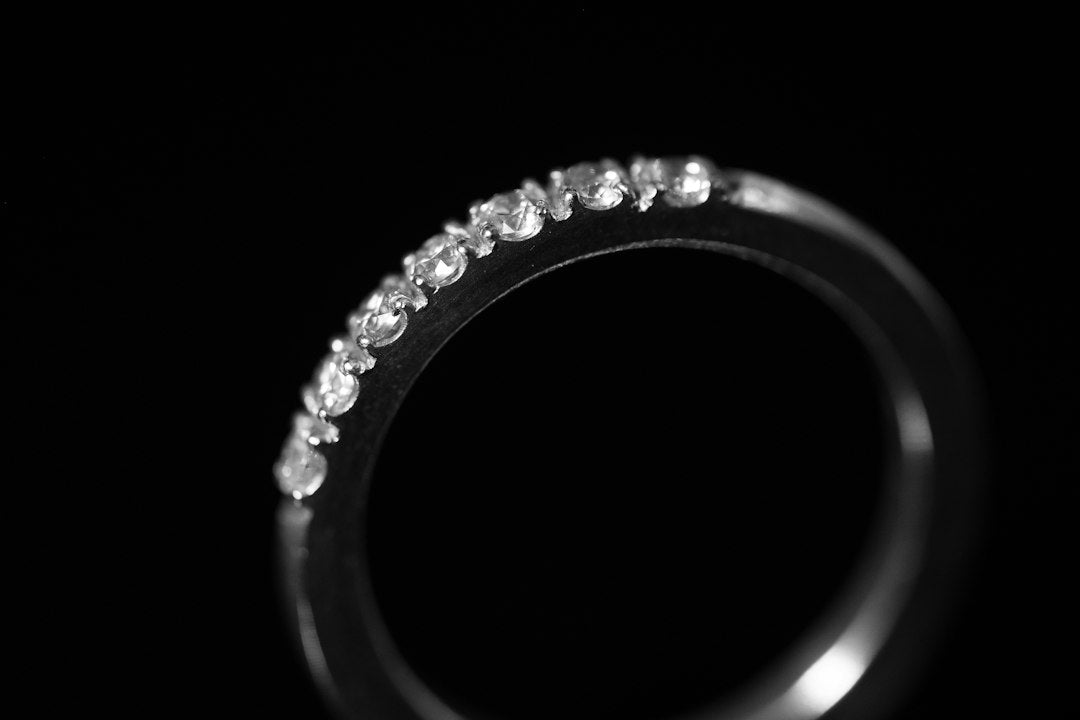
- Half Eternity Rings: Stones cover the top half (or three-quarters) of the band, leaving the underside in solid precious metal.
A full lab diamond eternity band provides unmatched luxury and visual continuity, making it a standout showstopper whether worn alone or stacked alongside an engagement ring. Half eternity designs provide extra flexibility if your fingers tend to fluctuate in size, while full bands offer that classic 360-degree brilliance.
Lab-Created Diamonds vs. Natural Diamonds: Science and Benefits
A common misconception is that lab-created stones are diamond imitations like cubic zirconia or moissanite. In reality, lab diamonds are 100% authentic diamonds. They possess the exact same chemical composition (pure carbon arranged in a cubic crystal lattice), physical properties, and optical brilliance as diamonds pulled from deep within the earth.

Modern gemological laboratories produce these stones using two primary techniques:
- Chemical Vapor Deposition (CVD): A microscopic diamond seed is placed into a vacuum chamber filled with carbon-rich gases (such as methane). When heated to high temperatures, the gases break down into pure carbon atoms that deposit onto the seed layer by layer, crystallizing into a rough diamond.
- High Pressure High Temperature (HPHT): This method replicates the extreme geological conditions found deep within the earth’s mantle. Pure carbon is subjected to pressures exceeding 1.5 million pounds per square linear inch and temperatures around 2,700°F to form a rough gem.
Beyond the fascinating science, the real-world advantages of choosing lab-grown stones are substantial:
- Financial Savings: Lab diamonds typically cost 60% to 85% less than mined diamonds of equivalent cut, color, clarity, and carat weight. This lets you maximize your total carat weight or invest in a more intricate setting.
- Ethical & Environmental Integrity: Nearly 70% of jewelry buyers under 40 actively seek out lab-grown stones due to environmental transparency. In fact, a lab diamond produces roughly 0.028 grams of carbon per carat compared to 0.2 grams for a mined diamond—an estimated sevenfold decrease in overall emissions.
- Consistent Quality: Because growth environments are strictly monitored, lab-grown diamonds often exhibit exceptional crystal purity. To dive deeper into the differences and similarities, explore our comprehensive breakdown on lab diamond rings vs real.
Why Choose Eternity Rings Lab Grown Diamonds for Everyday Wear
Eternity rings are rarely kept tucked away inside a safe—they are designed to be worn and loved daily. Because lab-created stones register as a 10 out of 10 on the Mohs Hardness Scale, they are impervious to daily scratching from household surfaces, fabric, or other metal jewelry.
Investing in lab diamond jewelry allows you to achieve a substantial, premium look that can easily withstand everyday routines, from business meetings to weekend errands, without constant worry.
Popular Settings, Diamond Cuts, and Metal Options
Every detail of an eternity ring dictates how it reflects light, how comfortable it feels on your hand, and how well the stones remain secured over decades of wear.
Choosing Your Diamond Cut
- Round Brilliant: The gold standard for light return. Round diamonds maximize fire and scintillation, seamlessly complementing almost any existing ring stack.
- Oval Cut: Contemporary and flattering, oval stones elongate the finger while providing soft, curved edges with exceptional sparkle.
- Princess & Emerald Cuts: Geometric cuts offer a modern, architectural presence. Princess cuts deliver crisp, square brilliance, while emerald cuts present an understated, hall-of-mirrors step-cut luster.
Setting Types Compared
| Setting Type | Security Level | Brilliance & Light Entry | Daily Wear Comfort | Best Suited For |
|---|---|---|---|---|
| Shared Prong | High | Maximum | Moderate | Showcasing maximum diamond visibility with minimal metal |
| Channel Setting | Very High | Moderate | High | Active lifestyles; diamond edges are shielded by metal walls |
| Bezel Setting | Maximum | Moderate-High | Highest | Ultra-smooth finish; snag-free wear with distinct modern style |
| Pavé / Micro-Pavé | Moderate | High | High | Dainty bands with subtle, delicate texture and shimmer |
| Flush / Gypsy | Maximum | Subtle | Highest | Low-profile rings with completely flush gemstones |
When it comes to precious metals, platinum remains the premier choice for durability and hypoallergenic qualities. For a warm, classic look, 14k or 18k yellow and rose gold create gorgeous contrast against high-color lab diamonds. If you have a specific vision in mind, creating custom wedding bands in Miami FL allows you to select the exact stone size, cut, and metal profile to match your personal aesthetic.
Selecting the Best Settings for Eternity Rings Lab Grown Diamonds
When designing or choosing your eternity band, consider finger spacing and ring height. Prongs that sit too high can cause rubbing between adjacent fingers. A low-profile basket or a softly contoured shared-prong setting ensures comfortable, natural movement throughout the day.
Quality Verification, Certification, and Value Considerations
Just like mined diamonds, lab diamonds are evaluated according to the classic 4Cs: Cut, Color, Clarity, and Carat weight. The Gemological Institute of America provides a widely recognized diamond grading framework that explains how each characteristic affects a stone's appearance and value.
In a multi-stone eternity band, consistency across every individual diamond is essential. If a single stone leans slightly warm or has an obvious inclusion, it disrupts the visual harmony of the entire ring. At Rudy Santayana Fine Jewelry, we hand-match every diamond for color grade (typically DEF colorless) and clarity (VS+), ensuring an even, luminous line of fire all the way around.
Always verify that your jewelry is accompanied by independent grading documentation from reputable institutes such as the International Gemological Institute (IGI) or the Gemological Institute of America (GIA). Our detailed lab diamond ring buying guide breaks down exactly what to look for on a laboratory grading certificate.
Understanding Long-Term and Resale Value
The global lab-grown diamond market was valued at approximately $22.8 billion in 2023 and is projected to climb to $55.6 billion by 2033. As production technology advances, supply continues to expand, which keeps retail prices approachable.
When considering resale value, it is helpful to keep market expectations realistic:
- Neither mined nor lab diamonds should be purchased primarily as liquid financial investments; fine jewelry is an emotional, sentimental heirloom.
- Because lab-grown diamonds save you 60% to 85% at the point of purchase, your upfront savings remain immediately in your pocket.
- Mined diamonds typically yield 20% to 50% of their original purchase price on the secondary market due to substantial retail markups, while secondary market liquidity for lab-created stones continues to mature.
Proper Sizing, Care, and Ring Maintenance
Because full eternity rings feature a continuous perimeter of stones and prongs, traditional ring resizing is often impossible without compromising the setting's integrity. For this reason, getting an exact measurement upfront is crucial.
That your finger size can shift depending on the weather, hydration levels, and the overall width of the band. Wider eternity bands generally require sizing up by a quarter to a half size for a relaxed, comfortable fit.
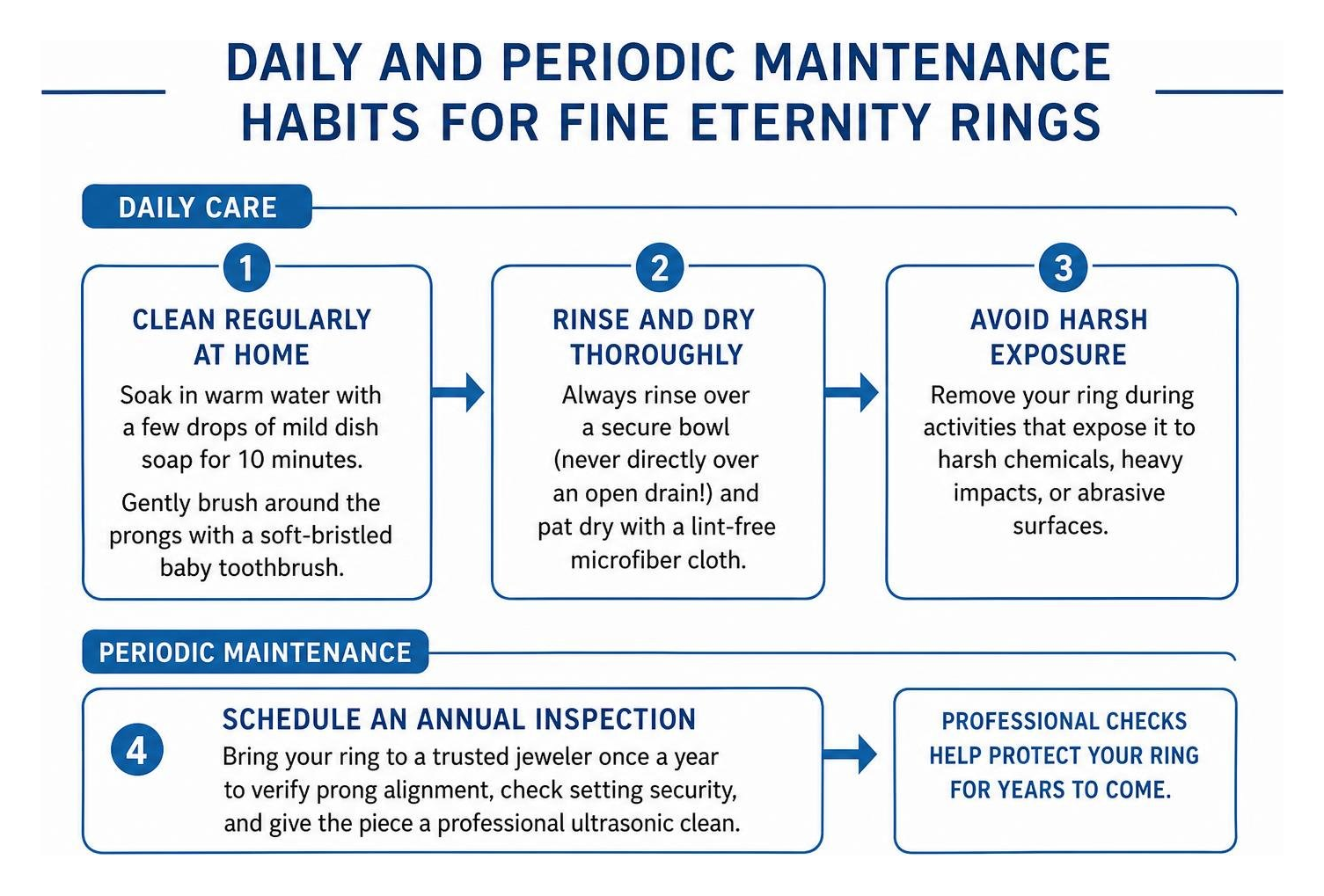
Daily Care Best Practices
- Clean regularly at home: Soak your ring in warm water mixed with a few drops of mild dish soap for 10 minutes. Gently brush around the prongs with a soft-bristled baby toothbrush to remove trapped hand lotions and oils.
- Rinse and dry thoroughly: Always rinse over a secure bowl (never directly over an open drain!) and pat dry with a lint-free microfiber cloth.
- Schedule an annual inspection: Bring your ring to a trusted jeweler once a year to verify prong alignment, check setting security, and give the piece a professional ultrasonic clean.
- Remove during heavy impact activities: Take off your eternity band before weightlifting, rigorous yard work, or using abrasive chemical cleaners to protect the delicate metal setting.
Frequently Asked Questions About Lab Diamond Eternity Bands
Can a lab diamond full eternity ring be resized later?
Full eternity bands typically cannot be resized due to the continuous ring of diamonds encircling the metal band. Expanding or compressing the ring can bend the prongs, leading to loose or lost stones. If you anticipate your ring size changing, opt for a half or three-quarter eternity band, which preserves a smooth metal section at the base for easy adjustments.
Do lab grown diamonds test as real diamonds?
Yes. Because lab-grown diamonds share the identical carbon crystal lattice, thermal conductivity, and electrical properties of mined diamonds, standard diamond testers will verify them as real diamonds. Only specialized gemological equipment used by labs like IGI or GIA can distinguish lab growth patterns from geological diamond formations.
How do lab diamond eternity rings compare in resale value to mined diamonds?
Both mined and lab-grown diamonds experience depreciation on the secondary retail market. However, because lab diamonds are priced 60% to 85% lower upfront, buyers avoid massive retail markups from the start, making the initial investment significantly more affordable.
Conclusion
An eternity ring is more than just an exquisite piece of jewelry—it is a lasting symbol of cherished milestones, enduring love, and unique personal style. By choosing lab-grown diamonds, you gain access to exceptional clarity, brilliant carat weights, and ethical sourcing, all while staying well within your budget.
At Rudy Santayana Fine Jewelry, we handcraft custom, innovative pieces tailored to your exact preferences. Whether you are searching for a sleek bezel band or a bespoke multi-carat shared-prong ring, our Coral Gables team is here to bring your vision to life.
Explore our comprehensive guide to lab diamonds to discover the endless possibilities of lab-created luxury, or visit our showroom to design the eternity band of your dreams.