Lab Diamond Rings vs Real Mined Stones Comparison Guide
Lab Diamond Rings vs Real Mined Diamonds: The Quick Answer
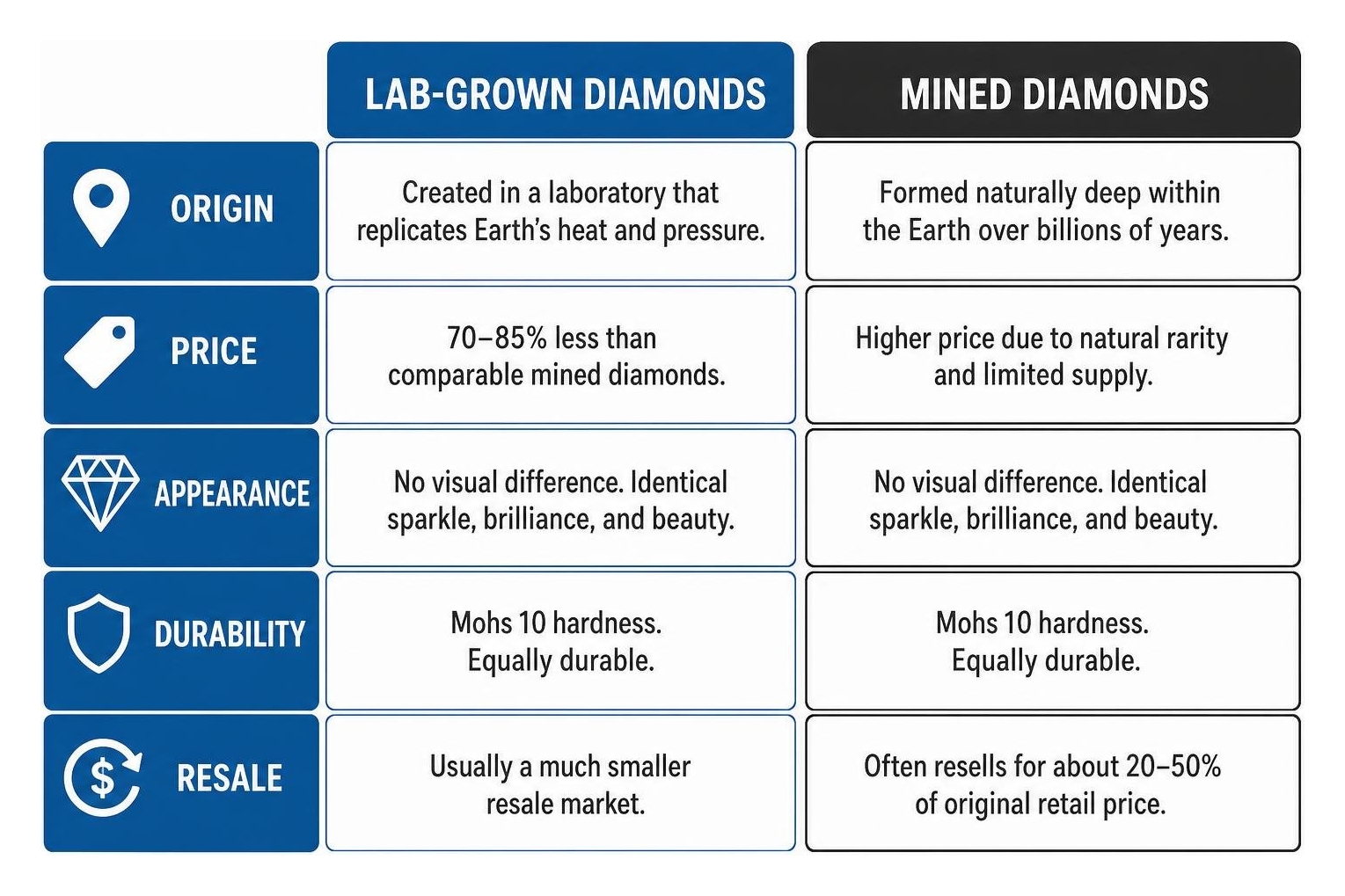
Lab-grown diamonds are real diamonds. They have the same carbon makeup, sparkle, and Mohs 10 hardness as mined diamonds. The key differences are origin, price, rarity, and resale value.
For a lab diamond rings vs real comparison in 2026:
- Choose lab-grown if you want a larger, high-quality diamond for less. Comparable lab diamonds commonly cost 70-85% less than natural stones.
- Choose natural if rarity, traditional origin, and stronger resale potential matter most. Natural diamonds often resell for about 20-50% of original retail price, while lab diamonds usually have a much smaller resale market.
- Do not expect a visual difference. A lab-grown and mined diamond of equal cut, color, clarity, and carat weight cannot be reliably separated by the naked eye.
A lab diamond is not a fake, and it will not turn cloudy over time. Both types can be certified and graded using the 4Cs. The better choice comes down to what you value: maximum size and value today, or natural rarity and potential heirloom appeal over time.
I am Rudy Santayana, a Miami fine jewelry designer specializing in custom bridal jewelry, redesigns, and personal guidance for diamond buyers comparing lab diamond rings vs real mined stones. In the sections ahead, I will break down the details that matter before you choose a ring designed to be worn, loved, and remembered.
Are Lab Grown Diamonds Real Diamonds?
Yes, without exception. From a scientific standpoint, a lab-grown diamond is a real diamond. It is not an imitation like cubic zirconia or moissanite, nor is it a coated crystal. It is pure crystalline carbon formed in a laboratory environment that precisely replicates the intense heat and pressure found deep within the Earth's mantle.
In 2018, the Federal Trade Commission (FTC) formally updated its jewelry guidelines to confirm that lab-grown diamonds are diamonds. The commission removed the word "natural" from the basic definition of a diamond, defining it by its chemical composition ($C$) and crystal structure rather than its geological origin.
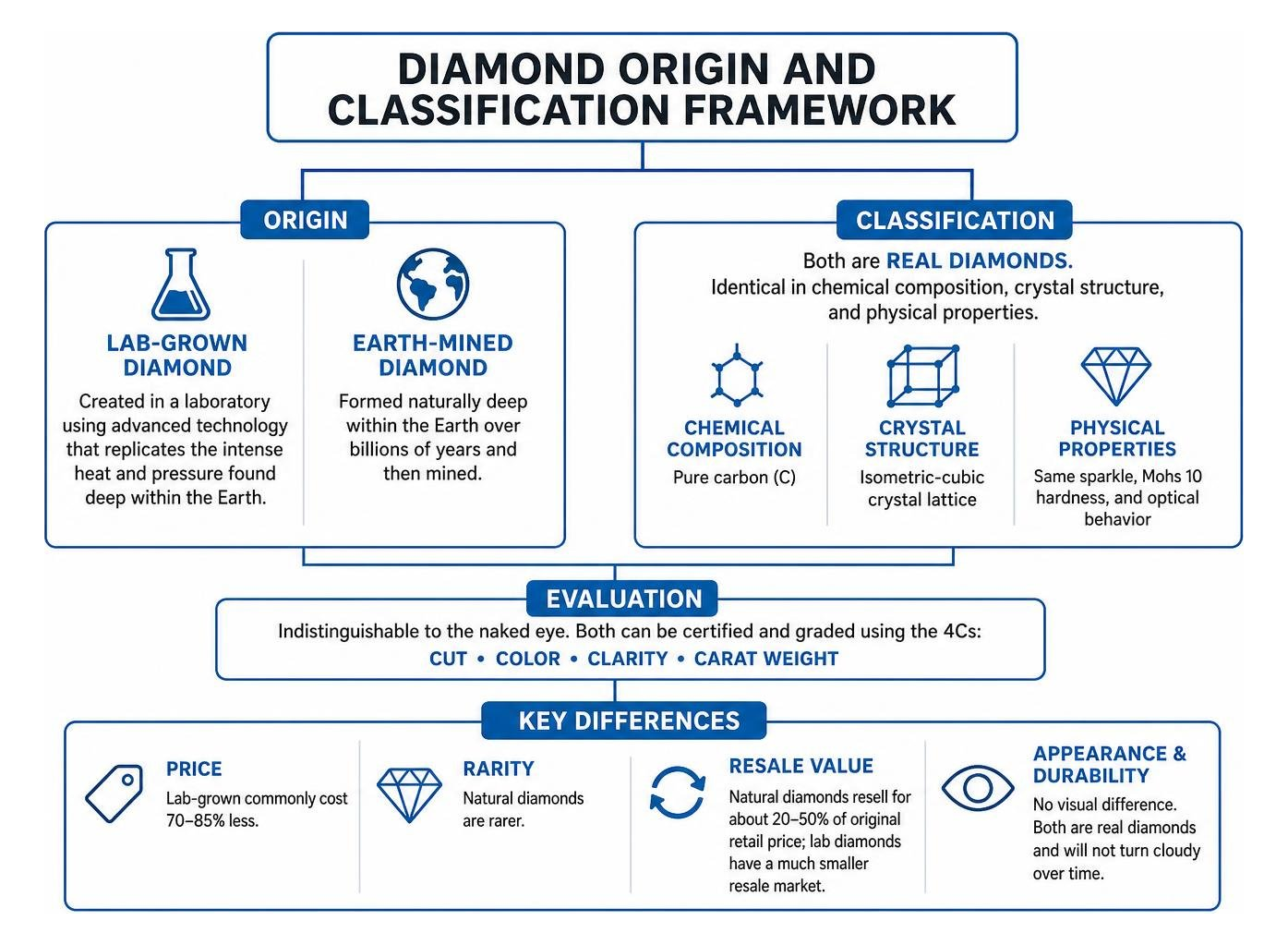
When tested by standard gemological instruments, a lab diamond exhibits the exact same thermal conductivity, electrical resistance, and optical behavior as an earth-mined stone. For a deeper breakdown of how these gems entered the fine jewelry space, our buying artificial diamonds guide 2026 explores the history and certification of lab-created gems.
Chemical Composition and Crystal Structure
At an atomic level, both lab-grown and earth-mined diamonds consist of carbon atoms tightly bound in an isometric-cubic crystal lattice. This specific cubic structure gives diamonds their extraordinary physical properties:
- Refractive Index (2.42): Determines how light bends upon entering the stone, creating bright brilliance.
- Dispersion (0.044): Breaks white light into spectral colors, creating the fire and rainbow flashes you see when the ring catches the sun.
- Thermal Conductivity: Diamonds disperse heat faster than almost any other known solid material.
- Hardness (10 on Mohs Scale): The tight tetrahedral covalent bonds make diamond the hardest mineral on the planet.
Because their physical and chemical architectures are identical, a lab-created diamond delivers identical brilliance, scintillation, and physical strength as an earth-mined gem.
HPHT vs CVD Production Methods
Today's fine jewelry market relies on two advanced manufacturing methods to grow gem-quality diamonds: High Pressure High Temperature (HPHT) and Chemical Vapor Deposition (CVD).
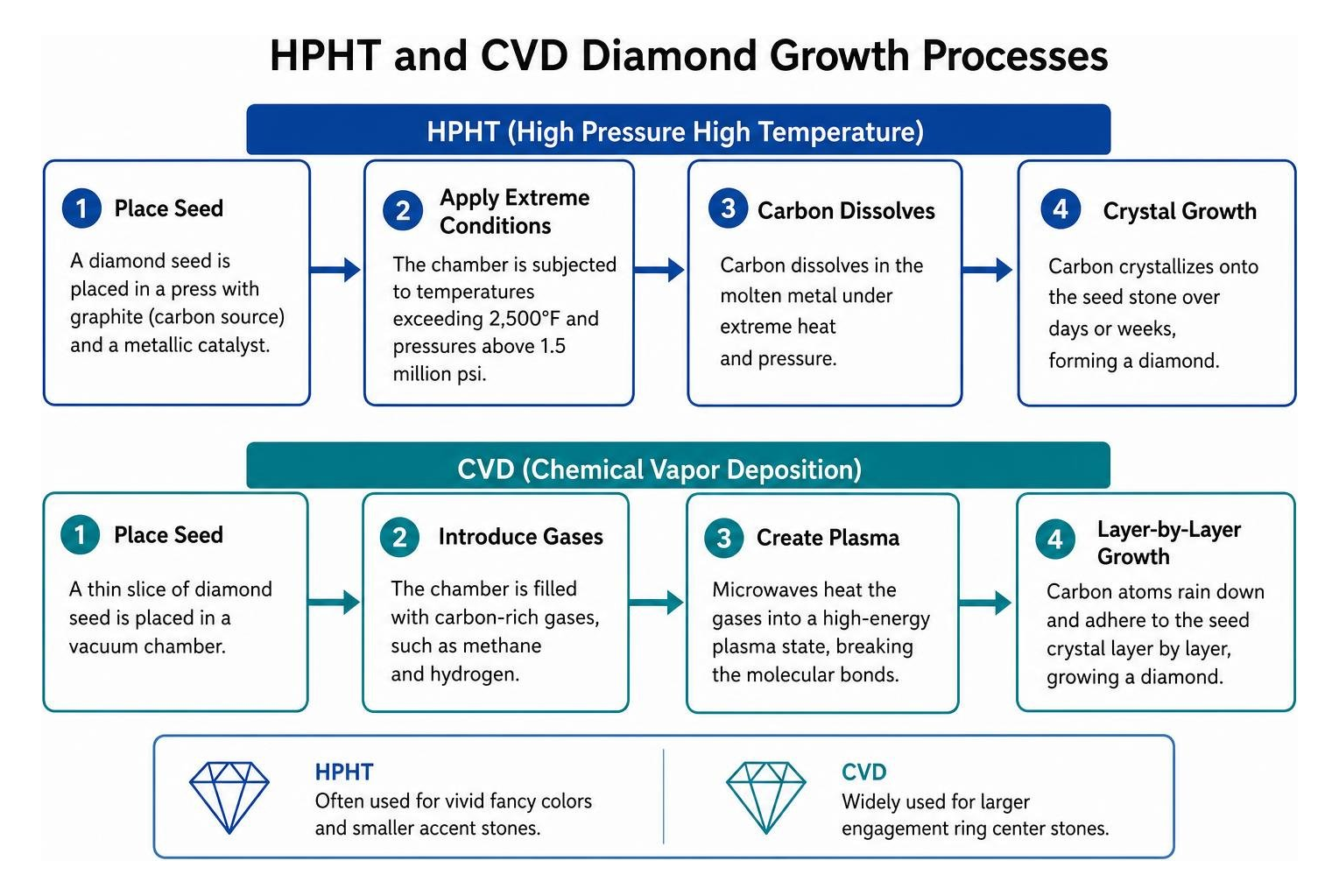
- High Pressure High Temperature (HPHT): This technique mimics the geological forces that create natural diamonds 100 miles below the Earth's crust. A small diamond seed is placed inside a mechanical press alongside a pure carbon source (graphite) and a metallic catalyst. The chamber is subjected to temperatures exceeding 2,500°F and pressures above 1.5 million pounds per square inch (psi). The carbon dissolves in the molten metal and crystallizes onto the seed stone over days or weeks.
- Chemical Vapor Deposition (CVD): In a CVD chamber, a thin slice of diamond seed is placed in a vacuum chamber filled with carbon-rich gases (such as methane and hydrogen). Microwaves heat the gases into a high-energy plasma state, breaking the molecular bonds. Carbon atoms rain down and adhere to the seed crystal layer by single atomic layer, growing a rough diamond cube.
Both processes produce authentic diamonds. HPHT is often favored for producing vivid fancy colors and smaller accent stones, while CVD is widely used for larger engagement ring center stones.
Lab Diamond Rings vs Real Diamonds: 2026 Price, Quality, and Value
The price difference between lab-grown and earth-mined diamonds represents the most dramatic market shift in modern jewelry history. In September 2026, lab-grown diamonds cost between 70% and 85% less than natural diamonds of identical size, cut, color, and clarity.
Between 2022 and early 2026, wholesale prices for one-carat lab-grown diamonds fell by approximately 75%—dropping from around $4,300 to under $1,200—because global manufacturing capacity quintupled since 2019. The cost to produce a rough gem-quality lab diamond has dropped from over $4,000 per carat a decade ago to under $300 per carat today.
Meanwhile, natural diamond wholesale prices softened 15% to 20% over that same stretch before stabilizing in early 2026 due to controlled supply from major mining operations.
| Diamond Carat Weight | Natural Diamond (G/VS2, Excellent Cut) | Lab-Grown Diamond (G/VS2, Excellent Cut) | Approximate Savings |
|---|---|---|---|
| 1.00 Carat | $4,500 – $7,500 | $600 – $1,200 | ~80% |
| 2.00 Carat | $16,000 – $24,000 | $1,200 – $2,000 | ~88% |
| 3.00 Carat | $30,000 – $55,000 | $2,000 – $4,000 | ~90% |
| 4.00 Carat | $60,000 – $120,000 | $3,500 – $6,500 | ~93% |
To understand how to maximize your carat size and cut precision within your specific spending limit, consult our comprehensive lab diamond ring buying guide before shopping.
Lab Diamond Rings vs Real Diamonds: Visual Appearance and Sparkle

Can you tell the difference between a lab-grown and a natural diamond simply by looking at them on your hand? In short: no.
Even experienced bench jewelers and certified gemologists cannot identify a lab diamond with the naked eye or a standard 10x jeweler's loupe. Both types display the exact same light performance:
- Brilliance: White light reflections returning to your eyes from the internal facets.
- Fire: Spectral rainbow colors dispersing across the crown facets.
- Scintillation: The sparkle pattern and flashes of light created when the ring or light source moves.
Both natural and lab-created diamonds have natural growth characteristics known as inclusions (internal marks) and blemishes (surface marks). Natural diamonds may feature tiny mineral crystals, feathers, or internal graining trapped over billions of years. Lab diamonds can contain microscopic metallic flux remnants (from HPHT growth) or tiny carbon pinpoints (from CVD growth).
Whether you choose a classic round brilliant or a sharp lab-grown princess cut diamond, the sparkle factor depends entirely on the precision of the diamond's cut, not whether it grew in the ground or in a lab. For a deeper look at independent industry analyses, review this Lab-Grown vs Natural Diamonds: An Honest 2026 Guide.
Resale Value: Lab Diamond Rings vs Real Earth-Mined Stones
While lab diamonds offer unmatched affordability upfront, their financial performance on the secondary market tells a very different story.

- Natural Diamond Resale Value: Natural diamonds maintain an established secondary market built on finite geological supply. If you sell an earth-mined diamond back to a jeweler, estate dealer, or auction house, you can generally expect to recoup 20% to 50% of its original retail purchase price (depending on market conditions, the cut, and your original markup).
- Lab-Grown Diamond Resale Value: Because lab diamonds can be manufactured in scalable volumes, they carry very limited resale value—typically 10% to 30% of their purchase price, if an open buyer can be found. Most diamond wholesalers and retail jewelers do not purchase pre-owned lab diamonds from the public because buying newly grown rough stones directly from growers is more cost-effective.
When purchasing a ring, view a lab diamond as an enjoyable luxury purchase—similar to fine electronics or a custom designer suit—rather than a financial investment. If holding equity and generational resale stability is your primary requirement, a natural mined diamond remains the traditional vehicle.
Certification, Durability, and Diamond Simulants
Every diamond purchase—regardless of origin—should be accompanied by an independent grading report from a reputable gemological laboratory such as the Gemological Institute of America (GIA) or the International Gemological Institute (IGI).
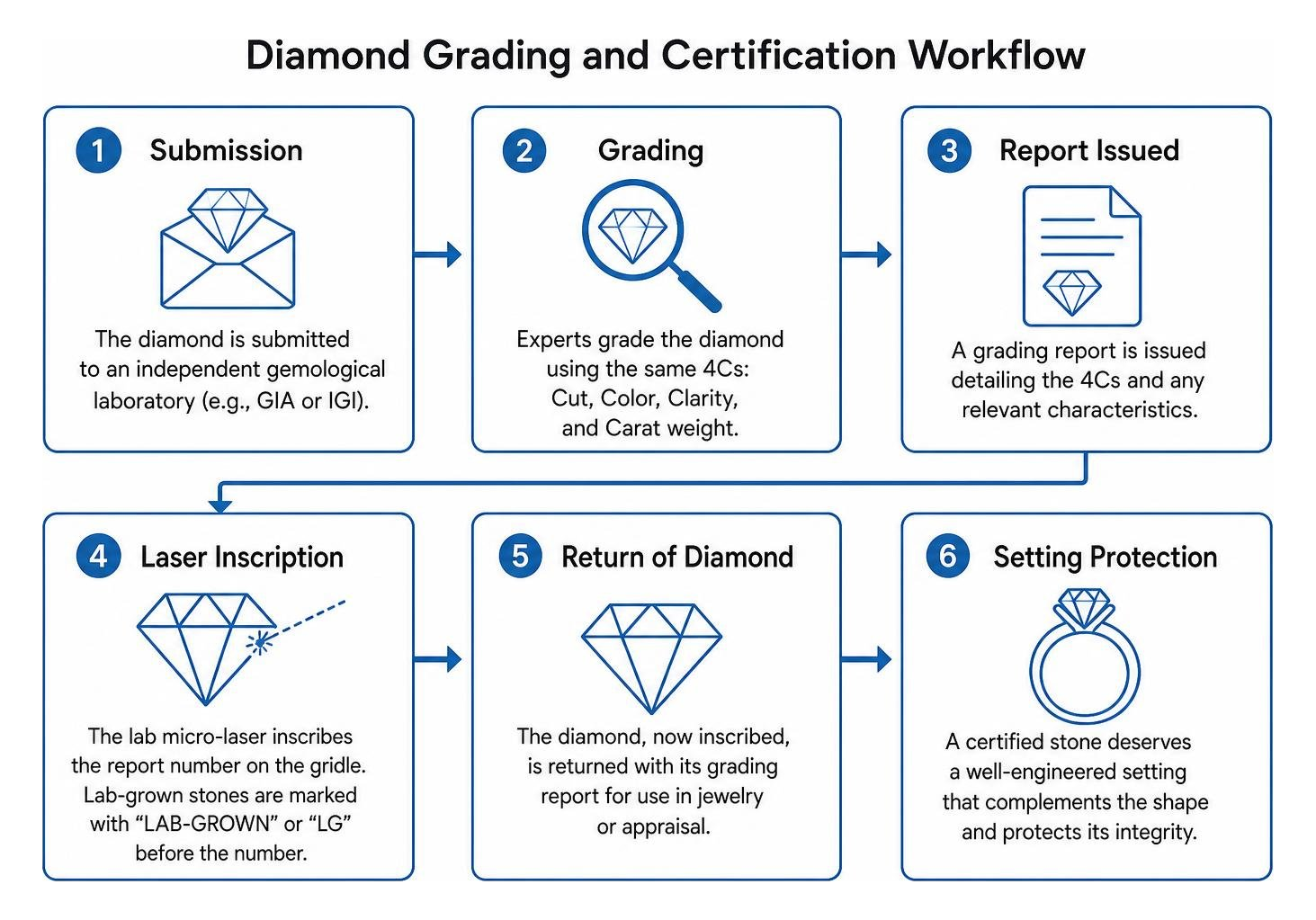
These laboratories grade lab-grown and mined stones using the exact same 4Cs criteria: Cut, Color, Clarity, and Carat weight.
- Laser Inscription: Reputable grading labs micro-laser an inscription onto the diamond's girdle. For lab-created stones, the report number is preceded by words like "LAB-GROWN" or "LG," ensuring total transparency for future appraisals or resizing.
- Setting Protection: A certified stone deserves an equally well-engineered mount. Learn how to choose a diamond ring setting that complements your diamond's shape while protecting its structural integrity.
If you are considering popular elongated shapes, a 2 carat oval lab-grown diamond ring provides an expansive surface area and finger coverage at a fraction of the cost of its mined counterpart. For a side-by-side analysis of lab stones and simulants, read this Lab Grown vs Natural Diamonds: The Complete 2026 Comparison Guide.
Hardness, Long-Term Wear, and Durability
Diamonds are renowned for their durability, and lab-created stones share this resilience completely.
- Hardness: Both score a perfect 10 on the Mohs Hardness Scale. Only another diamond can scratch a diamond.
- Toughness: Both possess good crystal toughness, making them resistant to chipping under normal daily wear.
- Heat and Chemical Resistance: Neither lab nor natural diamonds are affected by everyday household chemicals, chlorine, perfumes, or boiling cleaning solutions used in jewelry studios.
You can wear a lab-grown diamond ring daily for fifty years through gardening, dishwashing, sports, and work without worrying that the stone will wear down, fade, or lose its facet edges.
Lab Diamonds vs Moissanite and Cubic Zirconia
It is crucial not to confuse lab-grown diamonds with diamond simulants. Simulants are different chemical compounds designed to look somewhat like a diamond, but they possess fundamentally different optical and physical traits.
| Feature | Lab-Grown Diamond | Natural Mined Diamond | Moissanite | Cubic Zirconia (CZ) |
|---|---|---|---|---|
| Chemical Formula | Carbon ($C$) | Carbon ($C$) | Silicon Carbide ($SiC$) | Zirconium Dioxide ($ZrO_2$) |
| Mohs Hardness | 10 | 10 | 9.25 | 8.0 – 8.5 |
| Refraction Type | Single | Single | Double (creates doubling) | Single |
| Dispersion (Fire) | 0.044 | 0.044 | 0.104 (intense rainbow) | 0.058 – 0.065 |
| Long-Term Wear | Permanent | Permanent | Highly durable | Scratches & clouds |
| Thermal Testing | Tests as Diamond | Tests as Diamond | Tests as Diamond/Moiss | Fails Diamond Tester |
While moissanite creates an intense, fiery "disco ball" effect due to its double refraction, and cubic zirconia easily scratches over time, lab diamonds maintain the crisp light return of genuine carbon. You can see this distinction in everyday fine pieces like artificial diamond studs, which deliver enduring diamond brilliance for daily wear.
Ethical, Environmental, and Buyer Decision Guide
The conversation surrounding ethical sourcing and sustainability is a major factor for modern couples selecting engagement rings. Both diamond origins come with specific environmental and social considerations.
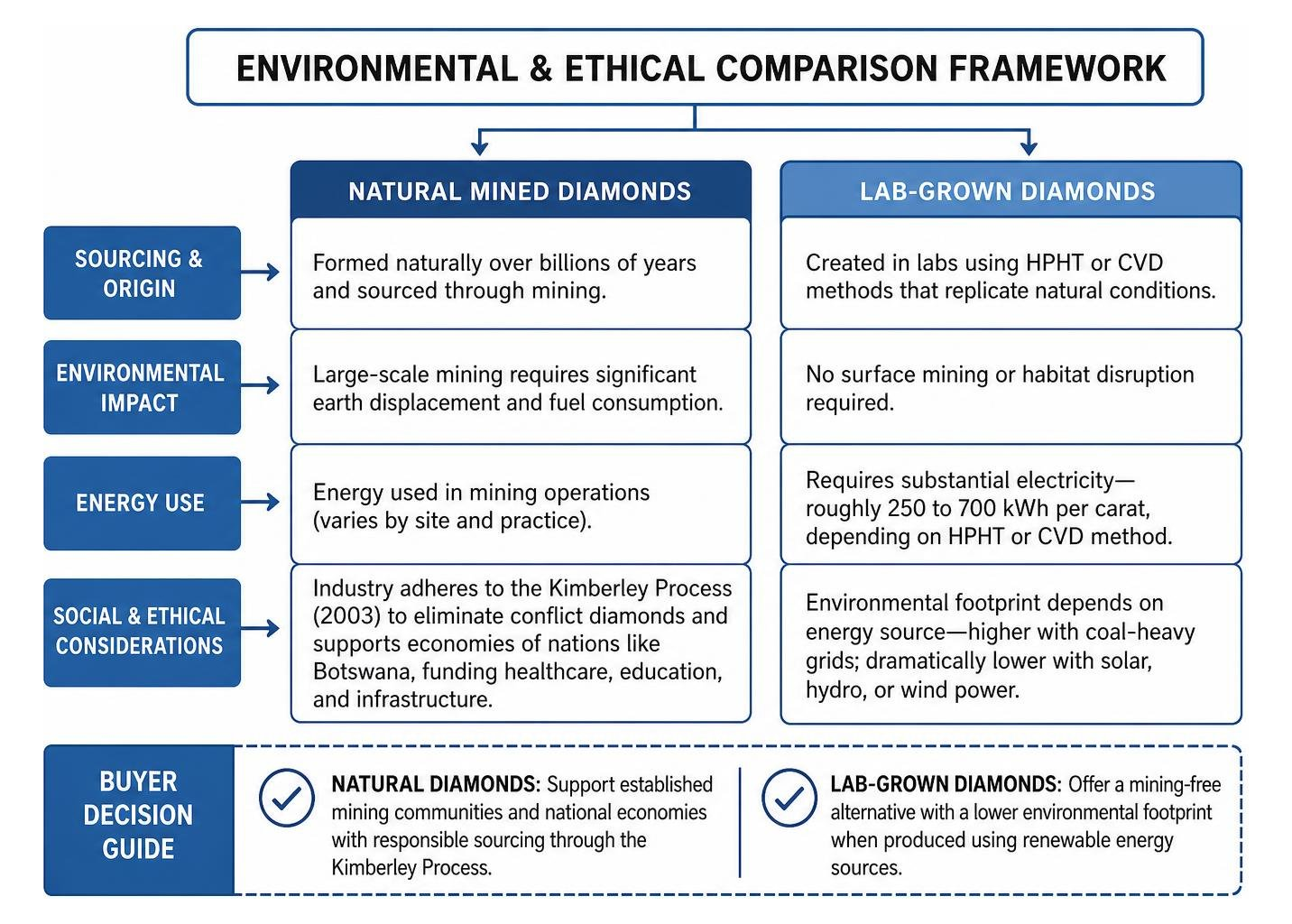
- Natural Diamond Sourcing: The natural diamond industry adheres to the Kimberley Process, established in 2003 to eliminate conflict diamonds from global supply chains. Large-scale mining requires significant earth displacement and fuel consumption, but it also serves as a vital economic engine for nations like Botswana, funding national healthcare, education, and infrastructure.
- Lab Diamond Sustainability: Lab diamonds eliminate the need for surface mining and habitat disruption. However, growing diamond crystals requires immense electrical power—roughly 250 to 700 kWh per carat, depending on whether HPHT or CVD methods are used. When diamond labs operate on coal-heavy power grids, their carbon footprint can rival that of mining operations. When grown in facilities powered by solar, hydro, or wind energy, their environmental footprint is dramatically lower.
To see how these considerations fit into your overall bridal jewelry planning, our engagement rings ultimate guide 2026 provides an in-depth roadmap. You can also explore our everyday fine jewelry collections in our lab diamond jewelry gallery.
Who Should Choose a Lab-Grown Diamond Ring?
A lab-grown diamond is typically the ideal match if you:
- Prioritize Carat Size and Visual Quality: You want a 2.00 to 4.00-carat center stone with flawless cut grades while remaining within a $2,000 to $5,000 budget.
- Prefer Guaranteed Origin Transparency: You appreciate knowing your stone originated in a controlled laboratory setting.
- View Jewelry as Sentiment Rather Than Equity: You plan to wear the ring for life and have no intention of reselling or trading it on the secondary market.
- Want to Allocate Budget to Settings: You prefer spending more of your overall budget on a handcrafted, custom-designed platinum or 18k gold mounting.
Who Should Choose a Natural Mined Diamond?
A natural earth-mined diamond is the right choice if you:
- Value Natural Rarity and Geological Heritage: You are drawn to the romance of a gem forged billions of years ago in the Earth's mantle.
- Prioritize Value Retention and Resale: You want a gemstone supported by established global secondary trading markets.
- Plan to Create a Generational Heirloom: You wish to pass down a rare natural mineral through family generations.
- Appreciate Traditional Luxury: You value the exclusivity that comes with finite, scarce natural resources.
Frequently Asked Questions About Lab and Real Diamonds
Can a Jeweler Tell if a Diamond Is Lab Grown?
A jeweler cannot identify a lab-grown diamond using a standard eye loupe or basic thermal pen tester. Because the physical, thermal, and optical properties of lab and mined diamonds are identical, thermal testers will register both as real diamond.
To reliably differentiate between them, a gemologist must use advanced UV and photoluminescence spectroscopy equipment. These laboratory instruments analyze trace crystal growth patterns, nitrogen aggregation levels, and phosphorescence characteristics unique to laboratory synthesis.
Do Lab Grown Diamonds Get Cloudy or Change Over Time?
No. A lab-grown diamond will never get cloudy, change color, fade, or lose its brilliance. Because it is solid, crystallized carbon (Mohs 10), its crystalline structure is completely permanent.
If your lab diamond ring appears dull after several months of continuous wear, it is simply due to standard surface residue from lotion, hand soaps, body oils, and dust gathering on the back facets of the setting. A quick soak in warm water with mild dish soap and a gentle brushing with a soft toothbrush will immediately restore its original fire and sparkle.
Will Lab Grown Diamond Prices Continue to Fall?
While lab diamond prices declined sharply between 2022 and 2025 as manufacturing scaled globally, market prices are stabilizing throughout 2026. The baseline production cost of high-grade rough crystal (plasma reactor operation, technical labor, precision cutting, and gemological certification) has reached an operational plateau. Further price drops are expected to be minor and incremental compared to the steep shifts seen in prior years.
Conclusion
Choosing between a lab-grown and a natural mined diamond comes down to your personal values, aesthetic vision, and budget priorities. Both options deliver genuine diamond beauty, permanent durability, and unmatched light performance.
At Rudy Santayana Fine Jewelry, we believe that an engagement ring should be as unique as the love story it represents. Located in Coral Gables, FL, our atelier blends custom design, generational bench expertise, and personalized service to craft rings that stand out. Whether you want to hand-select an earth-mined heirloom gem or explore our bespoke lab diamonds to maximize your design possibilities, we are here to guide you through every detail.
Ready to bring your dream ring to life? Design your own diamond engagement rings with our master jewelers in our Coral Gables showroom or schedule a virtual custom design consultation today.